

The Pension Divide | 연금의 세대 충돌 구조
The Pension Divide는 단순한 복지 정책의 문제가 아니라 사회 전체의 시간 구조가 충돌하는 지점입니다.
세대 간 계약은 “현재의 노동이 미래의 안정으로 전환된다”는 신뢰 위에 구축되어 있습니다.
그러나 인구 구조가 변화하면서 이 신뢰의 기반은 점점 약해지고 있습니다.
젊은 세대는 줄어들고, 은퇴 세대는 증가하는 구조는 연금 시스템의 균형을 직접적으로 흔듭니다.
이 변화는 단순한 숫자의 문제가 아니라 사회 계약의 재정의 문제입니다.
우리는 이미 “지속 가능한 약속”이 아닌 “지속 불가능한 기대” 위에 서 있을 가능성을 마주하고 있습니다.
연금은 더 이상 단순한 금융 구조가 아니라 세대 간 생존 시스템으로 변하고 있습니다.
이 구조적 충돌은 정책으로만 해결되지 않으며, 사회 전체의 재설계가 요구됩니다.
D’all Society Agenda는 The Pension Divide를 단순한 연금 재정 문제가 아니라, 인구 변화와 제도 설계, 세대 간 부담이 충돌하는 하나의 사회 시스템으로 해석한다. 핵심 질문은 연금의 재정을 어떻게 보완하는가가 아니라, 변화한 인구 구조 속에서 세대 간 약속을 어떻게 지속 가능한 사회계약으로 다시 설계할 것인가에 있다.
The Pension Divide is not merely a welfare policy issue but a structural collision of societal time systems.
Intergenerational contracts are built on trust that present labor secures future stability.
However, demographic shifts are weakening the foundation of this trust.
A shrinking workforce and an expanding retired population destabilize the pension equilibrium.
This is no longer a numerical adjustment problem but a structural redefinition of social contracts.
We are increasingly standing on expectations that may not be economically sustainable.
Pensions are evolving from financial mechanisms into survival infrastructures between generations.
This structural tension cannot be resolved through policy alone but requires systemic redesign.
D’all Society Agenda reads The Pension Divide not simply as a pension financing problem, but as a social system where demographic change, institutional design, and intergenerational burdens increasingly collide. The central question is not simply how to stabilize pension finances, but how society can redesign the intergenerational contract for a changing demographic structure.
🎥 Related Video | The Pension Crisis Explained
Germany’s Pension Crisis | DW Business Analysis (WGogH2Znvtg)
This video examines the growing pension crisis in Germany, driven by rapid demographic Germany’s pension system is under pressure due to rapid aging and a shrinking workforce.
Fewer workers are now supporting a growing number of retirees, increasing fiscal strain.
Rising life expectancy and demographic imbalance are pushing the system toward long-term instability.
This reflects a broader structural challenge across advanced economies.
독일 연금 시스템은 고령화와 노동 인구 감소로 인해 압박을 받고 있다.
노동자 감소와 은퇴자 증가로 부양 구조가 불균형해지고 있다.
기대수명 증가까지 더해지며 재정 지속 가능성이 약화되고 있다.
이는 선진국 전반에서 나타나는 구조적 문제다.
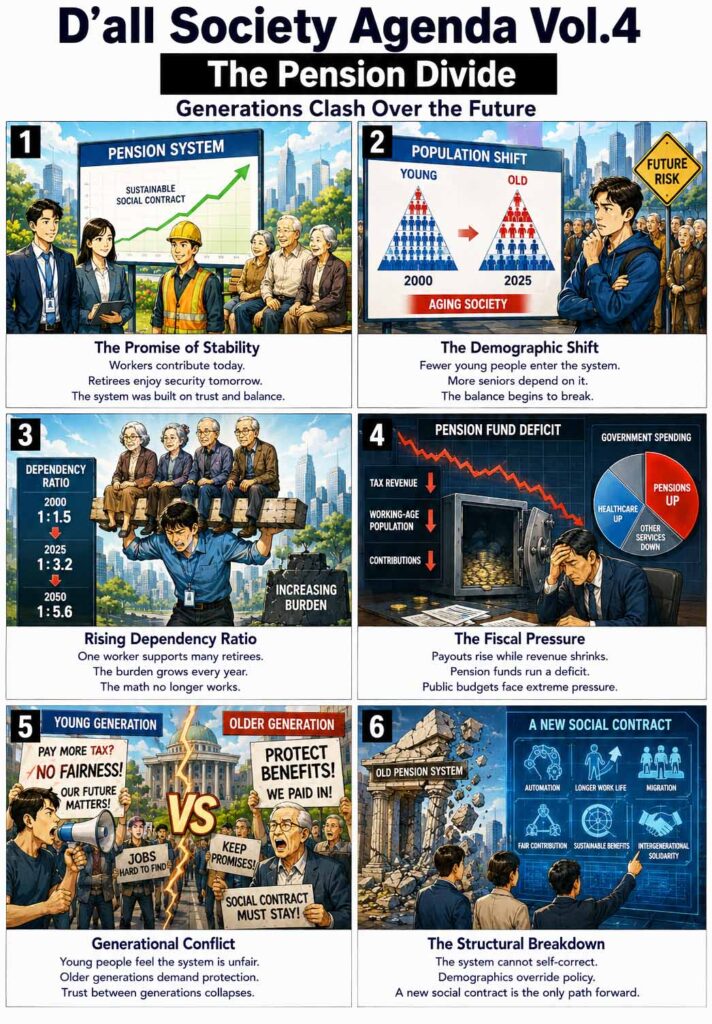
The Promise of Stability | 안정의 약속 구조
Pension systems were designed as a long-term stability mechanism linking workers and retirees.
The system assumed continuous population growth and stable workforce expansion.
This allowed intergenerational trust to become embedded in institutions.
However, this assumption is no longer valid in many advanced economies.
What was once structural stability is now demographic dependency.
연금 시스템은 노동 세대와 은퇴 세대를 연결하는 장기 안정 장치로 설계되었습니다.
이 시스템은 지속적인 인구 증가를 전제로 작동했습니다.
그 결과 세대 간 신뢰는 제도에 깊게 내재되었습니다.
그러나 이 전제는 더 이상 유지되지 않고 있습니다.
The Demographic Shift | 인구 구조 변화
Fewer workers are entering the labor force while more retirees are living longer.
This creates a persistent imbalance between contributors and beneficiaries.
Governments face rising pressure to adjust contributions or reduce benefits.
The demographic shift transforms pensions into a structural tension system.
노동 인구는 줄어드는 반면 은퇴 인구는 증가하고 있습니다.
이 구조는 기여자와 수혜자 간 불균형을 지속적으로 확대합니다.
정부는 보험료 인상 또는 급여 축소 압박을 받습니다.
Rising Dependency Ratio | 부양비 상승 구조
One worker must support increasingly more retirees.
This shifts pensions from redistribution systems into survival balancing systems.
The mathematical structure of pensions becomes unstable under demographic pressure.
한 명의 노동자가 점점 더 많은 은퇴자를 부양해야 합니다.
연금 시스템은 재분배 구조에서 생존 균형 구조로 변합니다.
The Fiscal Pressure | 재정 압박 구조
Pension payouts rise faster than contributions.
Tax bases shrink while welfare costs expand.
Public budgets are redistributed away from other sectors.
연금 지출은 증가하고 세수는 감소합니다.
복지 비용은 증가하고 다른 예산은 축소됩니다.
Generational Conflict | 세대 갈등 구조
Younger generations feel overburdened by contributions.
Older generations demand protection of benefits.
This creates structural political conflict.
Trust between generations weakens steadily.
젊은 세대는 부담 증가를 불공정으로 느낍니다.
고령 세대는 혜택 유지가 필요하다고 주장합니다.
이로 인해 세대 간 신뢰가 약화됩니다.
The Structural Breakdown | 구조적 붕괴
Pension systems designed for growth economies cannot sustain shrinking populations.
Incremental reforms are insufficient to restore equilibrium.
A full redesign of intergenerational systems is required.
연금 시스템은 성장 경제를 전제로 설계되어 인구 감소 환경에서 지속이 어렵습니다.
점진적 개혁만으로는 균형 회복이 불가능합니다.
Mini Insight
The Pension Divide reveals that pension systems are demographic structures disguised as financial systems.
연금 시스템은 금융 구조가 아니라 인구 구조를 반영하는 시스템이다.
D’all Insight
The Pension Divide is fundamentally a mismatch between demographic reality and institutional design.
Modern pension systems were built on assumptions of population stability and continuous workforce expansion.
However, most advanced economies are now experiencing long-term demographic contraction.
This creates a structural imbalance where fewer workers must support more retirees for longer lifespans.
The pressure accumulates silently over decades rather than appearing as a sudden crisis.
Policy tools such as contribution increases or benefit reductions only redistribute the burden.
Extending retirement age shifts stress onto individuals rather than resolving systemic imbalance.
Migration can partially offset workforce decline but introduces integration complexity.
Automation increases productivity but does not directly resolve intergenerational transfer structures.
Ultimately, pension sustainability requires redesigning the relationship between labor, aging, and social contracts.
연금 위기는 인구 현실과 제도 설계 간의 구조적 불일치다.
현대 연금 시스템은 인구 안정과 노동력 확장을 전제로 설계되었다.
그러나 대부분의 선진국은 장기적인 인구 감소 국면에 진입하고 있다.
이로 인해 더 적은 노동자가 더 많은 은퇴자를 더 오래 부양해야 하는 구조가 형성된다.
이 압력은 갑자기 나타나는 것이 아니라 수십 년에 걸쳐 누적된다.
보험료 인상과 급여 조정은 부담을 이동시킬 뿐 해결하지 못한다.
정년 연장은 개인에게 부담을 전가하는 방식이다.
이민과 자동화도 구조 자체를 해결하지는 못한다.
결국 연금 지속 가능성은 노동·고령화·사회계약 구조 재설계에 달려 있다.
One-line Insight
The Pension Divide begins when demographic reality breaks the illusion of intergenerational balance.
연금 위기는 세대 간 균형이라는 환상이 깨지는 순간 시작된다.
Previous Post :
D’all Society Agenda Vol.3
Facing the Care Crisis requires immediate structural redesign.
#ThePensionDivide #PensionCrisis #AgingSociety #DemographicShift #DependencyRatio #SocialContract #FiscalPressure #IntergenerationalConflict #RetirementSystem #StructuralBreakdown #WorkforceDecline #EconomicStructure #FutureOfSociety #PensionReform #DallSocietyAgenda
#연금위기 #연금제도 #고령화사회 #인구구조변화 #부양비 #세대갈등 #사회계약 #재정압박 #노후연금 #경제구조 #노동인구감소 #구조적문제 #미래사회 #사회재설계 #디올소사이어티어젠다
Source
This content is synthesized from OECD Pension Outlook reports, IMF aging economy analysis, and United Nations demographic transition studies focusing on structural pension instability under long-term demographic decline.
본 콘텐츠는 OECD 연금 전망 보고서, IMF 고령화 경제 분석, UN 인구 전환 연구를 기반으로 종합되었습니다. 장기 인구 감소가 연금 시스템 구조에 미치는 영향을 분석합니다.
- D'all Visual Intelligence
- D’all Public Design Intelligence
- D’all Motion Intelligence
- D’all Interaction Intelligence
- D’all Spatial Intelligence
- D’all Advertising Intelligence
- D’all Economy Brief
- D’all Food Intelligence
- D’all Health Insight
- D’all Global Power
- D’all Culture Hybrid
- D’all Knowledge Architecture
- D'all Capital History
- D’all Society Agenda
