

Saudi Vision 2030 | 사우디아라비아, 석유 이후를 설계하는 국가
Saudi Vision 2030. 사우디아라비아는 오랫동안 세계 최대의 석유 강국으로 불려왔다.
막대한 원유 매장량은 국가 성장의 원동력이었고, 에너지 시장의 중심에서 세계 경제를 움직여 왔다.
그러나 사우디는 더 이상 석유만으로 미래를 만들 수 없다는 사실을 누구보다 먼저 인식했다.
이제 국가는 석유 수출국이 아니라 기술, 관광, 금융, 물류, 친환경 에너지까지 아우르는 새로운 경제 시스템을 구축하고 있다.
Vision 2030은 단순한 경제개혁이 아니라 국가의 구조 자체를 다시 설계하는 프로젝트다.
NEOM, PIF, AI 산업, 스마트시티, 수소경제는 모두 하나의 미래 전략으로 연결된다.
중동의 중심이라는 지정학적 위치 역시 새로운 성장 전략과 결합되고 있다.
사우디는 에너지 패권을 넘어 투자와 혁신의 허브를 꿈꾸고 있다.
석유는 여전히 강력한 자산이지만, 미래의 권력은 새로운 산업을 얼마나 빠르게 구축하느냐에 달려 있다.
21세기 사우디의 경쟁력은 ‘석유 생산국’이 아니라 ‘미래를 설계하는 국가’라는 새로운 정체성에서 시작된다.
Saudi Vision 2030 | Designing a Nation Beyond Oil
Saudi Arabia has long been recognized as one of the world’s greatest energy powers.
For decades, oil exports generated wealth, geopolitical influence, and economic stability.
Yet the Kingdom understands that the next century cannot rely on hydrocarbons alone.
Saudi Vision 2030 is an ambitious national transformation strategy designed to diversify the economy beyond petroleum.
Mega-projects such as NEOM, renewable energy, advanced manufacturing, tourism, artificial intelligence, and logistics are reshaping the country’s future.
At the center of this transformation stands the Public Investment Fund, deploying capital across emerging industries around the world.
Rather than abandoning energy, Saudi Arabia is redefining energy leadership while simultaneously building new engines of growth.
Its strategic geography linking Asia, Europe, and Africa further strengthens this transition.
Saudi Arabia is no longer preparing only for the next oil cycle.
It is preparing for the post-oil global economy.
D’all Perspective | 디올 관점
D’all Global Power does not read Saudi Arabia simply as an oil-producing country or as a collection of large national projects. It examines how energy wealth, sovereign investment, economic diversification, technology, infrastructure, and geopolitical geography are being connected into a new national system. Saudi Vision 2030 is therefore important not only because it seeks to reduce oil dependence, but because it attempts to transform the way national economic power is created. The key question is whether capital generated by the old energy system can be converted into productive capabilities for the next one. This perspective allows D’all to examine Saudi Arabia not as a finished success story, but as an ongoing national transformation whose results depend on execution, institutions, human capital, and long-term economic resilience.
D’all Global Power는 사우디아라비아를 단순한 석유 생산국이나 대형 국가 프로젝트의 집합으로 바라보지 않는다. 에너지 자산과 국부펀드, 산업 다각화, 기술, 인프라, 지정학적 위치가 서로 연결되면서 새로운 국가 시스템을 어떻게 만들어가는지를 살펴본다. 따라서 Saudi Vision 2030의 핵심은 단순히 석유 의존도를 낮추는 데 있지 않다. 기존 에너지 경제에서 만들어진 자본을 다음 세대의 생산 역량으로 얼마나 성공적으로 전환할 수 있는지가 더 중요한 질문이다. D’all은 사우디를 이미 완성된 성공 사례로 규정하기보다, 실행력과 제도, 인재, 민간경제, 장기적인 경제 회복력이 결과를 결정하는 진행형 국가 전환 프로젝트로 분석한다.
Related Video | 관련 영상
Saudi Arabia’s Vision 2030 is more than an economic diversification plan.
It represents a broader attempt to redesign the Kingdom’s economic structure beyond oil.
Investment, technology, tourism, energy transition, and new industries are becoming interconnected parts of this transformation.
The real question is whether these ambitions can develop into sustainable economic capabilities.
사우디아라비아의 Vision 2030은 단순한 경제 다각화 정책을 넘어선 국가 전환 전략이다.
석유 이후를 대비해 투자, 기술, 관광, 에너지 전환, 신산업을 하나의 경제 시스템으로 연결하고 있다.
중요한 것은 대규모 프로젝트의 규모가 아니라 이러한 투자가 지속 가능한 산업과 경쟁력으로 이어질 수 있는가이다.
이 영상은 현재 진행 중인 사우디의 변화를 이해하는 데 유용한 참고 자료가 된다.
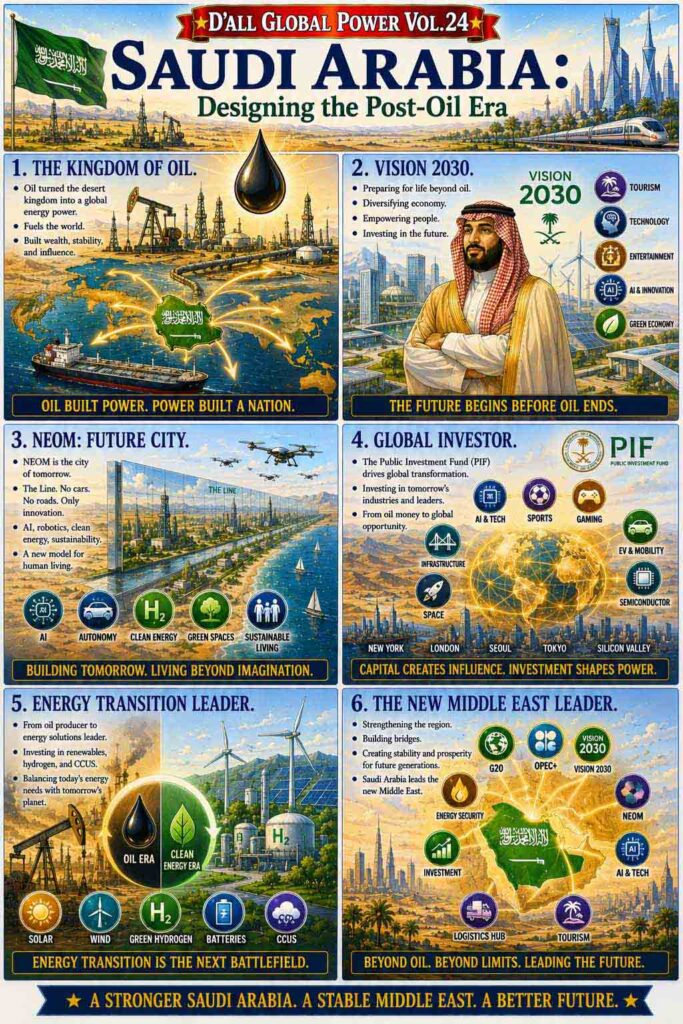
Saudi Vision 2030 | THE KINGDOM OF OIL. | 석유가 만든 국가
For decades, Saudi Arabia built its economic strength through vast petroleum reserves and energy exports.
Oil transformed the Kingdom into one of the world’s most influential energy producers while providing the financial foundation for national development and geopolitical influence.
수십 년 동안 사우디아라비아는 막대한 원유 매장량과 에너지 수출을 기반으로 국가 경쟁력을 키워 왔다.
석유는 경제 성장뿐 아니라 국제 정치에서 영향력을 확대하는 핵심 자산이 되었으며 오늘날 국가 발전의 토대를 마련했다.
Saudi Vision 2030 | VISION 2030 TRANSFORMATION. | 국가를 다시 설계하는 비전
Vision 2030 is not simply an economic reform plan.
It is a comprehensive blueprint to diversify industries, strengthen private enterprise, increase tourism, accelerate digital innovation, and prepare Saudi Arabia for a post-oil future through structural transformation.
Vision 2030은 단순한 경제 개혁 정책이 아니다.
산업 다각화와 민간경제 활성화, 관광 확대, 디지털 혁신, 미래 산업 육성을 통해 석유 이후 시대를 준비하는 국가 재설계 프로젝트이다.
NEOM Saudi Arabia | BUILDING THE CITY OF TOMORROW. | 미래 도시를 만드는 실험
NEOM represents one of the world’s largest urban innovation projects.
Designed around artificial intelligence, renewable energy, autonomous mobility, and sustainable living, it aims to redefine how future cities operate while attracting global talent and investment.
NEOM은 세계 최대 규모의 미래 도시 프로젝트 가운데 하나이다.
인공지능, 친환경 에너지, 자율교통, 스마트 인프라를 중심으로 설계되며 미래 도시의 새로운 기준을 제시하고 글로벌 인재와 자본을 끌어들이는 것을 목표로 하고 있다.
공유된 ChatGPT 채팅의 사본입니다. 메모리에 추가되지 않습니다.대화 신고하기
Public Investment Fund | GLOBAL INVESTOR. | 세계를 투자하는 국부펀드
The Public Investment Fund (PIF) has become one of the world’s largest sovereign wealth funds.
Rather than preserving oil wealth alone, the fund actively invests in artificial intelligence, semiconductors, mobility, sports, tourism, infrastructure, and advanced technology.
Capital has become one of Saudi Arabia’s most important geopolitical tools for expanding global influence.
사우디 국부펀드(PIF)는 세계 최대 규모의 국부펀드 가운데 하나로 성장했다.
단순히 석유 수익을 보관하는 것이 아니라 AI, 반도체, 미래 모빌리티, 스포츠, 관광, 인프라, 첨단기술 산업에 적극 투자하며 새로운 성장동력을 만들고 있다.
오늘날 자본은 사우디가 국제사회에서 영향력을 확대하는 가장 강력한 전략 자산 가운데 하나가 되었다.
Energy Transition Saudi | ENERGY TRANSITION LEADER. | 에너지 전환의 새로운 리더
Saudi Arabia is preparing for the next energy era by investing in renewable energy, hydrogen, carbon capture, and next-generation industrial technologies.
Rather than abandoning oil immediately, the Kingdom seeks to balance today’s energy security with tomorrow’s sustainability.
Its strategy is to lead both the current and future energy systems simultaneously.
사우디는 신재생에너지, 수소경제, 탄소포집(CCUS), 차세대 산업기술에 대규모 투자를 확대하며 새로운 에너지 시대를 준비하고 있다.
석유를 급격히 포기하는 것이 아니라 현재의 에너지 안보와 미래의 지속가능성을 동시에 확보하는 전략을 추진하고 있다.
현재의 에너지 시장과 미래의 친환경 산업을 함께 선도하는 것이 사우디의 장기 목표이다.
Saudi Middle East Leadership | THE NEW MIDDLE EAST LEADER. | 새로운 중동의 리더
Saudi Arabia is redefining its regional role through diplomacy, investment, logistics, technology, and economic diversification.
Vision 2030 connects national competitiveness with regional stability while strengthening partnerships across the Middle East and beyond.
The Kingdom is evolving from an energy exporter into a comprehensive strategic power.
사우디아라비아는 외교와 투자, 물류, 기술혁신, 산업 다각화를 통해 중동에서 새로운 리더십을 구축하고 있다.
Vision 2030은 국가 경쟁력 강화와 지역 안정이라는 두 가지 목표를 동시에 추진하며 다양한 국가와 전략적 협력을 확대하고 있다.
사우디는 단순한 에너지 수출국을 넘어 종합적인 글로벌 전략국가로 진화하고 있다.
Mini Insight
Saudi Arabia is not replacing oil.
It is using oil as the foundation for building an entirely new economic structure.
The country’s greatest transformation is shifting from exporting energy to exporting opportunity.
사우디아라비아는 석유를 버리는 것이 아니다.
석유를 기반으로 완전히 새로운 경제 구조를 구축하고 있다.
가장 큰 변화는 에너지를 수출하는 국가에서 미래 산업과 투자 기회를 수출하는 국가로 진화하고 있다는 점이다.
D’all Insight
Saudi Arabia represents one of the most ambitious national transformation projects of the twenty-first century.
For decades, oil provided extraordinary wealth and geopolitical influence, but dependence on a single resource also created structural vulnerability.
Vision 2030 acknowledges that reality and seeks to redesign the Kingdom’s economic foundation before global energy demand fundamentally changes.
Rather than waiting for the post-oil era to arrive, Saudi Arabia is attempting to create it on its own terms.
Mega-projects such as NEOM, the expansion of the Public Investment Fund, renewable energy initiatives, advanced manufacturing, artificial intelligence, and logistics all form parts of a single long-term national strategy.
The Kingdom is also leveraging its unique geographic position connecting Asia, Europe, and Africa to become a global logistics and investment hub.
Success is not guaranteed.
Execution, human capital development, institutional reform, and sustained private-sector growth remain significant challenges.
Nevertheless, Saudi Arabia has already demonstrated that future competitiveness depends not only on natural resources but also on the ability to redesign national systems.
The countries that successfully transform resource wealth into innovation ecosystems will shape the next global economic order.
사우디아라비아는 21세기 가장 거대한 국가 전환 프로젝트를 추진하고 있는 대표적인 국가 가운데 하나이다.
수십 년 동안 석유는 막대한 부와 지정학적 영향력을 제공했지만, 하나의 자원에 대한 높은 의존도는 동시에 구조적인 위험요인이기도 했다.
Vision 2030은 이러한 현실을 인정하고, 세계 에너지 시장이 근본적으로 변화하기 전에 국가 경제의 기반 자체를 새롭게 설계하려는 전략이다.
사우디는 석유 이후 시대를 기다리는 것이 아니라 스스로 새로운 시대를 만들어 가고 있다.
NEOM, 국부펀드(PIF), AI 산업, 친환경 에너지, 첨단 제조업, 관광, 글로벌 물류 허브 구축은 모두 하나의 장기 국가 전략으로 연결되어 있다.
또한 아시아·유럽·아프리카를 연결하는 지정학적 위치를 적극 활용하여 투자와 물류 중심국가로 도약하려 하고 있다.
물론 이러한 변화가 자동으로 성공을 보장하는 것은 아니다.
인재 육성, 제도 개혁, 민간경제 활성화, 기술 경쟁력 확보는 앞으로도 해결해야 할 중요한 과제이다.
그럼에도 사우디는 국가 경쟁력은 더 이상 자원의 양이 아니라 미래 시스템을 얼마나 빠르게 설계하고 실행하느냐에 달려 있다는 사실을 보여주고 있다.
앞으로 자원 부국에서 혁신 국가로 전환에 성공하는 국가들이 새로운 글로벌 경제 질서를 주도하게 될 가능성이 더욱 커질 것이다.
One-line Insight
Oil created Saudi Arabia.
Vision 2030 is creating its future.
석유가 오늘의 사우디를 만들었다면, Vision 2030은 미래의 사우디를 만들고 있다.
#SaudiVision2030 #SaudiArabia #NEOM #PostOilEconomy #PublicInvestmentFund #EnergyTransition #MiddleEast #SmartCity #HydrogenEconomy #ArtificialIntelligence #GlobalInvestment #EconomicDiversification #Geopolitics #FutureEconomy #DallGlobalPower
#사우디비전2030 #사우디아라비아 #네옴 #석유이후경제 #국부펀드 #에너지전환 #중동 #스마트시티 #수소경제 #인공지능 #글로벌투자 #산업다각화 #지정학 #미래경제 #디올글로벌파워
Source
This article is based on publicly available information from Saudi Vision 2030, the Public Investment Fund, the IMF, and the World Bank.
These sources provide factual context on economic diversification, investment, non-oil growth, and structural reform.
D’all Global Power independently interprets these materials rather than reproducing the original reports.
The analysis focuses on how Saudi Arabia is converting energy wealth into new economic and strategic capabilities.
It also considers execution, human capital, private-sector development, and institutional reform as key challenges.
The final perspective is an original editorial analysis by D’all Global Power.
이 글은 Saudi Vision 2030, Public Investment Fund, IMF, World Bank 등 공개 자료를 바탕으로 작성했다.
이 자료들은 사우디아라비아의 경제 다각화, 투자, 비석유 성장, 구조개혁의 흐름을 이해하기 위한 근거로 활용했다.
D’all Global Power는 원문을 재생산하지 않고 주요 내용을 자체적인 분석 관점에서 재구성했다.
특히 에너지 자산에서 만들어진 부를 새로운 산업과 기술, 투자 역량으로 전환하는 과정에 주목했다.
동시에 실행력, 인적자본, 민간경제, 제도 개혁을 장기적인 핵심 과제로 함께 바라본다.
최종 내용은 D’all Global Power의 독자적인 편집적·지정학적 해석이다.
- D'all Visual Intelligence
- D’all Public Design Intelligence
- D’all Motion Intelligence
- D’all Interaction Intelligence
- D’all Spatial Intelligence
- D’all Advertising Intelligence
- D’all Economy Brief
- D’all Food Intelligence
- D’all Health Insight
- D’all Global Power
- D’all Culture Hybrid
- D’all Knowledge Architecture
- D'all Capital History
- D’all Society Agenda
