

Bitcoin and Gold | 비트코인과 금이 보여주는 자본의 이동
Bitcoin and Gold는 최근 금융시장에서 나타나는 자본 이동의 방향을 보여주는 중요한 신호다.
투자자들은 채권시장과 달러에 대한 기존의 신뢰를 다시 평가하고 있다.
그 과정에서 금과 비트코인 같은 대체자산에 대한 관심이 높아지고 있다.
동시에 일본에서는 유가와 원자재 가격 상승이 소비재 가격으로 전달되며 인플레이션 압력이 커지고 있다.
금융시장에서는 자산가격의 변화가 나타나고, 실물경제에서는 생활비의 변화가 나타나는 셈이다.
기업 부문에서는 삼성전자가 AI 반도체 수요로 증가한 이익을 대규모 주주환원으로 연결하려 하고 있다.
배당과 자사주 매입을 통해 최대 800억 달러를 주주에게 돌려주는 계획은 단순한 현금 배분 이상의 의미를 가진다.
결국 세 가지 뉴스는 서로 다른 영역에서 발생했지만 모두 자본의 이동과 배분이라는 하나의 문제로 연결된다.
신뢰가 흔들리면 자본은 새로운 가치 저장 수단을 찾는다.
가격 압력이 커지면 기업과 가계의 행동이 달라진다.
기업의 이익이 커지면 그 자본을 재투자할 것인지 주주에게 환원할 것인지 결정해야 한다.
D’all Perspective에서는 이번 흐름을 시장 신뢰 → 가격 압력 → 주주가치 → 자본 배분이라는 하나의 구조적 변화로 바라본다.
Bitcoin and gold are revealing an important shift in how capital is being positioned across global markets.
Investors are reassessing their confidence in bonds and the dollar as policy intervention changes the financial landscape.
As uncertainty rises, alternative stores of value can attract greater attention.
At the same time, Japan is experiencing renewed inflation pressure as higher oil and commodity costs pass through to consumer goods.
This represents the real-economy side of the same system: while financial assets respond to expectations, households experience changes through everyday prices.
In the corporate sector, Samsung Electronics is preparing a record shareholder-return programme of up to $80 billion through dividends and buybacks.
The decision reflects the growing importance of converting strong AI-related earnings into visible shareholder value.
These three developments therefore appear different but share a common structure: capital is constantly being reassessed, redirected and redistributed.
When trust changes, investors search for alternative stores of value.
When price pressure rises, businesses and households adjust their behaviour.
When corporate profits expand, management must decide how much capital should remain inside the company and how much should return to shareholders.
From the D’all Perspective, these developments form one connected movement: market trust → price pressure → shareholder value → capital allocation.
Related Video | 관련영상
Samsung Electronics is entering a new phase in which AI-driven earnings are increasingly connected to shareholder returns.
The video examines the company’s dividend outlook, cash generation and the relationship between AI semiconductor demand and capital allocation.
It provides useful context for understanding why shareholder returns have become an increasingly important part of corporate strategy.
The topic connects directly with this post’s broader question of where corporate capital ultimately creates value.
삼성전자는 AI 반도체 수요로 증가한 이익을 주주환원과 연결하는 새로운 자본배분 단계에 들어서고 있다.
이 영상은 삼성전자의 배당 전망과 현금창출력, AI 반도체 수요와 주주환원의 관계를 살펴본다.
주주환원이 왜 기업 전략의 중요한 요소로 부상하고 있는지 이해하는 데 도움이 된다.
이번 포스트가 바라보는 ‘기업의 자본은 어디로 이동하는가’라는 질문과도 직접 연결된다.
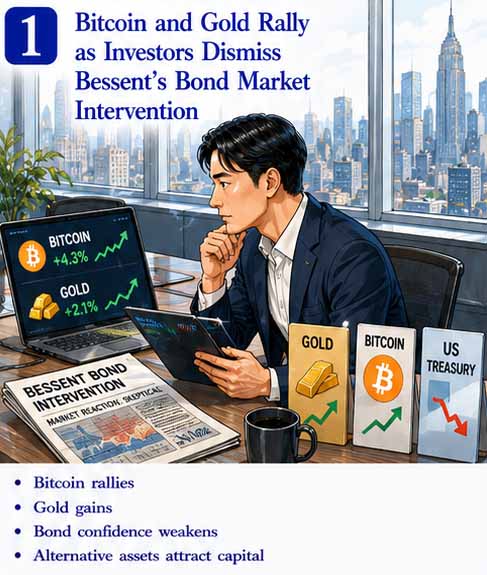
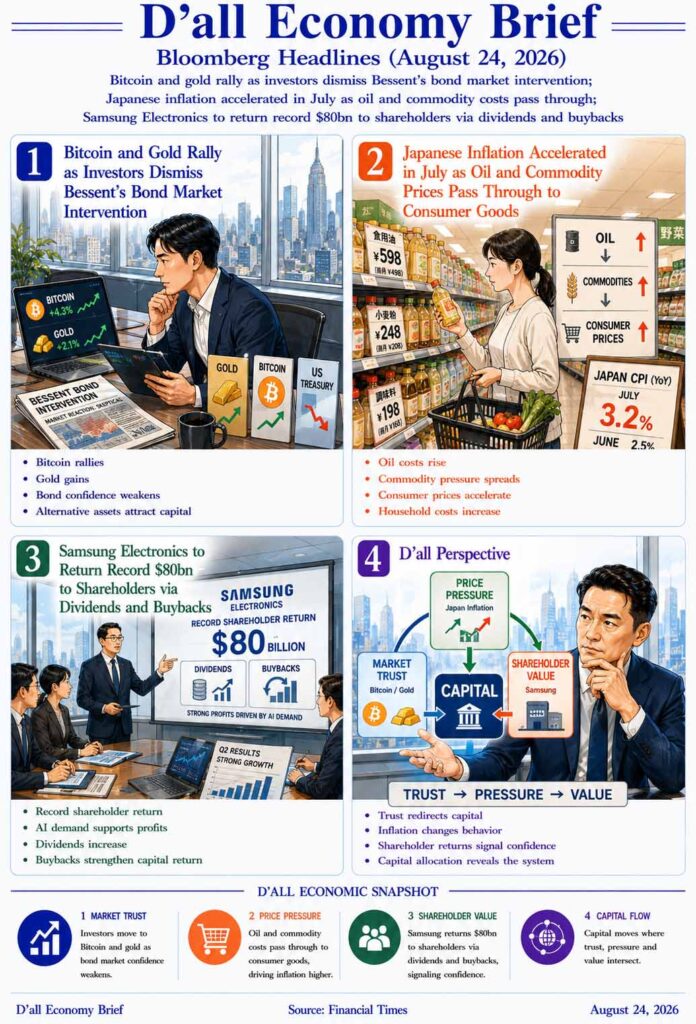
Bitcoin and Gold Rally | 비트코인과 금이 상승하는 이유
Bitcoin and gold are gaining as investors reassess bond-market confidence and the outlook for the dollar.
The movement suggests that capital is responding not only to expected returns but also to changing perceptions of financial stability.
When confidence in traditional assets becomes uncertain, investors can diversify toward assets viewed as alternative stores of value.
• Bitcoin gains momentum
• Gold strengthens
• Bond confidence is questioned
• Alternative assets attract capital
비트코인과 금의 상승은 투자자들이 채권시장과 달러에 대한 기존의 신뢰를 다시 평가하고 있음을 보여준다.
최근 금융시장에서는 정책 개입과 채권시장에 대한 우려가 맞물리면서 대체자산에 대한 관심이 커지고 있다.
중요한 것은 단순한 가격 상승이 아니라 자본이 위험과 신뢰를 판단하는 기준 자체가 변화하고 있다는 점이다.
• 비트코인 상승세 강화
• 금 가격 강세
• 채권시장 신뢰 재검토
• 대체자산으로 자본 이동
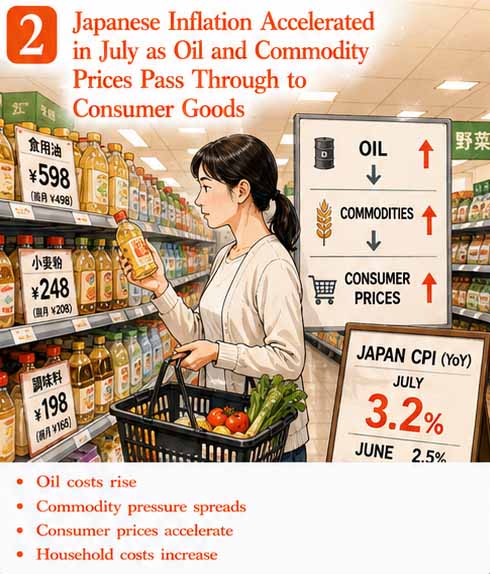
Japanese Inflation | 일본 인플레이션이 소비재로 전달되다
Japanese inflation is accelerating as higher oil and commodity prices pass through to consumer goods.
The development demonstrates how global commodity movements can eventually become household-level pressure.
Higher input costs affect businesses first, but part of that burden can eventually move into retail prices.
• Oil costs rise
• Commodity pressure spreads
• Consumer prices accelerate
• Household costs increase
일본의 인플레이션은 유가와 원자재 가격 상승이 소비재 가격으로 전달되면서 다시 압력을 받고 있다.
글로벌 시장에서 발생한 원자재 가격 변화가 기업의 비용을 거쳐 소비자의 생활비로 연결되는 구조다.
따라서 일본의 물가 흐름은 단순한 국내 지표가 아니라 글로벌 원자재 시장과 실물경제가 연결되는 과정을 보여준다.
• 유가 상승 영향 확대
• 원자재 가격 압력 전이
• 소비재 가격 상승
• 가계 비용 부담 증가
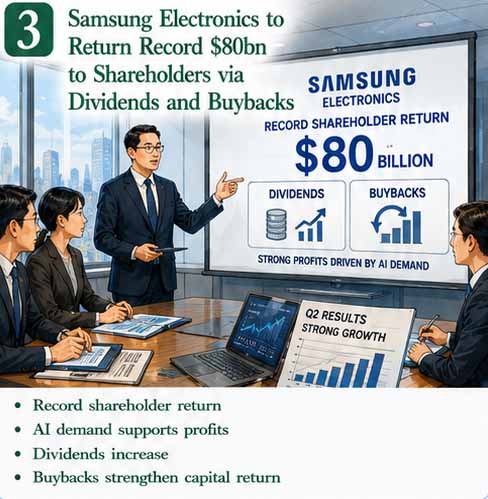
Samsung Electronics Shareholder Return | 삼성전자의 기록적인 주주환원
Samsung Electronics is preparing to return up to $80 billion to shareholders through dividends and share buybacks.
The programme represents the company’s largest shareholder-return plan and comes as AI-related semiconductor demand supports strong earnings. (Financial Times)
The decision highlights an important corporate question: how should companies allocate profits when growth, investment and shareholder expectations all rise simultaneously?
• Record shareholder return
• Dividends expand
• Buybacks strengthen capital return
• AI profits support cash generation
삼성전자는 배당과 자사주 매입을 통해 최대 800억 달러 규모의 기록적인 주주환원을 추진하고 있다.
AI 데이터센터와 고대역폭메모리 수요가 반도체 실적을 뒷받침하는 가운데, 기업이 창출한 이익을 어떻게 배분할 것인지가 중요한 경영 과제가 되고 있다. (Financial Times)
성장에 필요한 재투자와 투자자가 원하는 자본환원 사이의 균형이 기업가치를 결정하는 새로운 요소가 되고 있다.
• 기록적인 주주환원
• 배당 확대
• 자사주 매입 강화
• AI 수익이 현금창출을 지원
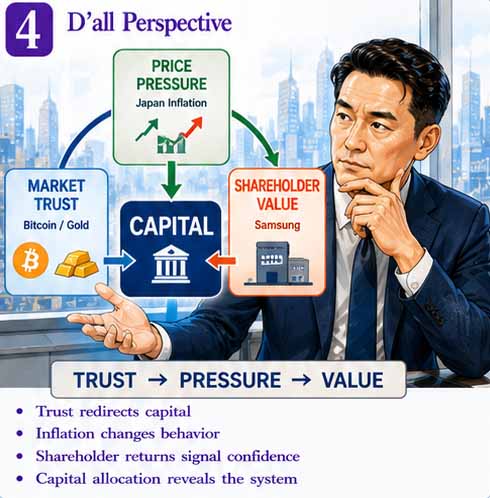
D’all Perspective | 디올 관점
The three headlines reveal different forms of capital movement.
Bitcoin and gold respond to changing perceptions of financial trust.
Japanese inflation shows how price pressure moves through the real economy.
Samsung’s shareholder return shows how corporate profits can become investor value.
Together, they form a broader system connecting trust, pressure, value and capital allocation.
• Trust redirects capital
• Inflation changes behaviour
• Corporate profits become shareholder value
• Capital allocation reveals the system
세 가지 헤드라인은 서로 다른 형태의 자본 이동을 보여준다.
비트코인과 금은 금융시장에 대한 신뢰 변화에 반응한다.
일본의 인플레이션은 가격 압력이 실물경제와 가계로 전달되는 과정을 보여준다.
삼성전자의 주주환원은 기업의 이익이 투자자의 가치로 전환되는 모습을 보여준다.
결국 세 흐름은 신뢰 → 압력 → 가치 → 자본 배분이라는 하나의 구조로 연결된다.
• 신뢰 변화가 자본 이동을 유도
• 인플레이션이 경제행동을 변화
• 기업이익이 주주가치로 전환
• 자본 배분이 시스템을 드러냄
Mini Insight
Capital moves differently when trust, prices and corporate performance change at the same time.
Alternative assets respond to financial uncertainty, households respond to inflation, and companies respond through capital allocation.
신뢰와 가격, 기업 성과가 동시에 변하면 자본의 움직임도 달라진다.
대체자산은 금융 불확실성에 반응하고, 가계는 인플레이션에 반응하며, 기업은 자본 배분으로 대응한다.
D’all Insight
The August 24 market illustrates how different economic events can be connected through capital allocation.
Bitcoin and gold are responding to changing perceptions of financial trust.
Their strength suggests that investors are reassessing where value can be preserved when traditional market assumptions become less certain.
Japan presents another part of the system.
Higher oil and commodity prices are moving through businesses and eventually reaching consumers.
This shows that inflation is not simply a central-bank statistic but a force that changes real economic behaviour.
Samsung Electronics provides a third perspective.
The company’s record shareholder-return programme demonstrates how strong AI-related earnings can be transformed into direct investor value. (Financial Times)
These three developments may appear unrelated at first glance.
One concerns alternative assets, another concerns household prices, and the third concerns corporate finance.
Yet all three involve the same underlying question: where does capital go when the economic environment changes?
Investors seek protection when trust weakens.
Consumers adjust when prices rise.
Companies reconsider the balance between reinvestment and shareholder returns when profits increase.
D’all therefore reads these headlines as a broader map of capital movement rather than three separate market events.
The important signal is not simply whether Bitcoin, gold or Samsung shares rise.
The deeper signal is how expectations are changing the destination and purpose of capital.
This makes capital allocation one of the most important structural indicators for understanding the next stage of the global economy.
8월 24일 시장은 서로 다른 경제 현상들이 자본 배분을 통해 연결될 수 있음을 보여준다.
비트코인과 금은 금융시장에 대한 신뢰의 변화에 반응하고 있다.
이는 전통적인 금융자산에 대한 기존의 가정이 흔들릴 때 투자자들이 가치 저장의 대상을 다시 찾고 있음을 의미한다.
일본은 이 구조의 또 다른 측면을 보여준다.
높아진 유가와 원자재 가격이 기업의 비용을 거쳐 소비자에게 전달되고 있기 때문이다.
인플레이션은 단순한 중앙은행의 통계가 아니라 실제 경제주체의 행동을 변화시키는 힘이다.
삼성전자는 세 번째 관점을 보여준다.
기록적인 주주환원 계획은 AI 관련 이익을 직접적인 투자자 가치로 전환하려는 기업의 자본 배분을 보여준다. (Financial Times)
처음에는 세 가지 뉴스가 서로 관련 없어 보일 수 있다.
하나는 대체자산이고, 다른 하나는 가계 물가이며, 세 번째는 기업금융의 문제이기 때문이다.
그러나 세 흐름의 중심에는 동일한 질문이 존재한다.
경제 환경이 변할 때 자본은 어디로 이동하는가?
신뢰가 약해지면 투자자는 자산의 보호처를 찾는다.
가격이 상승하면 소비자는 행동을 바꾼다.
기업의 이익이 증가하면 재투자와 주주환원 사이의 균형을 다시 결정한다.
D’all은 따라서 이번 헤드라인을 세 개의 독립적인 사건이 아니라 자본 이동을 보여주는 하나의 구조적 지도로 바라본다.
중요한 것은 비트코인이나 금, 삼성전자 주가가 단순히 상승하는가가 아니다.
더 중요한 것은 변화하는 기대가 자본의 목적지와 사용 방식을 어떻게 바꾸고 있는가이다.
결국 자본 배분은 다음 글로벌 경제의 방향을 이해하는 핵심적인 구조적 지표가 될 수 있다.
One-line Insight
Capital moves where trust, pressure and value intersect.
자본은 신뢰와 압력, 가치가 만나는 곳으로 이동한다.
D’ALL ECONOMIC SNAPSHOT
1. MARKET TRUST
Bitcoin and gold rally as investors reassess bond-market confidence.
투자자들이 채권시장에 대한 신뢰를 다시 평가하면서 비트코인과 금이 상승한다.
2. PRICE PRESSURE
Japanese inflation accelerates as higher oil and commodity costs reach consumer goods.
유가와 원자재 가격 상승이 소비재로 전달되면서 일본의 인플레이션이 가속화된다.
3. SHAREHOLDER VALUE
Samsung Electronics prepares up to $80 billion in dividends and buybacks.
삼성전자가 최대 800억 달러 규모의 배당과 자사주 매입을 추진한다.
4. CAPITAL ALLOCATION
Trust, price pressure and corporate performance reshape where capital flows next.
신뢰, 가격 압력, 기업 성과가 글로벌 자본의 다음 이동 방향을 다시 만든다.
#Bitcoin #Gold #BondMarket #Dollar #JapaneseInflation #JapanEconomy #SamsungElectronics #ShareholderReturns #Dividends #StockBuybacks #CapitalAllocation #GlobalMarkets #FinancialMarkets #MarketAnalysis #DallEconomyBrief
#비트코인 #금 #채권시장 #달러 #일본인플레이션 #일본경제 #삼성전자 #주주환원 #배당 #자사주매입 #자본배분 #글로벌시장 #금융시장 #시장분석 #디올이코노미브리프
Source
Financial Times (August 24, 2026)
This article is an editorial interpretation based on publicly available reporting from Financial Times. It examines the structural implications of Bitcoin and gold rising amid changing bond-market confidence, accelerating Japanese inflation driven by higher oil and commodity costs, and Samsung Electronics’ record shareholder-return plan through the Visual Intelligence perspective of D’all Economy Brief. (Financial Times)
이 글은 Financial Times의 공개 보도를 바탕으로 D’all이 재구성한 편집적 해석이다. 채권시장에 대한 신뢰 변화 속에서 나타난 비트코인과 금의 상승, 유가와 원자재 가격 상승에 따른 일본의 인플레이션, 삼성전자의 기록적인 주주환원 계획이 자본의 신뢰와 가격 압력, 기업가치 및 자본 배분에 미치는 구조적 의미를 D’all Economy Brief의 Visual Intelligence 관점에서 분석한다. (Financial Times)
- D'all Visual Intelligence
- D’all Public Design Intelligence
- D’all Motion Intelligence
- D’all Interaction Intelligence
- D’all Spatial Intelligence
- D’all Advertising Intelligence
- D’all Economy Brief
- D’all Food Intelligence
- D’all Health Insight
- D’all Global Power
- D’all Culture Hybrid
- D’all Knowledge Architecture
- D'all Capital History
- D’all Society Agenda

How does changing investor confidence in traditional assets influence the movement of capital toward Bitcoin and gold?
When confidence in traditional assets weakens, investors may diversify into alternative stores of value such as Bitcoin and gold.
Gold often reflects macro uncertainty, while Bitcoin represents a different, digital form of capital diversification.
From the D’all Perspective, it is less about replacing traditional assets and more about where confidence is shifting.