

Risk Sentiment | 방향성을 잃은 시장과 불안한 투자심리
Risk Sentiment는 5월 말 글로벌 시장을 설명하는 가장 중요한 흐름 중 하나가 되고 있다.
최근 월스트리트 증시는 뚜렷한 상승도 하락도 아닌 애매한 흐름 속에서 방향성을 잃고 있다.
투자자들은 금리와 유동성, 공급망 리스크, 소비 둔화 가능성 사이에서 새로운 균형점을 찾지 못하고 있다.
특히 지정학적 긴장은 다시 글로벌 공급망 압박을 확대시키고 있으며, 물류와 원자재 비용 불확실성 역시 재부각되고 있다.
동시에 유통업체들은 하반기 소비 둔화 가능성에 대비해 재고 전략과 할인 정책을 조정하기 시작했다.
이는 단순한 경기 둔화 우려가 아니라, 소비와 공급, 금융 환경이 동시에 흔들리는 복합 구조에 가깝다.
현재 시장은 강한 낙관론보다는 리스크 관리 중심으로 이동하고 있다.
기업들은 공격적 확장보다 비용 통제와 운영 안정성을 우선시하기 시작했다.
글로벌 경제는 여전히 움직이고 있지만, 투자자들의 심리는 점점 더 조심스러워지고 있다.
이번 D’all Economy Brief는 Risk Sentiment와 Supply Chains 흐름이 글로벌 시장 구조를 어떻게 변화시키고 있는지 분석한다.
Risk Sentiment and Supply Chains Reshape Global Markets
Risk Sentiment is becoming one of the most important themes shaping global financial markets as May comes to an end.
Wall Street stocks are struggling to establish a clear direction as investors balance inflation concerns, liquidity conditions, geopolitical risks, and slowing consumer momentum.
Markets are no longer driven purely by optimism surrounding technology or artificial intelligence expansion.
Instead, investors are becoming increasingly cautious about operational stability and global economic resilience.
At the same time, geopolitical tensions are once again pressuring global supply chains.
Shipping routes, logistics networks, and industrial transportation systems are facing renewed uncertainty across multiple regions.
Rising transportation costs and supply disruptions are increasing pressure on companies already dealing with slower consumer demand.
Retailers are also beginning to prepare for weaker spending conditions during the second half of the year.
Inventory strategies and discount competition are becoming more important as businesses attempt to preserve profitability in a slowing demand environment.
Today’s D’all Economy Brief explores how Risk Sentiment, Supply Chains, and Consumer Spending are reshaping global market psychology and operational strategy.
Embedded Video | Global Markets, Consumer Demand and Economic Uncertainty | 임베디드 영상 | 글로벌 시장과 소비 둔화, 경제 불확실성
How weakening consumer confidence, slowing spending activity, and rising market uncertainty are reshaping global economic sentiment.
소비자 신뢰 약화와 소비 둔화, 시장 불확실성이 글로벌 경제 심리를 어떻게 변화시키고 있는가.
Risk Sentiment | 투자심리 약화와 방향성 혼란
Wall Street stocks struggled to find direction as investors reassessed liquidity conditions and economic risks near the end of May.
Markets are increasingly moving toward defensive positioning rather than aggressive risk-taking.
Treasury-yield volatility and uncertainty surrounding global growth continue pressuring sentiment.
• Markets lose clear direction
• Investors await new signals
• Treasury yields remain volatile
• Risk sentiment weakens
월스트리트 증시는 5월 말 유동성과 경기 불확실성을 다시 평가하는 투자자들 속에서 방향성을 잃고 있다.
시장은 공격적 위험추구보다 방어적 포지션으로 이동하는 흐름을 보이고 있다.
국채 수익률 변동성과 글로벌 성장 불확실성 역시 투자심리를 압박하고 있다.
• 시장 방향성 약화
• 투자자 관망 심리 확대
• 국채금리 변동성 지속
• 투자심리 약세 확대

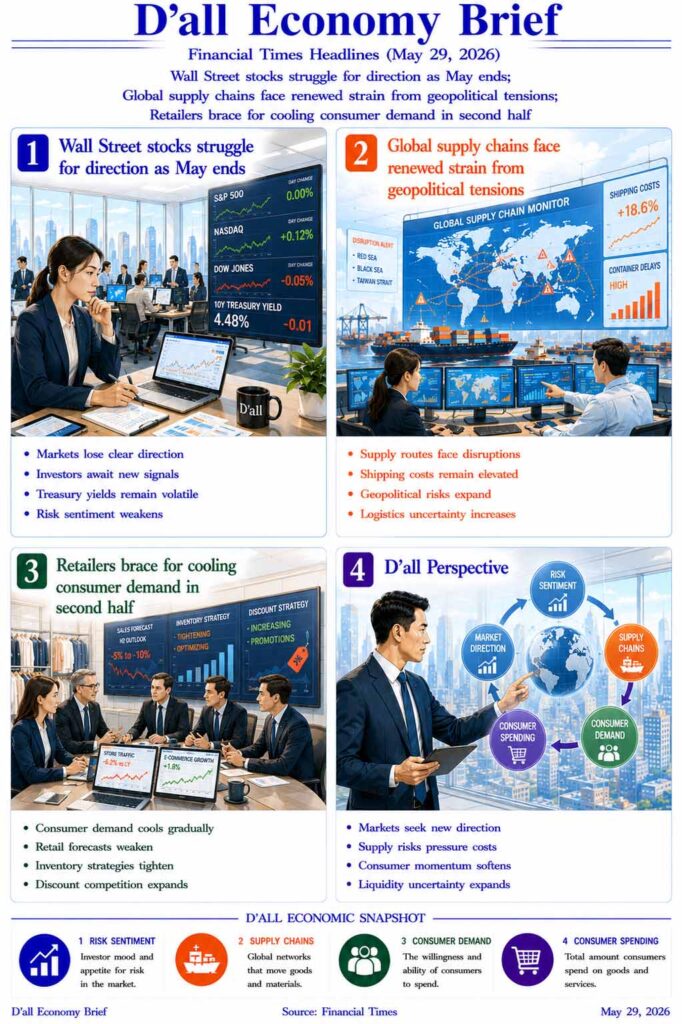
Supply Chains | 다시 흔들리는 글로벌 공급망
Global supply chains are facing renewed strain as geopolitical tensions expand across major trade routes.
Shipping costs and logistics uncertainty are rising once again, increasing pressure on industrial operations and international trade flows.
Companies are becoming more cautious about inventory management and transportation reliability.
• Supply routes face disruptions
• Shipping costs remain elevated
• Geopolitical risks expand
• Logistics uncertainty increases
지정학적 긴장 확대로 글로벌 공급망은 다시 압박받기 시작했다.
운송 비용과 물류 불확실성이 상승하면서 산업 운영과 국제 교역 흐름에 부담이 확대되고 있다.
기업들은 재고 관리와 물류 안정성에 더욱 신중해지고 있다.
• 공급 경로 불안 확대
• 운송 비용 상승 지속
• 지정학 리스크 확대
• 물류 불확실성 증가
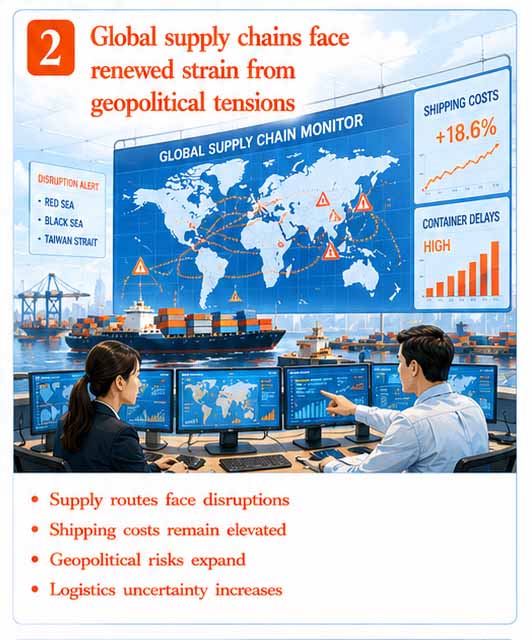
Consumer Demand | 둔화 조짐을 보이는 소비 수요
Retailers are preparing for softer consumer demand during the second half of the year.
Companies are adjusting inventory strategies and discount plans to protect margins under weaker spending conditions.
Consumer momentum remains active, but growth expectations are gradually cooling.
• Consumer demand cools gradually
• Retail forecasts weaken
• Inventory strategies tighten
• Discount competition expands
유통업체들은 하반기 소비 둔화 가능성에 대비하기 시작했다.
기업들은 약화되는 소비 환경 속에서 수익성을 유지하기 위해 재고 전략과 할인 정책을 조정하고 있다.
소비 활동은 유지되고 있지만 성장 기대는 점차 둔화되고 있다.
• 소비 증가세 둔화
• 유통 전망 약화
• 재고 전략 조정 확대
• 할인 경쟁 심화
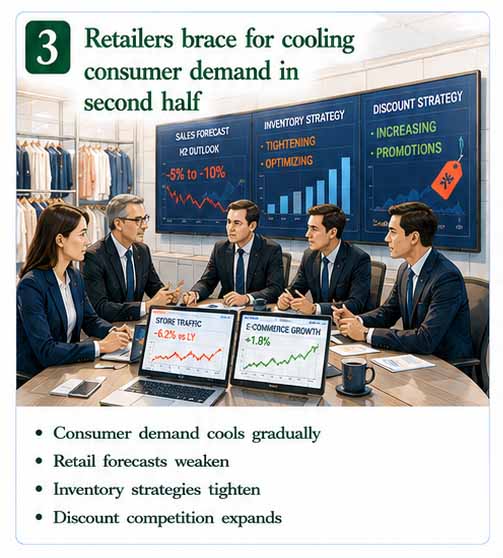
D’all Perspective | 디올 관점
Global markets are increasingly entering a phase defined by uncertainty rather than expansion optimism.
Investors are no longer focused only on growth narratives or technology momentum.
Instead, financial markets are becoming more sensitive to operational risks, geopolitical instability, and consumer resilience.
Supply-chain disruptions are once again becoming structural concerns rather than temporary disruptions.
Meanwhile, retailers and corporations are shifting toward more defensive strategies as demand expectations cool.
This combination is creating a market environment where liquidity, logistics, and operational efficiency matter as much as innovation or expansion potential.
• Markets seek new direction
• Supply risks pressure costs
• Consumer momentum softens
• Liquidity uncertainty expands
글로벌 시장은 점점 성장 낙관론보다 불확실성이 중심이 되는 국면으로 이동하고 있다.
투자자들은 단순 성장 서사보다 운영 리스크와 지정학 불안정성, 소비 회복력에 더욱 민감하게 반응하고 있다.
공급망 문제는 일시적 현상이 아니라 구조적 변수로 다시 부상하고 있다.
동시에 유통업체들과 기업들은 소비 둔화 가능성에 대비해 보다 방어적인 전략으로 이동하고 있다.
결국 시장은 혁신과 확장성뿐 아니라 유동성과 물류 안정성, 운영 효율까지 동시에 요구하는 복합 환경으로 이동하고 있다.
• 시장 방향성 약화
• 공급 리스크 확대
• 소비 모멘텀 둔화
• 유동성 불확실성 증가

Mini Insight
Markets are shifting from expansion optimism toward operational caution and defensive positioning.
시장은 확장 낙관론에서 운영 안정성과 방어적 전략 중심 구조로 이동하고 있다.
D’all Insight
Global financial markets are increasingly reflecting uncertainty rather than confidence.
Over the past two years, investors largely focused on growth themes such as artificial intelligence, technology expansion, and post-pandemic recovery momentum.
However, market psychology is now becoming far more complicated.
One of the biggest shifts is the return of supply-chain instability.
During the pandemic era, global logistics disruptions exposed how fragile international trade networks could become under external pressure.
Although conditions later stabilized, geopolitical tensions are now creating a second wave of uncertainty.
Shipping routes and industrial transportation systems are once again under pressure.
Companies are becoming more cautious about inventory planning, sourcing strategies, and transportation costs because operational disruptions can rapidly affect profitability.
At the same time, consumer momentum is beginning to soften.
Retailers are increasingly preparing for slower spending conditions during the second half of the year.
This does not necessarily mean a collapse in consumer demand, but it does suggest that households are becoming more selective and cautious.
This matters because modern economies depend heavily on stable consumption.
When consumers reduce discretionary spending, companies often respond by slowing hiring, cutting expansion plans, or tightening operational budgets.
Financial markets are reacting to this uncertainty by reducing aggressive risk exposure.
Instead of chasing high-growth momentum, investors are increasingly prioritizing stability, liquidity, and operational resilience.
This reveals a broader structural transition.
Global markets are no longer driven only by optimism surrounding innovation or expansion.
They are increasingly shaped by geopolitical risk, supply-chain efficiency, and the ability of consumers to sustain economic momentum under uncertain conditions.
현대 글로벌 금융시장은 점점 확신보다 불확실성을 더 강하게 반영하기 시작하고 있다.
지난 2년 동안 투자자들은 AI와 기술 확장, 팬데믹 이후 회복 흐름 같은 성장 서사에 집중해왔다.
하지만 시장 심리는 이제 훨씬 복잡한 국면으로 이동하고 있다.
가장 큰 변화 중 하나는 공급망 불안정성의 재등장이다.
팬데믹 시기 글로벌 물류 혼란은 국제 교역 시스템이 얼마나 취약할 수 있는지를 보여주었다.
이후 안정화 흐름이 나타났지만, 최근 지정학적 긴장은 다시 새로운 불확실성을 만들고 있다.
운송 경로와 산업 물류 시스템은 다시 압박받고 있다.
기업들은 운영 차질이 수익성에 직접 영향을 줄 수 있기 때문에 재고 계획과 공급 전략, 물류 비용 관리에 더욱 신중해지고 있다.
동시에 소비 모멘텀 역시 점차 둔화 조짐을 보이고 있다.
유통업체들은 하반기 소비 둔화 가능성에 대비하기 시작했다.
이는 소비 붕괴를 의미하는 것은 아니지만, 가계가 보다 선택적이고 신중해지고 있음을 보여준다.
현대 경제는 안정적 소비 흐름에 크게 의존한다.
소비가 약화되면 기업들은 고용과 투자, 운영 계획을 동시에 조정하기 시작한다.
금융시장 역시 이러한 불확실성에 반응하고 있다.
투자자들은 고위험 성장 추구보다 안정성과 유동성, 운영 회복력을 우선시하기 시작했다.
결국 글로벌 시장은 혁신과 성장만으로 움직이는 구조에서 벗어나고 있다.
이제 시장은 지정학 리스크와 공급망 효율성, 그리고 소비 지속 가능성까지 동시에 반영하는 복합 구조로 이동하고 있다.

When confidence fades, even luxury consumers begin to hesitate. 시장에 대한 신뢰가 흔들리기 시작하면, 럭셔리 소비자들조차 쉽게 지갑을 열지 않는다.
One-line Insight
“Global markets are shifting from expansion optimism toward operational resilience and defensive positioning.”
“글로벌 시장은 확장 낙관론에서 운영 안정성과 방어적 전략 중심 구조로 이동하고 있다.”
D’ALL ECONOMIC SNAPSHOT
1️⃣ Risk Sentiment | 투자심리
Risk sentiment refers to the overall willingness of investors to take financial risks in the market.
Weak risk sentiment usually pushes investors toward safer assets and defensive positioning.
투자심리는 투자자들이 시장에서 위험자산을 얼마나 적극적으로 선호하는지를 의미한다.
투자심리가 약해지면 안전자산 선호와 방어적 포지션이 확대되는 경우가 많다.
2️⃣ Supply Chains | 글로벌 공급망
Supply chains are global networks that move raw materials, products, and goods across economies.
Disruptions inside supply chains can increase costs and reduce operational efficiency worldwide.
공급망은 원자재와 상품, 완제품을 세계 경제 전반으로 이동시키는 글로벌 물류 네트워크를 의미한다.
공급망 혼란은 비용 상승과 운영 효율 저하를 유발할 수 있다.
3️⃣ Consumer Demand | 소비 수요
Consumer demand represents the willingness and ability of households to purchase goods and services.
Strong consumer demand often supports economic growth and corporate profitability.
소비 수요는 가계가 상품과 서비스를 구매하려는 의지와 능력을 의미한다.
강한 소비 수요는 경제 성장과 기업 수익성을 지탱하는 핵심 요소다.
4️⃣ Consumer Spending | 소비 지출
Consumer spending refers to the total amount consumers spend on goods and services across the economy.
Changes in consumer spending strongly influence retail sales, employment, and overall economic momentum.
소비 지출은 소비자들이 경제 전반에서 상품과 서비스 구매에 사용하는 총지출 규모를 의미한다.
소비 지출 변화는 유통 판매와 고용, 경제 성장 흐름에 큰 영향을 준다.
#RiskSentiment #SupplyChains #ConsumerDemand #ConsumerSpending #FinancialTimes #GlobalMarkets #RetailSales #Geopolitics #Liquidity #WallStreet #EconomicOutlook #RetailIndustry #Logistics #MarketVolatility #DallEconomyBrief
#투자심리 #글로벌공급망 #소비수요 #소비지출 #파이낸셜타임즈 #글로벌시장 #유통판매 #지정학 #유동성 #월스트리트 #경제전망 #유통산업 #물류 #시장변동성 #디올이코노미브리프
Source
Financial Times, May 29, 2026
Based on Financial Times coverage regarding Wall Street uncertainty, supply-chain pressure, and slowing consumer demand.
Content reconstructed and expanded for analytical insight by D’all Economy Brief.
- D'all Visual Intelligence
- D’all Public Design Intelligence
- D’all Motion Intelligence
- D’all Interaction Intelligence
- D’all Spatial Intelligence
- D’all Advertising Intelligence
- D’all Economy Brief
- D’all Food Intelligence
- D’all Health Insight
- D’all Global Power
- D’all Culture Hybrid
- D’all Knowledge Architecture
- D'all Capital History
- D’all Society Agenda
