

Treasury Yields | 금리 압박과 기술주 조정 확대
Treasury Yields 흐름은 다시 글로벌 시장의 핵심 압박 변수로 부상하고 있다.
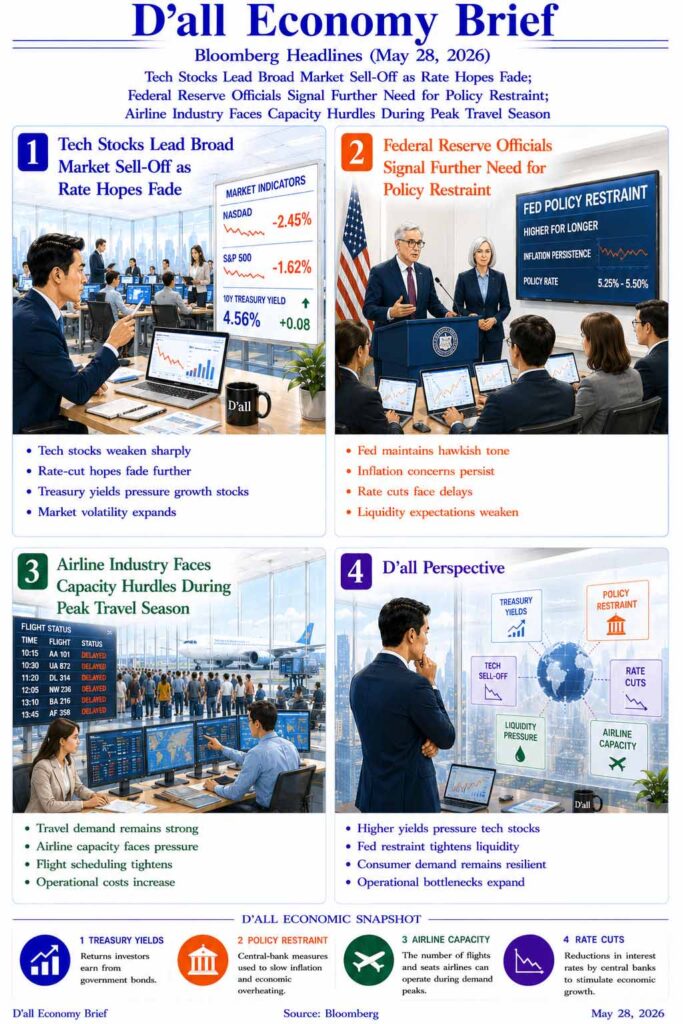
최근 기술주 중심의 시장 조정은 단순 차익실현이 아니라, 금리 인하 기대 약화와 유동성 경계 심리가 동시에 작동한 결과에 가깝다.
특히 미국 국채 수익률 상승은 성장주 밸류에이션에 직접적인 부담을 주고 있다.
연준 위원들은 여전히 인플레이션 압력이 충분히 해소되지 않았다고 판단하고 있으며, 추가 긴축 필요성을 반복적으로 시사하고 있다.
이는 시장이 기대했던 빠른 완화 전환 가능성을 다시 늦추고 있다.
동시에 실물경제에서는 항공업계가 성수기 수요 증가에도 불구하고 공급 역량 문제에 직면하고 있다.
항공기 부족과 인력 문제, 운영 비용 상승은 여행 산업 전반의 병목 현상을 확대시키고 있다.
현재 글로벌 시장은 AI 낙관론과 금리 압박, 그리고 공급 제약이 동시에 충돌하는 복합 국면으로 이동하고 있다.
높은 금리 환경은 기술주와 소비시장, 산업 운영 효율 모두에 영향을 미치기 시작했다.
이번 D’all Economy Brief는 Treasury Yields와 긴축 지속 흐름이 글로벌 자산시장과 산업 운영 구조를 어떻게 재편하는지 분석한다.
Treasury Yields and Policy Restraint Reshape Global Markets
Treasury Yields are once again becoming one of the most important pressure points across global financial markets.
The recent sell-off led by technology stocks reflects more than simple profit-taking.
Markets are increasingly responding to fading expectations for near-term rate cuts and tighter liquidity conditions.
Rising U.S. government-bond yields are placing direct pressure on growth-stock valuations.
Federal Reserve officials continue signaling that inflation risks remain persistent and additional policy restraint may still be necessary.
This is delaying expectations surrounding a rapid monetary-policy pivot.
At the same time, the airline industry is struggling with operational bottlenecks despite strong seasonal travel demand.
Aircraft shortages, staffing pressure, and rising operational costs are limiting supply flexibility during peak travel season.
Global markets are now entering a more complicated phase where AI optimism, high interest rates, and supply constraints are colliding simultaneously.
Today’s D’all Economy Brief explores how Treasury yields and prolonged policy restraint are reshaping market liquidity and operational efficiency across industries.
Embedded Video | Treasury Yields and Global Liquidity Outlook | 임베디드 영상 | 국채금리 상승과 글로벌 유동성 전망
How rising Treasury yields, persistent inflation pressure, and shifting rate-cut expectations are reshaping global market sentiment.
높아지는 국채 수익률과 지속되는 인플레이션 압력, 변화하는 금리 인하 기대가 글로벌 시장 심리를 어떻게 재편하고 있는가.
Treasury Yields | 국채 수익률 상승과 기술주 압박 확대
Technology stocks led a broader market sell-off as investors reduced expectations for near-term interest-rate cuts.
Higher Treasury yields are increasingly pressuring growth-stock valuations and liquidity conditions.
Markets are becoming more sensitive to inflation data and Federal Reserve commentary.
• Tech stocks weaken sharply
• Treasury yields continue rising
• Rate-cut hopes fade further
• Market volatility expands
기술주 중심의 시장 매도세는 투자자들이 금리 인하 기대를 낮추기 시작하면서 확대되었다.
높아지는 국채 수익률은 성장주 밸류에이션과 시장 유동성에 부담을 주고 있다.
시장은 인플레이션 데이터와 연준 발언에 더욱 민감하게 반응하기 시작했다.
• 기술주 약세 확대
• 국채 수익률 상승 지속
• 금리 인하 기대 약화
• 시장 변동성 확대

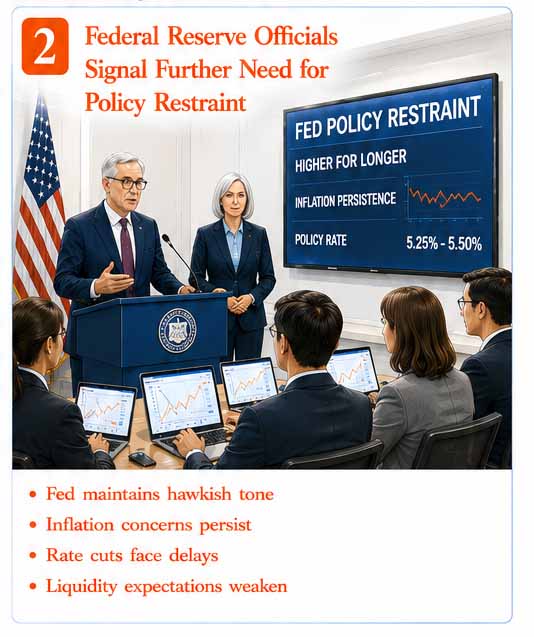
Policy Restraint | 정책 긴축 지속 시그널
Federal Reserve officials signaled that additional policy restraint may still be necessary to fully contain inflation pressure.
Markets increasingly believe interest rates may remain elevated for longer than previously expected.
Liquidity expectations are gradually tightening across global financial systems.
• Fed maintains hawkish stance
• Inflation concerns persist
• Rate cuts face delays
• Liquidity conditions tighten
연준 위원들은 인플레이션 압력을 통제하기 위해 추가 긴축이 필요할 수 있다고 시사했다.
시장은 높은 금리가 예상보다 오래 유지될 가능성을 점차 반영하고 있다.
글로벌 금융시장 전반에서는 유동성 기대 역시 점차 위축되고 있다.
• 연준 매파 기조 유지
• 인플레이션 우려 지속
• 금리 인하 지연 가능성
• 유동성 압박 확대
Airline Capacity | 항공 공급 역량 부족 확대
The airline industry is facing operational bottlenecks during peak travel season despite strong demand recovery.
Limited aircraft availability and staffing shortages are reducing operational flexibility.
Travel demand remains resilient, but supply capacity is struggling to keep pace.
• Airline demand remains strong
• Capacity pressure expands
• Flight scheduling tightens
• Operational costs continue rising
항공업계는 성수기 여행 수요 증가 속에서도 공급 역량 문제에 직면하고 있다.
항공기 부족과 인력 문제는 운영 유연성을 제한하고 있다.
여행 수요는 강하지만 공급 시스템은 이를 충분히 따라가지 못하고 있다.
• 항공 수요 강세 유지
• 공급 압박 확대
• 운항 일정 경직
• 운영 비용 상승 지속

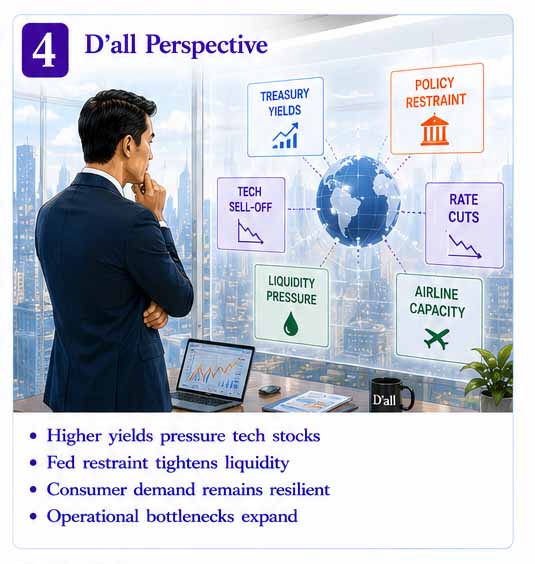
D’all Perspective | 디올 관점
Markets are increasingly shifting away from pure AI optimism toward a more cautious liquidity-focused environment.
Rising Treasury yields are pressuring technology stocks while Federal Reserve policy restraint continues tightening financial conditions.
At the same time, operational bottlenecks inside the real economy are becoming more visible across transportation and logistics industries.
The global economy is now balancing technological expansion against tightening monetary conditions and supply constraints.
• Treasury yields pressure tech valuations
• Fed restraint limits liquidity expansion
• Operational bottlenecks increase
• Markets enter selective-risk phase
시장은 점차 AI 낙관론 중심 구조에서 유동성 경계 중심 구조로 이동하고 있다.
높은 국채 수익률은 기술주 밸류에이션을 압박하는 동시에 금융 환경 역시 긴축시키고 있다.
동시에 실물경제에서는 운송과 물류 산업을 중심으로 공급 병목 현상이 확대되고 있다.
글로벌 경제는 기술 확장과 긴축 정책, 공급 제약 사이에서 새로운 균형을 찾고 있다.
• 국채 수익률과 기술주 압박
• 연준 긴축과 유동성 제한
• 운영 병목 현상 확대
• 선택적 리스크 국면 진입
Mini Insight
Treasury yields and prolonged policy restraint are becoming the dominant forces reshaping liquidity and technology valuations.
국채 수익률과 긴축 지속 흐름은 시장 유동성과 기술주 밸류에이션을 재편하는 핵심 변수로 부상하고 있다.
D’all Insight
Global markets are increasingly transitioning into a phase where liquidity conditions matter more than narrative optimism.
Over the past year, artificial intelligence investment and technology-sector expansion helped support strong market momentum despite elevated interest rates.
However, investors are now reassessing how sustainable those valuations remain under tighter monetary conditions.
Treasury yields have become a central signal inside this transition.
When government-bond yields rise, borrowing costs increase across nearly every layer of the economy.
Higher yields reduce the attractiveness of high-growth assets because future earnings become less valuable under elevated discount rates.
This is why technology stocks often react aggressively whenever markets reduce expectations surrounding future rate cuts.
The recent sell-off reflects how investors are beginning to prioritize liquidity preservation over aggressive risk-taking.
At the same time, Federal Reserve officials continue emphasizing inflation risks.
Markets had previously expected faster policy easing once inflation slowed.
Instead, policymakers are signaling that restrictive conditions may need to remain in place longer than investors hoped.
Meanwhile, operational bottlenecks are becoming increasingly visible across the real economy.
The airline industry is a clear example.
Strong travel demand exists globally, but supply systems are struggling to keep pace because of aircraft shortages, staffing limitations, and rising operational costs.
This reveals an important structural reality.
Even when consumer demand remains relatively healthy, supply-side inefficiencies can still create inflationary pressure and operational instability.
Global markets are therefore entering a more selective environment.
Liquidity conditions, operational efficiency, and policy direction are becoming more important than pure growth expectations alone.
현대 금융시장은 점점 유동성 조건이 서사적 낙관론보다 더 중요해지는 국면으로 이동하고 있다.
지난 1년 동안 AI 투자와 기술주 확장은 높은 금리 환경 속에서도 강한 시장 상승을 지탱했다.
하지만 투자자들은 이제 이러한 밸류에이션이 긴축 환경 속에서도 지속 가능한지를 다시 계산하기 시작했다.
국채 수익률은 이러한 전환의 핵심 신호가 되고 있다.
정부 채권 수익률이 상승하면 경제 전반의 자금조달 비용 역시 동시에 상승한다.
높은 금리는 미래 수익의 현재 가치를 낮추기 때문에 성장주에는 직접적인 부담이 된다.
이 때문에 시장이 금리 인하 기대를 낮출 때마다 기술주는 강하게 흔들리는 경향을 보인다.
최근 매도세는 투자자들이 공격적 위험추구보다 유동성 보존을 우선시하기 시작했음을 보여준다.
동시에 연준은 여전히 인플레이션 리스크를 강조하고 있다.
시장은 원래 더 빠른 정책 완화를 기대했지만, 정책 당국은 긴축 조건이 예상보다 오래 지속될 가능성을 시사하고 있다.
한편 실물경제에서는 운영 병목 현상 역시 확대되고 있다.
항공 산업은 대표적인 사례다.
강한 여행 수요가 존재하지만 항공기 부족과 인력 문제, 비용 상승 때문에 공급 시스템이 이를 충분히 따라가지 못하고 있다.
이는 중요한 구조적 현실을 보여준다.
소비 수요가 유지되더라도 공급 비효율은 여전히 인플레이션 압력과 운영 불안정을 유발할 수 있다는 점이다.
결국 글로벌 시장은 점점 더 선택적인 국면으로 이동하고 있다.
유동성 환경과 운영 효율, 정책 방향성이 단순 성장 기대보다 더욱 중요한 변수로 부상하고 있다.
One-line Insight
“Markets are shifting from AI optimism toward liquidity discipline and operational reality.”
“시장은 AI 낙관론에서 유동성과 운영 현실 중심 구조로 이동하고 있다.”
D’ALL ECONOMIC SNAPSHOT
1️⃣ Treasury Yields | 국채 수익률
Treasury yields represent the returns investors earn from holding government bonds.
Rising yields often signal tighter liquidity conditions and reduced expectations for near-term interest-rate cuts.
미국 국채 수익률은 정부 채권 투자자가 받는 수익률을 의미한다.
국채금리 상승은 유동성 긴축과 금리 인하 기대 약화를 의미하는 경우가 많다.
2️⃣ Policy Restraint | 정책 긴축
Policy restraint refers to central-bank actions designed to slow inflation and prevent economic overheating.
Higher interest rates and restrictive monetary conditions are common forms of policy restraint.
정책 긴축은 중앙은행이 인플레이션과 경기 과열을 억제하기 위해 사용하는 통화정책을 의미한다.
높은 금리와 긴축적 금융 환경은 대표적인 정책 긴축 방식이다.
3️⃣ Airline Capacity | 항공 공급 역량
Airline capacity refers to the number of available flights and passenger seats airlines can operate during periods of strong travel demand.
Capacity shortages can increase ticket prices and operational pressure across the travel industry.
항공 공급 역량은 항공사가 성수기 수요 기간 동안 운영할 수 있는 항공편과 좌석 규모를 의미한다.
공급 부족은 항공권 가격 상승과 운영 압박 확대를 유발할 수 있다.
4️⃣ Rate Cuts | 금리 인하
Rate cuts refer to central-bank decisions to lower benchmark interest rates in order to stimulate economic activity and ease financial conditions.
Markets closely monitor rate-cut expectations because they strongly influence liquidity and asset prices.
금리 인하는 중앙은행이 경기 부양과 금융 환경 완화를 위해 기준금리를 낮추는 정책을 의미한다.
시장은 금리 인하 기대 변화에 매우 민감하게 반응하며, 이는 자산가격과 유동성에 큰 영향을 준다.
#TreasuryYields #PolicyRestraint #AirlineCapacity #RateCuts #Bloomberg #FederalReserve #TechStocks #Liquidity #GlobalMarkets #Inflation #BondMarkets #MarketSelloff #TravelIndustry #MacroEconomy #DallEconomyBrief
#국채수익률 #정책긴축 #항공공급역량 #금리인하 #블룸버그 #연준 #기술주 #유동성 #글로벌시장 #인플레이션 #채권시장 #시장매도세 #항공산업 #거시경제 #디올이코노미브리프
Source
Bloomberg, May 28, 2026
Based on Bloomberg coverage regarding Treasury yields, Federal Reserve policy restraint, technology-stock weakness, and airline industry operational pressure.
Content reconstructed and expanded for analytical insight by D’all Economy Brief.
- D'all Visual Intelligence
- D’all Public Design Intelligence
- D’all Motion Intelligence
- D’all Interaction Intelligence
- D’all Spatial Intelligence
- D’all Advertising Intelligence
- D’all Economy Brief
- D’all Food Intelligence
- D’all Health Insight
- D’all Global Power
- D’all Culture Hybrid
- D’all Knowledge Architecture
- D'all Capital History
- D’all Society Agenda
