

Spatial Intelligence | 공간은 왜 인간 행동을 바꾸는가
사람들은 IKEA에 간다.
그리고 생각보다 오래 머문다.
예상보다 더 많이 걷고, 생각보다 더 많은 물건을 집어 든다.
하지만 대부분 사람들은 그 이유를 설명하지 못한다.
IKEA는 단순한 가구 매장이 아니다.
그곳은 인간의 이동, 시선, 체류시간, 감정, 소비 흐름을 설계하는 거대한 Behavioral Design System이다.
D’all Spatial Intelligence는 공간을 단순한 형태로 보지 않는다.
우리는 공간을 인간 행동을 유도하는 경험 구조로 해석한다.
Why IKEA Makes You Keep Walking
Humans do not simply move through space.
Space quietly designs human behavior.
IKEA is not just a furniture store.
It is a carefully engineered spatial experience system that controls movement, attention, emotional comfort, and purchasing behavior.
This is not only retail design.
This is Spatial Intelligence.
🎬 Embedded Experience
Experience Before Analysis
Main Experience Video
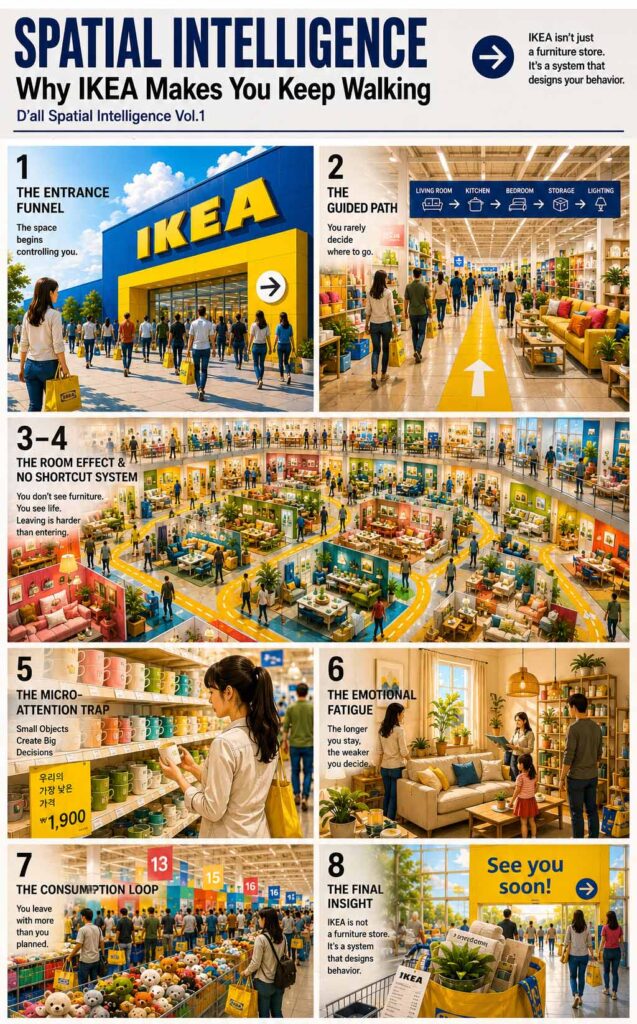
CUT 1 | THE ENTRANCE FUNNEL
People believe they are entering freely.
But spatial control has already begun.
Large-scale architecture, strong visual identity, and directional movement design quietly shape the first behavioral response.
사람들은 자유롭게 들어간다고 느낀다.
하지만 이미 공간은 방향을 제한하기 시작한다.
거대한 입구, 강한 컬러, 명확한 시선 유도.
인간은 공간 흐름 안으로 자연스럽게 흡수된다.
CUT 2 | THE GUIDED PATH
The IKEA experience is designed around continuous movement.
Every room naturally leads to the next.
Visitors believe they are exploring freely, but the store quietly guides behavior through a carefully engineered spatial path.
IKEA의 핵심은 “걷게 만드는 것”이다.
거실, 주방, 침실, 수납.
모든 공간은 하나의 흐름으로 연결된다.
인간은 선택한다고 느끼지만, 실제로는 설계된 동선을 따라 움직인다.
CUT 3-4 | THE ROOM EFFECT & NO SHORTCUT SYSTEM
Humans do not simply see furniture.
They emotionally project themselves into the space.
The rooms feel familiar, comfortable, and emotionally complete.
At the same time, the store minimizes shortcuts and encourages continuous movement.
The longer people stay, the more likely they are to consume.
사람들은 가구를 보는 것이 아니다.
그들은 삶의 장면을 본다.
작은 조명, 따뜻한 소파, 식물, 식탁, 아이 방.
공간은 제품을 판매하지 않는다.
공간은 감정을 시뮬레이션한다.
그리고 동시에 지름길은 사라진다.
계속 이동하게 되고, 계속 체류하게 되며, 계속 소비 흐름 안에 머물게 된다.
CUT 5 | THE MICRO-ATTENTION TRAP
Small objects create low-resistance decisions.
Mugs, containers, candles, and small accessories quietly capture attention.
By this stage, human attention is already fatigued.
That is why impulse purchases become easier.
작은 물건은 작은 결정처럼 보인다.
컵, 조명, 쿠션, 정리함.
하지만 인간의 주의력은 이미 피로해져 있다.
그래서 사람들은 생각보다 쉽게 충동 반응을 보인다.
CUT 6 | THE EMOTIONAL FATIGUE
The longer people remain inside the environment, the weaker rational decision-making becomes.
Warm lighting, comfortable layouts, and emotional stability reduce resistance.
This is environmental psychology through space.
오래 머무를수록 인간의 판단은 느슨해진다.
편안한 조명, 따뜻한 색감, 안정적인 공간.
IKEA는 인간을 긴장시키지 않는다.
오히려 계속 머물고 싶게 만든다.
CUT 7 | THE CONSUMPTION LOOP
The final zone is designed for maximum purchasing behavior.
Visitors often leave with far more than they originally intended.
This is not accidental.
It is behavioral design operating through space.
마지막 구간은 소비가 폭발하는 공간이다.
사람들은 원래 계획보다 더 많은 물건을 담는다.
공간은 단순 판매를 하지 않는다.
공간은 행동 흐름을 설계한다.
CUT 8 | THE FINAL INSIGHT
IKEA is not simply a furniture retailer.
It is a system that designs movement, attention, emotion, and consumption behavior.
Humans do not only experience space.
Space designs humans.
IKEA는 단순 가구 브랜드가 아니다.
그것은 인간 행동을 설계하는 Spatial Intelligence System이다.
우리는 공간을 “본다”고 생각한다.
하지만 실제로는 공간이 인간을 움직인다.
Observation | 무엇이 보이는가
IKEA is designed as a continuous behavioral flow.
Movement never fully stops.
Every visual path encourages the next decision, the next room, and the next interaction.
The environment itself becomes the guide.
IKEA의 구조는 단순하지 않다.
모든 동선은 연결되어 있고, 모든 시야는 다음 공간으로 이어진다.
모든 경험은 “계속 이동”하도록 설계되어 있다.
공간은 멈춤보다 흐름을 선택한다.
그리고 인간은 그 흐름 안에서 행동하게 된다.
Spatial Structure Analysis | 공간 구조 분석
The longer visitors remain inside the environment, the more emotionally connected they become.
This increases attention fatigue, lowers resistance, and increases spontaneous purchasing behavior.
Space becomes an invisible behavioral operating system.
IKEA의 핵심은 “판매”가 아니다.
핵심은 체류시간이다.
더 오래 머물수록 감정 연결은 증가하고, 판단 피로는 커지며, 충동 소비는 쉬워진다.
이것이 Spatial Intelligence의 핵심 구조다.
Cognitive Layer | 인간은 왜 즉시 반응하는가
Behavior begins before conscious analysis.
Humans emotionally react to spatial comfort, movement rhythm, and environmental familiarity.
The brain interprets these signals as safety and continuity.
That is why people stay longer, walk farther, and purchase more.
인간은 이해보다 먼저 반응한다.
편안한 조명, 따뜻한 공간, 연결된 흐름, 반복되는 이동은 인간의 뇌에 안정감을 준다.
“계속 이동해도 된다.”
“이 공간은 안전하다.”
이 신호가 행동 흐름을 만든다.
D’all Insight | 공간은 인간 행동을 설계한다
Space is no longer passive.
Modern environments actively shape behavior, emotion, movement, and consumption patterns.
This is the future of Spatial Intelligence.
우리는 종종 공간을 “배경”이라고 생각한다.
하지만 현대 공간은 단순 배경이 아니다.
공간은 행동을 유도하고, 감정을 조절하며, 인간 흐름을 설계한다.
IKEA는 그 구조를 가장 대중적으로 보여주는 사례 중 하나다.
D’all Spatial Intelligence는 공간을 단순 건축이 아니라, 인간 경험을 설계하는 시스템으로 해석한다.
🎬 Related Experience
Behavioral Design & Retail Psychology
Final Insight
Humans do not simply move through environments.
They emotionally synchronize with them.
That is why great spatial design becomes invisible behavioral control.
And that is why Spatial Intelligence matters.
인간은 공간을 지나가는 것이 아니다.
공간 안에서 생각하고, 느끼고, 반응하고, 행동한다.
그리고 결국 공간은 인간 행동을 설계한다.
One-Line Insight
Space quietly designs human behavior.
공간은 조용히 인간 행동을 설계한다.
#SpatialIntelligence #IKEAStoreDesign #BehavioralDesign #RetailPsychology #ConsumerBehavior #SpatialDesign #EnvironmentalPsychology #HumanCenteredDesign #StoreExperience #Architecture #DesignThinking #VisualIntelligence #RetailExperience #ExperienceDesign #DallSpatialIntelligence
#공간지능 #이케아 #행동디자인 #리테일심리 #소비행동 #공간디자인 #환경심리 #인간중심디자인 #스토어디자인 #공간경험 #디자인사고 #비주얼인텔리전스 #리테일경험 #경험디자인 #디올스페이셜인텔리전스
- D'all Visual Intelligence
- D’all Public Design Intelligence
- D’all Motion Intelligence
- D’all Interaction Intelligence
- D’all Spatial Intelligence
- D’all Advertising Intelligence
- D’all Economy Brief
- D’all Food Intelligence
- D’all Health Insight
- D’all Global Power
- D’all Culture Hybrid
- D’all Knowledge Architecture
- D'all Capital History
- D’all Society Agenda
