

엔화 변동성과 구조 변화 속 자본 이동
시장 구조가 다시 흔들리고 있다.
단순한 환율 변동이 아니라, 자본의 방향 자체가 재설정되고 있다.
엔화의 변동성 확대는 글로벌 자금 흐름의 불균형을 드러내고 있다.
각국 중앙은행은 더 이상 기존의 인플레이션 목표를 그대로 유지하기 어렵다.
노동력 부족이라는 구조적 변화가 정책 프레임 자체를 바꾸고 있다.
기업들은 이미 다음 단계로 이동했다.
클라우드 중심 투자에서 AI 인프라 중심 투자로 빠르게 전환 중이다.
이 세 가지 흐름은 각각 독립적이지 않다.
통화, 정책, 자본은 서로 연결되어 하나의 방향을 만들고 있다.
지금 시장은 “변동성”이 아니라 “구조 변화”의 초기 단계다.
Yen Volatility
The market is not just reacting—it is restructuring.
Yen volatility reflects deeper imbalances in global capital flows.
Central banks are being forced to rethink inflation targets.
Structural labor shortages are changing policy assumptions.
Meanwhile, corporations are already shifting capital allocation.
AI infrastructure is becoming a dominant investment theme.
These forces are not separate—they are interconnected.
Currency, policy, and capital are moving together.
This is not short-term noise, but a long-term shift.
Markets are entering a new structural phase.
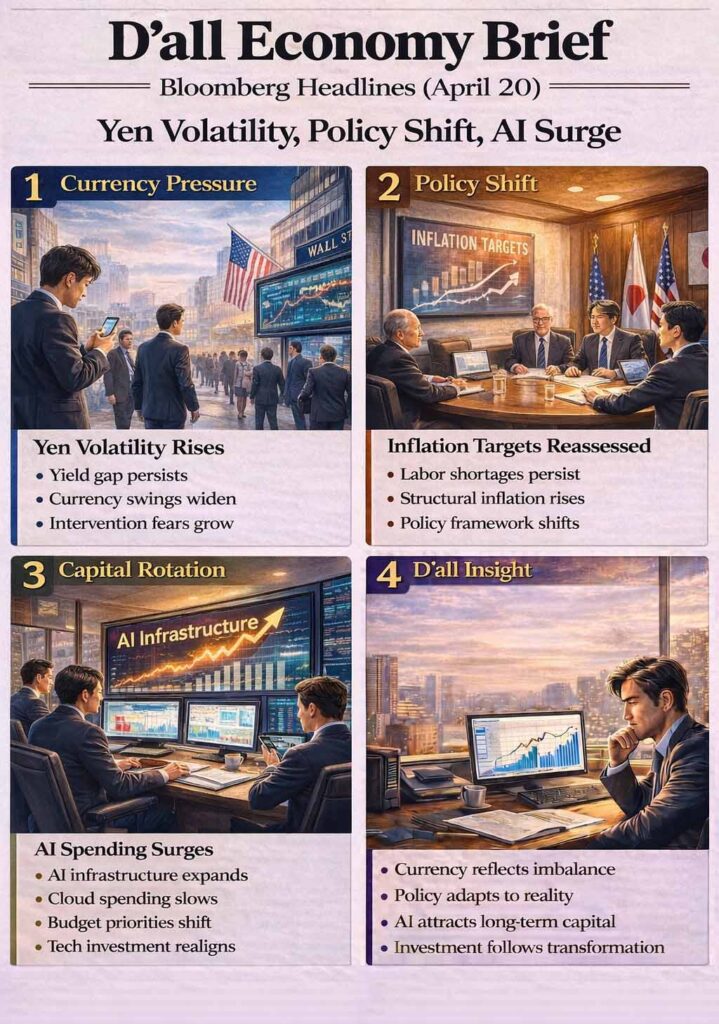
1️⃣ Yen Volatility and Currency Imbalance
Yen volatility is rising as yield differentials between major economies persist.
This widening gap is increasing pressure on currency markets and raising expectations of possible intervention.
The movement is not isolated—it reflects a broader imbalance in global capital allocation.
엔화 변동성은 주요 국가 간 금리 격차가 지속되면서 확대되고 있다.
이 격차는 환율 시장의 압력을 높이고 있으며 개입 가능성까지 거론되고 있다.
이 흐름은 단순한 환율 문제가 아니라 글로벌 자본 배분의 불균형을 보여준다.
- Yield gap persists
- Currency swings widen
- Intervention watch intensifies
- 수익률 격차 지속
- 환율 변동성 확대
- 개입 가능성 증가
2️⃣ Central Bank Policy Shift
Central banks are reassessing inflation targets as structural labor shortages reshape economic dynamics.
Traditional inflation frameworks are becoming less effective in a world where supply constraints persist.
Policy is shifting from short-term control toward long-term structural adaptation.
중앙은행들은 구조적인 노동력 부족 속에서 인플레이션 목표를 재평가하고 있다.
공급 제약이 지속되는 환경에서는 기존의 물가 관리 방식이 점점 효과를 잃고 있다.
정책은 단기 대응에서 구조 변화 대응으로 이동하고 있다.
- Labor shortages persist
- Structural inflation rises
- Policy framework shifts
- 노동력 부족 지속
- 구조적 인플레이션 상승
- 정책 프레임 변화
3️⃣ AI Infrastructure Investment Surge
Corporate budgets are shifting decisively toward AI infrastructure investment.
This marks a turning point where AI spending surpasses traditional cloud investment.
The shift signals that companies are prioritizing long-term computational capacity over short-term efficiency gains.
기업 예산은 빠르게 AI 인프라 중심으로 이동하고 있다.
이는 AI 투자가 기존 클라우드 지출을 넘어서는 전환점이다.
기업들은 단기 효율보다 장기적인 연산 능력 확보를 우선시하고 있다.
- AI infrastructure expands
- Cloud spending slows
- Budget priorities shift
- Tech investment realigns
- AI 인프라 확대
- 클라우드 지출 둔화
- 예산 우선순위 변화
- 기술 투자 재편
4️⃣ D’all Insight: Capital Follows Structure
Markets are not moving randomly—they are following structural change.
Currency volatility reflects imbalance.
Policy shifts reflect adaptation.
Capital flows toward future dominance.
시장은 무작위로 움직이지 않는다.
구조 변화가 방향을 결정한다.
통화는 불균형을 보여주고, 정책은 적응을 나타낸다.
자본은 미래가 있는 곳으로 이동한다.
- Currency reflects imbalance
- Policy adapts to reality
- AI attracts long-term capital
- Investment follows transformation
- 통화는 불균형을 반영
- 정책은 현실에 적응
- AI는 장기 자본을 흡수
- 투자는 구조 변화를 따른다
Mini Insight
Structural signals matter more than short-term data.
단기 데이터보다 구조적 신호가 더 중요하다.
D’all Insight
The current market is undergoing a structural transformation rather than a cyclical fluctuation.
Yen volatility is not just a currency issue—it reflects global capital imbalance driven by yield differentials.
Central banks are facing a new challenge.
Inflation is no longer purely demand-driven; it is shaped by labor shortages and supply constraints.
This forces policymakers to rethink long-standing targets and frameworks.
At the same time, corporations are moving ahead faster than policy.
AI infrastructure investment is accelerating, surpassing cloud spending as a dominant capital allocation priority.
This indicates a shift toward long-term technological positioning rather than short-term efficiency.
These three forces—currency, policy, and capital—are converging.
They are not independent signals but part of a single structural transition.
Capital does not wait for clarity; it anticipates direction.
That is why investment is already moving into AI and away from traditional models.
The market is not simply volatile.
It is redefining how value, growth, and stability are measured.
지금 시장은 단순한 경기 변동이 아니라 구조적 전환을 겪고 있다.
엔화 변동성은 금리 격차로 인한 글로벌 자본 불균형을 반영한다.
중앙은행은 새로운 문제에 직면하고 있다.
인플레이션은 수요가 아니라 노동력 부족과 공급 제약에 의해 결정된다.
이로 인해 정책 목표와 프레임을 다시 설정해야 한다.
동시에 기업은 정책보다 빠르게 움직이고 있다.
AI 인프라 투자는 클라우드 지출을 넘어서는 핵심 투자로 자리 잡고 있다.
이는 단기 효율이 아니라 장기 경쟁력을 의미한다.
이 세 가지 흐름은 하나로 연결된다.
통화, 정책, 자본은 동일한 방향으로 움직인다.
자본은 기다리지 않는다.
방향을 예측하고 먼저 이동한다.
지금 시장은 단순한 변동성이 아니라
가치 기준 자체를 다시 정의하는 단계다.
One-line Insight
Capital always moves ahead of policy.
자본은 항상 정책보다 먼저 움직인다.
#YenVolatility #CentralBankPolicy #AIInfrastructure #GlobalMarkets #InvestmentShift #CurrencyMarket #InflationTarget #TechInvestment #MarketStructure #CapitalFlow #Bloomberg #EconomicShift #FinanceInsights #GlobalEconomy #DallEconomyBrief
#엔화변동성 #중앙은행정책 #AI인프라 #글로벌시장 #투자전환 #환율시장 #인플레이션목표 #기술투자 #시장구조 #자본흐름 #블룸버그 #경제변화 #금융인사이트 #세계경제 #디올이코노미브리프
Source
Bloomberg, April 20, 2026
Based on Bloomberg coverage of currency markets, central bank policy discussions, and AI infrastructure investment trends. Content has been paraphrased and restructured for D’all visual analysis.
- D'all Visual Intelligence
- D’all Public Design Intelligence
- D’all Motion Intelligence
- D’all Interaction Intelligence
- D’all Spatial Intelligence
- D’all Advertising Intelligence
- D’all Economy Brief
- D’all Food Intelligence
- D’all Health Insight
- D’all Global Power
- D’all Culture Hybrid
- D’all Knowledge Architecture
- D'all Capital History
- D’all Society Agenda
