

Global Markets Edge Lower | 경제적 역풍 속 시장의 신중한 출발
Global Markets는 경제적 역풍이 커지는 가운데 방향성을 조심스럽게 탐색하고 있다.
글로벌 증시는 강한 상승 모멘텀보다 경기와 정책에 대한 불확실성에 더 민감하게 반응하고 있다.
투자자들은 단순한 지수 움직임보다 앞으로의 성장 경로와 기업 비용 구조를 함께 살펴보고 있다.
특히 경제적 부담이 커질수록 자본은 성장 가능성만이 아니라 실행 가능성을 요구하게 된다.
한편 미국과 북한 사이의 정상회담 가능성은 금융시장에 새로운 지정학적 변수를 추가한다.
외교적 움직임은 당장의 가격보다 향후 위험 인식과 정책 기대에 영향을 줄 수 있다.
기업 측면에서는 AI 인프라 투자가 계속 확대되는 가운데 비용 증가에 대한 검증도 강화되고 있다.
데이터센터, 전력, 컴퓨팅 인프라에 대한 투자는 AI 경쟁력을 위한 기반이지만 동시에 자본 부담을 높인다.
결국 오늘의 세 가지 헤드라인은 서로 다른 분야처럼 보이지만 하나의 질문으로 연결된다.
얼마나 많은 자본을 어디에 배분하고, 그 자본을 얼마나 지속 가능한 가치로 전환할 수 있는가.
D’all Perspective는 시장, 지정학, 기술 투자를 각각의 뉴스가 아니라 자본 배분 구조의 변화로 바라본다.
Global Markets Edge Lower: Economic Headwinds Reshape Investor Decisions
Global markets are edging lower as investors weigh a more complicated economic environment.
The movement is not simply a story of falling prices.
It reflects a broader reassessment of growth expectations, policy uncertainty and corporate resilience.
When economic headwinds become more visible, investors tend to become more selective about where capital is committed.
Strong companies can still attract capital, but the standard for confidence becomes higher.
Instead of asking only whether markets can rise, investors increasingly ask what can sustain the rise.
That distinction matters because short-term sentiment and long-term value are not always aligned.
The current environment therefore rewards discipline rather than indiscriminate optimism.
D’all Economy Brief interprets this movement as a transition from broad market enthusiasm toward more selective capital allocation.
Related Video | 관련영상
Trump on North Korea’s Kim Jong Un: “I Think He Misses Me” | WSJ News
Trump’s comments on Kim Jong Un provide useful context for the renewed attention on US–North Korea diplomacy.
The video shows how Trump has previously framed his relationship with the North Korean leader.
It helps connect today’s diplomatic headline with the broader geopolitical context.
This perspective is particularly relevant when considering how diplomacy can reshape perceived market risk.
트럼프의 김정은 위원장 관련 발언은 다시 주목받고 있는 미·북 외교의 배경을 이해하는 데 도움이 된다.
영상은 트럼프가 과거 김정은과의 관계를 어떻게 설명해왔는지를 보여준다.
오늘의 정상회담 추진 소식을 기존의 외교적 맥락과 연결해 볼 수 있는 자료다.
특히 외교적 움직임이 시장의 지정학적 위험 인식에 어떤 영향을 줄 수 있는지 살펴보는 데 의미가 있다.
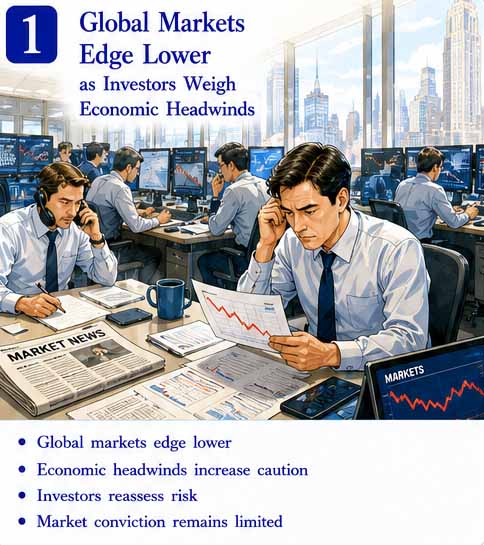
Global Markets Edge Lower | 경제적 역풍이 투자 판단을 바꾸는 방식
Global markets are becoming more selective as investors weigh economic headwinds against the possibility of continued corporate resilience.
A softer market does not automatically mean that investors have abandoned risk.
Instead, capital may be moving toward companies, sectors and assets with stronger visibility.
The key variable is confidence in future earnings and the ability of businesses to absorb higher costs.
Economic uncertainty therefore changes the quality of market participation rather than simply reducing it.
• Global markets edge lower
• Economic headwinds increase caution
• Investors reassess risk
• Capital becomes more selective
글로벌 시장은 경제적 역풍을 고려하면서 보다 신중한 투자 판단으로 이동하고 있다.
시장 하락 자체보다 중요한 것은 투자자들이 어떤 위험을 다시 평가하고 있는가이다.
경기와 정책의 불확실성이 높아질수록 자본은 모든 성장 기회에 동일하게 반응하지 않는다.
실적의 가시성과 비용을 감당할 수 있는 구조, 지속 가능한 경쟁력이 더욱 중요해진다.
• 글로벌 시장 소폭 하락
• 경제적 역풍에 대한 경계 확대
• 투자자 위험 재평가
• 선택적 자본 배분 강화

Trump Pushes for a Kim Jong-un Meeting | 외교적 움직임이 만드는 새로운 지정학적 변수
Trump’s push for a meeting with Kim Jong-un introduces a different type of uncertainty into the economic environment.
Diplomatic developments do not always produce an immediate market reaction, but they can reshape perceptions of geopolitical risk.
A potential meeting would place the Korean Peninsula back into the broader conversation about US foreign policy and strategic stability.
For markets, the important question is not simply whether a meeting happens.
It is whether diplomatic engagement changes expectations about regional risk and future policy decisions.
• Trump pushes for a meeting
• US-North Korea diplomacy regains attention
• Geopolitical risk becomes more visible
• Policy expectations remain uncertain
트럼프의 김정은 위원장과의 회동 추진은 시장에 새로운 지정학적 변수를 추가한다.
외교 뉴스는 경제지표처럼 즉각적인 가격 변화를 만들지 않을 수 있지만 위험에 대한 인식 자체를 바꿀 수 있다.
특히 한반도 문제는 미국의 외교 전략과 동북아시아의 전략적 안정성이라는 더 큰 구조와 연결된다.
따라서 중요한 것은 회동 자체보다 외교적 움직임이 향후 위험 인식과 정책 기대에 어떤 변화를 만드는가이다.
• 트럼프의 정상회담 추진
• 미·북 외교 관심 재부상
• 지정학적 위험 가시화
• 정책 기대의 불확실성 지속

Big Tech and AI Infrastructure Costs | AI 투자의 규모보다 비용 효율성이 중요해지는 순간
Big Tech companies continue to invest heavily in AI infrastructure, but rising costs are changing the investment conversation.
Large-scale AI systems require computing capacity, data centers, electricity, cooling systems and supporting networks.
As these investments expand, investors increasingly need evidence that infrastructure spending can generate durable economic returns.
The issue is therefore moving from technological ambition toward capital efficiency.
Companies may continue spending aggressively, but the quality of that spending will become more important.
AI leadership will increasingly depend on the ability to convert infrastructure investment into productivity, revenue and competitive advantage.
• AI infrastructure costs continue to rise
• Big Tech spending remains substantial
• Capital efficiency faces greater scrutiny
• Returns must justify investment scale
빅테크 기업들은 AI 경쟁력을 확보하기 위해 인프라 투자를 확대하고 있지만 비용에 대한 검증 역시 강화되고 있다.
AI 인프라는 GPU와 데이터센터뿐 아니라 전력과 냉각, 네트워크 등 다양한 비용 구조를 포함한다.
투자 규모가 커질수록 시장은 얼마나 많은 돈을 쓰는지보다 그 돈이 어떤 성과로 연결되는지를 보게 된다.
결국 AI 경쟁의 다음 단계에서는 기술 규모뿐 아니라 자본 효율성과 실제 사업 성과가 중요한 기준이 된다.
• AI 인프라 비용 상승
• 빅테크 투자 규모 확대
• 자본 효율성 검증 강화
• 투자 규모에 상응하는 수익성 요구

D’all Perspective | Risk, Geopolitics and AI Costs | 시장·지정학·AI 비용이 만나는 지점
The three headlines appear unrelated at first.
One concerns global markets, another concerns diplomacy, and the third concerns technology investment.
Yet all three are connected by the movement of capital under uncertainty.
Economic headwinds can make investors more selective.
Geopolitical developments can change the risk premium attached to markets and regions.
AI infrastructure spending can redirect enormous amounts of capital toward technology, energy and data-center ecosystems.
The common factor is therefore not the headline itself but the quality of capital allocation behind it.
Markets can tolerate uncertainty when investors believe capital is being deployed efficiently.
Companies can justify large investments when future productivity and revenue growth provide credible support.
Governments can influence market expectations when diplomatic actions reduce or increase perceived geopolitical risk.
D’all Perspective therefore sees August 20 not as three separate news events, but as a single question about discipline under uncertainty.
세 가지 헤드라인은 처음에는 서로 다른 영역의 이야기처럼 보인다.
하나는 글로벌 시장이고, 하나는 외교이며, 다른 하나는 기술 투자다.
그러나 세 흐름은 모두 불확실성 속에서 자본이 어떻게 움직이는가라는 문제로 연결된다.
경제적 역풍은 투자자의 선택 기준을 더욱 엄격하게 만든다.
지정학적 움직임은 국가와 시장에 부여되는 위험 프리미엄을 바꿀 수 있다.
AI 인프라 투자는 기술뿐 아니라 전력, 데이터센터, 네트워크 등 다양한 산업으로 거대한 자본을 이동시킨다.
따라서 중요한 것은 각각의 뉴스가 아니라 그 뉴스 뒤에서 이루어지는 자본 배분의 질이다.
시장은 불확실성을 감당할 수 있지만 자본이 효율적으로 사용되고 있다는 신뢰가 필요하다.
기업 역시 대규모 AI 투자를 정당화하려면 생산성과 매출 성장으로 연결되는 구체적인 근거를 보여줘야 한다.
정부의 외교적 움직임 역시 지정학적 위험을 낮추거나 높이면서 시장의 기대를 변화시킬 수 있다.
D’all Perspective에서 이번 흐름은 결국 불확실성 속에서 얼마나 disciplined하게 자본을 배분하는가에 대한 이야기다.
Mini Insight
Economic uncertainty is making markets more selective, while geopolitics and AI infrastructure spending create new demands on capital discipline.
경제적 불확실성이 커질수록 시장은 선택적으로 움직이고 있으며, 지정학과 AI 인프라 투자는 자본의 규율을 더욱 중요하게 만들고 있다.
D’all Insight
Global markets are entering a phase where direction alone is no longer enough to explain investor behavior.
Economic headwinds are increasing the value of visibility, resilience and disciplined capital allocation.
The potential Trump-Kim meeting adds another layer because geopolitical developments can alter risk perception without immediately changing economic data.
At the same time, Big Tech’s continued AI investment is creating a different kind of market test.
Technology companies have demonstrated that they can mobilize enormous amounts of capital toward AI infrastructure.
The next question is whether that capital can generate proportional productivity and economic returns.
This distinction is becoming increasingly important as infrastructure costs rise.
A larger investment base creates greater opportunity, but it also raises the level of performance required to justify the investment.
The same principle applies to financial markets.
When economic conditions become less predictable, investors do not necessarily abandon growth.
They become more selective about which growth deserves capital.
That creates a market where execution, efficiency and adaptability become competitive advantages.
D’all sees this as a transition from a scale-driven environment toward a discipline-driven environment.
The winners of the next cycle may not simply be the companies with the largest technology budgets.
They may be the organizations that can translate capital into measurable productivity while managing risk across changing economic and geopolitical conditions.
글로벌 시장은 이제 단순히 상승과 하락의 방향만으로 투자자의 행동을 설명하기 어려운 국면에 들어서고 있다.
경제적 역풍은 가시성, 회복력, 자본 배분의 규율에 더 높은 가치를 부여한다.
트럼프와 김정은의 회동 추진 역시 경제지표를 직접 바꾸지 않더라도 지정학적 위험에 대한 시장의 인식을 변화시킬 수 있다.
동시에 빅테크의 AI 투자는 또 다른 형태의 검증을 만들고 있다.
기술 기업들은 AI 인프라를 위해 막대한 자본을 동원할 수 있다는 사실을 이미 보여주었다.
이제 시장이 확인하려는 것은 그 자본이 실제 생산성과 경제적 수익으로 얼마나 전환되는가이다.
인프라 비용이 증가할수록 이 문제의 중요성은 더욱 커진다.
투자 규모가 커질수록 그 투자를 정당화하기 위해 필요한 성과의 수준도 높아진다.
이는 금융시장에도 동일하게 적용된다.
경제 환경이 예측하기 어려워질수록 투자자는 성장 자체를 포기하는 것이 아니라 성장의 질을 더욱 엄격하게 구분한다.
결국 다음 사이클에서는 실행력, 효율성, 적응력이 새로운 경쟁력이 될 가능성이 높다.
D’all은 이러한 변화를 규모 중심의 경쟁에서 규율 중심의 경쟁으로 이동하는 과정으로 본다.
다음 시장의 승자는 단순히 가장 많은 기술 투자를 하는 기업이 아닐 수 있다.
자본을 실제 생산성으로 전환하면서 경제적·지정학적 변화까지 관리할 수 있는 기업이 더 강한 위치를 차지할 가능성이 높다.
One-line Insight
“Uncertainty does not stop capital; it makes capital more selective.”
“불확실성은 자본의 이동을 멈추게 하는 것이 아니라, 자본을 더욱 선택적으로 만든다.”
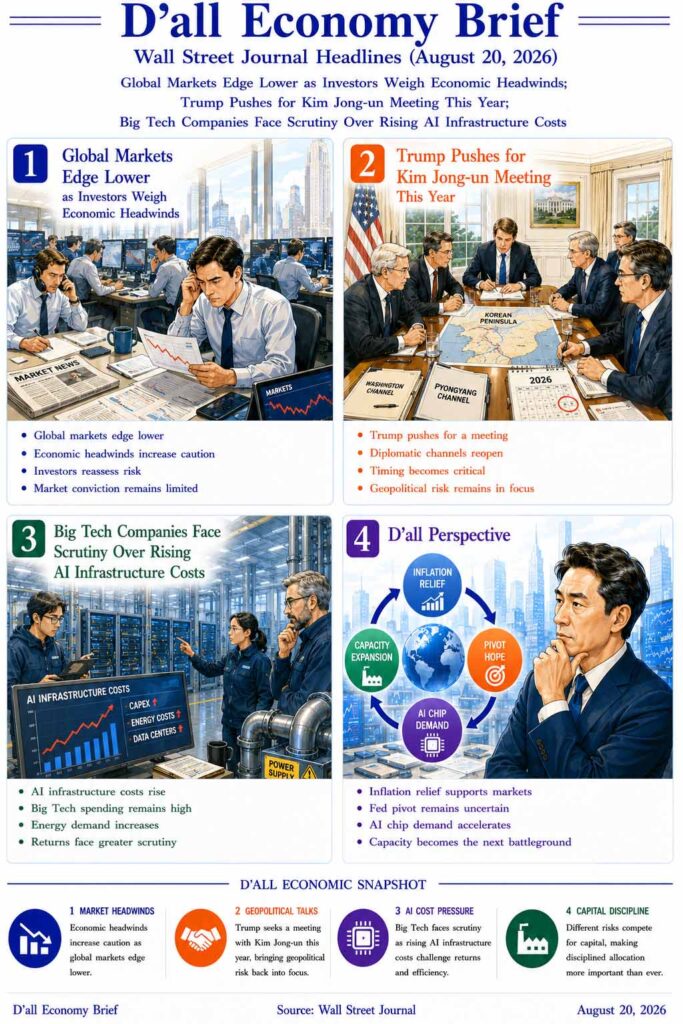
D’ALL ECONOMIC SNAPSHOT
1. MARKET HEADWINDS
Global markets edge lower as economic uncertainty encourages investors to reassess risk and growth expectations.
경제적 불확실성이 커지면서 투자자들이 위험과 성장 기대를 재평가하고 글로벌 시장은 소폭 하락.
2. GEOPOLITICAL TALKS
Trump’s push for a Kim Jong-un meeting brings US-North Korea diplomacy back into the geopolitical spotlight.
트럼프의 김정은 회동 추진으로 미·북 외교가 다시 지정학적 관심의 중심으로 부상.
3. AI COST PRESSURE
Big Tech faces rising scrutiny as expanding AI infrastructure investment increases pressure on capital efficiency and returns.
AI 인프라 투자 확대와 함께 빅테크의 자본 효율성과 투자수익성에 대한 검증 강화.
4. CAPITAL DISCIPLINE
Different risks are competing for capital, making disciplined allocation and execution increasingly important.
서로 다른 위험 요인이 자본을 놓고 경쟁하면서 규율 있는 자본 배분과 실행력이 더욱 중요해지는 국면.
#GlobalMarkets #EconomicHeadwinds #StockMarket #MarketOutlook #InvestorConfidence #CapitalAllocation #GeopoliticalRisk #TrumpKim #NorthKorea #AIInfrastructure #BigTech #AICapitalExpenditure #TechnologyInvestment #MarketAnalysis #DallEconomyBrief
#글로벌시장 #경제적역풍 #주식시장 #시장전망 #투자자신뢰 #자본배분 #지정학적위험 #트럼프김정은 #북한 #AI인프라 #빅테크 #AI투자 #기술투자 #시장분석 #디올이코노미브리프
Source
Wall Street Journal (August 20, 2026)
This article is an editorial interpretation based on publicly available reporting from The Wall Street Journal. It examines the structural implications of global market weakness, renewed US-North Korea diplomatic attention, and rising AI infrastructure costs through the Visual Intelligence perspective of D’all Economy Brief.
이 글은 Wall Street Journal의 공개 보도를 바탕으로 D’all이 재구성한 편집적 해석이다. 글로벌 시장의 경제적 역풍, 트럼프와 김정은의 회동 추진으로 다시 주목받는 미·북 외교, 그리고 상승하는 AI 인프라 비용이 시장의 위험 인식과 자본 배분에 미치는 구조적 의미를 D’all Economy Brief의 Visual Intelligence 관점에서 분석한다.
This content does not reproduce or substitute for the original reporting. It is an independent editorial analysis designed to connect separate economic, geopolitical and corporate developments through a visual and structural framework.
이 콘텐츠는 원문 기사를 복제하거나 대체하기 위한 것이 아니라, 서로 다른 경제·지정학·기업 이슈를 하나의 구조적 관점에서 연결해 해석한 독립적인 편집 콘텐츠다.
- D'all Visual Intelligence
- D’all Public Design Intelligence
- D’all Motion Intelligence
- D’all Interaction Intelligence
- D’all Spatial Intelligence
- D’all Advertising Intelligence
- D’all Economy Brief
- D’all Food Intelligence
- D’all Health Insight
- D’all Global Power
- D’all Culture Hybrid
- D’all Knowledge Architecture
- D'all Capital History
- D’all Society Agenda
