

US Stock Futures | 잭슨홀을 앞둔 시장의 신중한 출발
US stock futures는 잭슨홀 경제정책 심포지엄을 앞두고 방향성을 쉽게 결정하지 못하고 있다.
미국 증시는 상승 기대와 정책 불확실성이 동시에 작용하면서 신중한 흐름을 보이고 있다.
이번 시장의 핵심은 단순한 주가 움직임보다 향후 금리 경로에 대한 기대 변화다.
글로벌 중앙은행 관계자들이 잭슨홀에 모이면서 통화정책의 방향에 대한 관심도 커지고 있다.
특히 금리 인하가 언제, 어느 속도로 진행될 수 있는지가 투자자들의 포지셔닝에 영향을 줄 수 있다.
동시에 빅테크 기업들은 AI 경쟁을 위해 대규모 인프라 투자를 계속 확대하고 있다.
하지만 데이터센터와 컴퓨팅 인프라에 필요한 자본과 에너지 비용이 커지면서 투자 효율성에 대한 검증도 강화되고 있다.
따라서 이번 시장은 금리와 AI라는 서로 다른 이슈가 실제로는 자본비용이라는 하나의 축에서 연결되고 있음을 보여준다.
정책이 자본의 가격을 결정한다면 기업의 투자는 그 자본이 실제 성장과 생산성으로 이어질 수 있는지를 보여준다.
시장은 이제 기대만으로 움직이기보다 정책 신호와 기업의 실행력을 함께 확인하려는 단계로 이동하고 있다.
D’all Perspective에서는 이번 흐름을 시장 기대 → 통화정책 → AI 자본 → 실행력이 연결되는 구조적 변화로 바라본다.
잭슨홀의 정책 신호는 금리 기대를 움직이고, 이는 시장과 기업의 자본 배분에 영향을 준다.
동시에 AI 투자는 자본이 실제 성과로 전환될 수 있는지를 시험한다.
결국 시장의 다음 방향은 기대보다 실행력에서 결정될 가능성이 높다.
US Stock Futures | The Jackson Hole Test
US stock futures are wavering ahead of the Jackson Hole Economic Symposium as investors reassess the policy outlook.
The market is not reacting to a single economic number but attempting to anticipate the next monetary-policy environment.
For equities, the direction of interest rates influences valuation, financing conditions and investor risk appetite.
At the same time, Big Tech companies continue to expand AI infrastructure despite rising capital and operating costs.
That creates another layer of uncertainty because investors increasingly want evidence that large AI investments can produce sustainable returns.
The market is therefore balancing two expectations at once: the possibility of easier monetary conditions and the need for stronger corporate execution.
Jackson Hole represents the policy side of that equation, while AI infrastructure spending represents the corporate capital side.
The interaction between the two may become increasingly important as investors evaluate the durability of the current market cycle.
From the D’all Perspective, this market is a connected shift from market expectations → monetary policy → AI capital → execution.
Jackson Hole can reshape rate expectations, while those expectations influence capital allocation.
AI investment then tests whether that capital can become measurable economic value.
Ultimately, the next market direction may depend more on execution than expectation.
Related Video | 관련영상
Fed Chair Jerome Powell’s speech from the Jackson Hole Economic Policy Symposium
Jackson Hole has become a key event for understanding how Federal Reserve communication can reshape rate expectations and market sentiment.
Powell’s speech provides useful context for why investors closely watch policy language before making decisions on rates and risk.
The video connects directly with this post’s focus on monetary policy, market expectations and capital allocation.
It also helps explain why Jackson Hole can become an important signal for the next stage of the market cycle.
잭슨홀 심포지엄은 연준의 정책 메시지가 금리 기대와 시장 심리에 어떤 영향을 미치는지 이해할 수 있는 중요한 이벤트다.
파월 의장의 연설을 통해 투자자들이 왜 금리와 위험자산의 방향을 결정하기 전에 정책 언어를 주목하는지 살펴볼 수 있다.
이번 포스트의 핵심인 통화정책, 시장 기대, 자본 배분의 연결 구조와도 직접적으로 이어진다.
특히 잭슨홀이 다음 시장 사이클의 중요한 정책 신호가 될 수 있다는 점을 이해하는 데 유용한 영상이다.
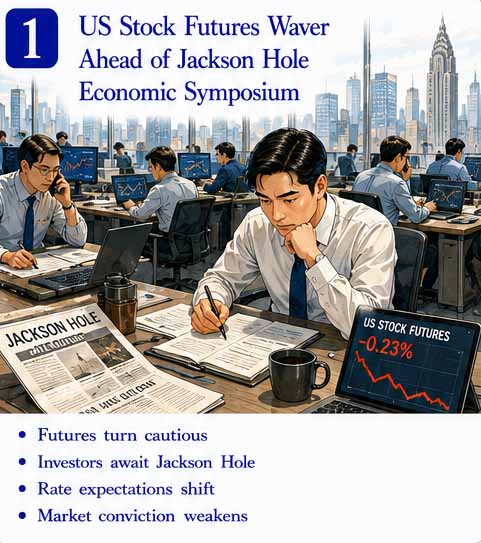
Jackson Hole Economic Symposium | 잭슨홀을 앞두고 흔들리는 미국 주식 선물
US stock futures are showing caution as investors wait for policy signals from Jackson Hole.
The market is attempting to anticipate how central-bank communication could affect the future cost of capital.
A more supportive policy message could strengthen risk appetite, while a cautious inflation assessment could keep investors defensive.
• Futures remain unsettled
• Investors await policy signals
• Rate expectations shape positioning
• Market conviction remains cautious
미국 주식 선물은 잭슨홀에서 나올 정책 신호를 기다리며 신중한 움직임을 보이고 있다.
시장은 중앙은행의 메시지가 향후 자본비용과 위험자산 선호에 어떤 영향을 줄지 미리 반영하려 하고 있다.
금리 인하에 우호적인 신호가 나온다면 투자심리가 개선될 수 있지만, 인플레이션에 대한 신중한 판단이 강조된다면 시장의 기대는 다시 조정될 수 있다.
• 주식 선물 방향성 불안정
• 정책 신호에 관심 집중
• 금리 기대가 포지셔닝에 영향
• 시장 확신은 아직 제한적

Central Bank Rate Cuts | 금리 인하 경로가 시장의 다음 변수
Global central bankers are gathering around Jackson Hole as investors seek greater clarity on the path for interest-rate cuts.
The central challenge is balancing resilient economic activity against inflation risks that may not disappear evenly across the global economy.
A stronger economy can reduce the urgency for immediate easing, while softer price pressures can create room for more flexible policy.
This makes central-bank communication especially important because financial markets often respond to expectations before formal decisions arrive.
• Central banks reassess growth
• Inflation remains a key constraint
• Rate-cut expectations shift
• Policy communication gains importance
글로벌 중앙은행들은 성장의 회복력과 물가 압력 사이에서 새로운 균형점을 찾고 있다.
경제가 견조하게 유지된다면 즉각적인 금리 인하의 필요성은 낮아질 수 있지만, 물가 압력이 완화된다면 정책 운신의 폭은 넓어질 수 있다.
따라서 실제 금리 결정뿐 아니라 중앙은행 관계자들의 표현과 전망이 시장의 중요한 정보가 된다.
투자자들은 정책이 실제로 바뀌기 전에 정책 언어의 변화부터 자산 가격에 반영하기 때문이다.
• 성장 전망 재평가
• 인플레이션이 주요 제약요인
• 금리 인하 기대 변화
• 정책 커뮤니케이션 중요성 확대

Big Tech AI Spending | 비용이 커질수록 AI 투자의 검증도 강해진다
Big Tech companies continue to increase AI infrastructure spending even as the cost of building and operating large-scale computing capacity rises.
Data centers, advanced computing systems and supporting energy infrastructure require substantial capital.
As investment expands, the key question is shifting from technological ambition to economic efficiency.
Investors increasingly need to see how infrastructure spending can translate into revenue growth, productivity and durable competitive advantages.
• AI spending continues to expand
• Infrastructure costs mount
• Capital efficiency faces scrutiny
• Returns must justify investment
빅테크의 AI 투자는 이제 단순한 기술 경쟁을 넘어 자본 효율성의 문제로 이동하고 있다.
데이터센터와 고성능 컴퓨팅 시스템, 전력 및 관련 인프라에 필요한 비용이 커질수록 투자 규모보다 투자 이후의 결과가 중요해진다.
AI 경쟁에서 앞선 기업이라도 대규모 자본지출이 실제 매출과 생산성, 지속적인 경쟁우위로 연결되지 않는다면 시장의 평가를 유지하기 어려울 수 있다.
• AI 지출 지속 확대
• 인프라 비용 증가
• 자본 효율성 검증 강화
• 투자 대비 수익성 중요
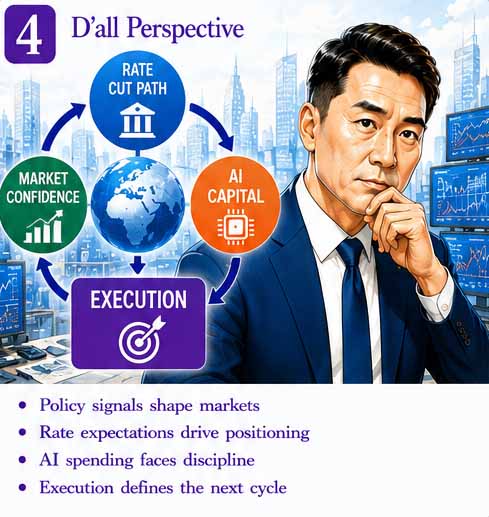
D’all Perspective | 디올 관점
The market is moving from expectation toward execution.
Jackson Hole shapes the policy signal, rate expectations shape market positioning, and AI investment tests whether capital can create measurable value.
These forces are increasingly connected rather than independent.
A change in rate expectations can alter financing conditions, while financing conditions can influence how aggressively companies invest.
At the same time, the success of AI investment depends on whether infrastructure can eventually produce economic returns.
This creates a broader cycle connecting policy, markets and corporate capital.
• Policy signals shape markets
• Rate expectations influence capital
• AI spending tests efficiency
• Execution determines durability
시장은 이제 기대에서 실행력의 단계로 이동하고 있다.
잭슨홀은 정책 신호를 만들고, 금리 기대는 시장의 포지셔닝을 바꾸며, AI 투자는 자본이 실제 가치로 전환될 수 있는지를 시험한다.
이 세 가지 힘은 서로 독립적인 요소가 아니라 점점 더 긴밀하게 연결되고 있다.
금리 기대의 변화는 자금조달 환경을 바꾸고, 변화된 자금조달 환경은 기업의 투자 속도와 규모에 영향을 줄 수 있다.
동시에 AI 투자의 성공 여부는 대규모 인프라가 실제 경제적 수익으로 전환되는지에 달려 있다.
결국 다음 시장 사이클의 경쟁력은 기대를 얼마나 크게 만드는가보다 그 기대를 얼마나 구체적인 성과로 전환하는가에 의해 결정될 가능성이 높다.
• 정책 신호가 시장을 움직임
• 금리 기대가 자본 배분에 영향
• AI 지출이 효율성을 시험
• 실행력이 지속성을 결정
Mini Insight
Rate-cut expectations can support markets, but rising AI infrastructure costs are forcing investors to demand stronger evidence of execution and sustainable returns.
금리 인하 기대는 시장을 지지할 수 있지만, 높아지는 AI 인프라 비용은 투자자들에게 더 강한 실행력과 지속 가능한 수익성의 증거를 요구하고 있다.
D’all Insight
The August 21 market is positioned between policy expectations and corporate execution.
Jackson Hole represents the policy side of this equation.
Central-bank communication can influence the expected cost of capital and change how investors value future earnings.
But monetary policy is only one part of the broader market structure.
Big Tech is simultaneously committing enormous amounts of capital to AI infrastructure.
The larger the investment becomes, the stronger the demand for measurable returns becomes as well.
This creates a structural tension between growth ambition and capital discipline.
Lower rates can make investment easier, but they do not automatically make every investment productive.
Companies still need to convert infrastructure spending into revenue, productivity and competitive advantage.
For investors, this means that the definition of growth is becoming more demanding.
Growth supported by efficient capital allocation may receive stronger recognition than growth driven primarily by higher spending.
The same principle applies to financial markets.
A supportive policy environment can improve sentiment, but sustained leadership requires evidence that expectations are becoming actual performance.
D’all therefore reads the current environment as a transition from expectation-driven valuation toward execution-driven valuation.
The next leaders may not simply be companies attracting the most capital, but companies demonstrating the clearest path from capital deployment to measurable value.
8월 21일 시장은 정책 기대와 기업 실행력 사이에 놓여 있다.
잭슨홀은 이 구조에서 정책 측면을 대표한다.
중앙은행의 커뮤니케이션은 자본비용에 대한 기대를 변화시키고 미래 이익에 대한 시장의 평가 방식에도 영향을 줄 수 있다.
그러나 통화정책만으로 시장의 방향이 결정되는 것은 아니다.
동시에 빅테크 기업들은 AI 인프라에 막대한 자본을 투입하고 있다.
투자 규모가 커질수록 그 자본이 실제 성과로 이어지는지를 확인하려는 시장의 요구도 강해진다.
여기에는 성장에 대한 야망과 자본 규율 사이의 구조적 긴장이 존재한다.
금리가 낮아지면 투자가 쉬워질 수 있지만, 낮은 자금조달 비용이 모든 투자의 생산성을 보장하지는 않는다.
기업은 인프라 투자를 실제 매출과 생산성, 경쟁우위로 전환해야 한다.
따라서 투자자들이 바라보는 성장의 기준도 점점 더 엄격해지고 있다.
단순히 지출을 늘리는 성장보다 효율적인 자본 배분을 통해 만들어지는 성장이 더 높은 평가를 받을 가능성이 커지고 있다.
시장 역시 같은 원리로 움직인다.
우호적인 정책 환경은 투자심리를 개선할 수 있지만, 지속적인 시장 리더십에는 기대가 실제 성과로 전환되고 있다는 증거가 필요하다.
D’all은 현재의 시장 환경을 기대 중심의 가치평가에서 실행 중심의 가치평가로 이동하는 과정으로 바라본다.
앞으로의 시장을 이끌 주체는 단순히 가장 많은 자본을 끌어들이는 기업이 아니라, 자본 투입을 측정 가능한 가치로 전환하는 경로를 가장 명확하게 보여주는 기업일 가능성이 높다.
One-line Insight
Policy expectations can move markets, but execution determines whether capital becomes lasting value.
정책 기대는 시장을 움직일 수 있지만, 실행력은 자본이 지속 가능한 가치가 될 수 있는지를 결정한다.
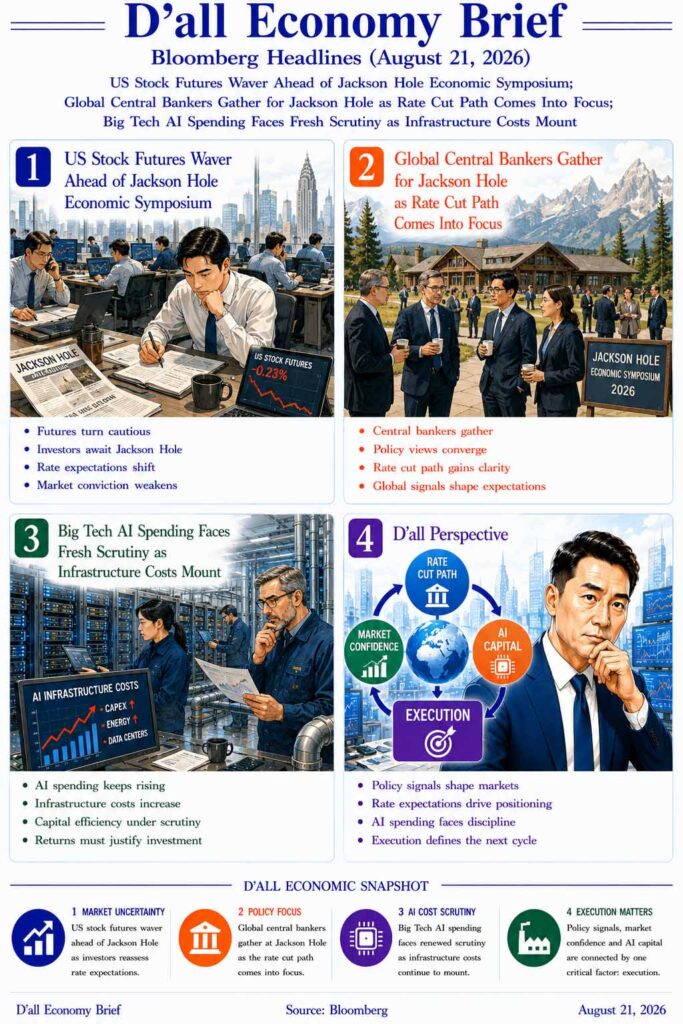
D’ALL ECONOMIC SNAPSHOT
1. MARKET UNCERTAINTY
US stock futures waver as investors reassess rate expectations ahead of Jackson Hole.
잭슨홀을 앞두고 금리 기대가 재조정되면서 미국 주식 선물의 방향성이 흔들리고 있다.
2. POLICY FOCUS
Global central bankers gather as investors look for clearer signals on the future rate-cut path.
글로벌 중앙은행 관계자들이 모이는 가운데 투자자들은 향후 금리 인하 경로에 대한 명확한 신호를 기다리고 있다.
3. AI COST SCRUTINY
Big Tech AI spending faces greater scrutiny as infrastructure and capital costs continue to rise.
인프라와 자본 비용이 높아지면서 빅테크의 AI 지출에 대한 검증이 더욱 강화되고 있다.
4. EXECUTION DISCIPLINE
Market confidence increasingly depends on turning policy expectations and corporate capital into measurable performance.
시장 신뢰는 정책 기대와 기업의 자본 투입을 실제 성과로 전환하는 실행력에 점점 더 좌우되고 있다.
#USStockFutures #JacksonHole #JacksonHoleSymposium #FederalReserve #CentralBanks #RateCuts #MonetaryPolicy #StockMarket #GlobalMarkets #BigTech #AISpending #AIInfrastructure #CapitalEfficiency #MarketOutlook #DallEconomyBrief
#미국주식선물 #잭슨홀 #잭슨홀심포지엄 #연준 #중앙은행 #금리인하 #통화정책 #주식시장 #글로벌시장 #빅테크 #AI투자 #AI인프라 #자본효율성 #시장전망 #디올이코노미브리프
Source
Bloomberg (August 21, 2026)
This article is an editorial interpretation based on publicly available reporting from Bloomberg. It examines the structural implications of wavering US stock futures ahead of the Jackson Hole Economic Symposium, changing expectations for the rate-cut path, and increasing scrutiny of Big Tech AI infrastructure spending through the Visual Intelligence perspective of D’all Economy Brief.
이 글은 Bloomberg의 공개 보도를 바탕으로 D’all이 재구성한 편집적 해석이다. 잭슨홀 경제정책 심포지엄을 앞둔 미국 주식 선물의 변동과 글로벌 중앙은행의 금리 인하 경로, 그리고 높아지는 빅테크 AI 인프라 비용이 시장 신뢰와 자본 배분에 미치는 구조적 의미를 D’all Economy Brief의 Visual Intelligence 관점에서 분석한다.
- D'all Visual Intelligence
- D’all Public Design Intelligence
- D’all Motion Intelligence
- D’all Interaction Intelligence
- D’all Spatial Intelligence
- D’all Advertising Intelligence
- D’all Economy Brief
- D’all Food Intelligence
- D’all Health Insight
- D’all Global Power
- D’all Culture Hybrid
- D’all Knowledge Architecture
- D'all Capital History
- D’all Society Agenda
