

Global Equity Markets | 주요 인플레이션 데이터를 앞둔 글로벌 증시의 신중한 출발
Global Equity Markets는 이번 주 핵심 인플레이션 데이터를 앞두고 신중한 흐름으로 출발하고 있다.
시장 참여자들은 새로운 물가 지표가 향후 통화정책과 위험자산의 방향을 어떻게 바꿀지 주목하고 있다.
최근 시장은 성장 기대와 정책 불확실성이 동시에 존재하는 복합적인 환경에 놓여 있다.
특히 경제 성장 신호가 지역과 지표별로 엇갈리면서 중앙은행의 정책 판단은 더욱 어려워지고 있다.
금리와 물가의 방향은 여전히 주식시장 밸류에이션을 결정하는 중요한 변수다.
동시에 기술기업들은 AI 경쟁에서 뒤처지지 않기 위해 모델 규모와 컴퓨팅 역량을 빠르게 확대하고 있다.
ByteDance의 대규모 AI 모델 구축은 이러한 경쟁이 단순한 서비스 경쟁을 넘어 인프라와 규모의 경쟁으로 이동하고 있음을 보여준다.
하지만 더 큰 모델과 더 많은 컴퓨팅 자원이 반드시 더 높은 경제적 가치를 의미하는 것은 아니다.
시장은 이제 AI 투자의 규모뿐 아니라 효율성과 수익성, 그리고 실제 사업 전환 능력을 함께 평가하기 시작했다.
D’all Economy Brief는 이 신호들을 개별적인 시장 이벤트가 아니라, 자본이 인플레이션과 정책, 기술 규모를 가격에 반영하는 하나의 연결된 변화로 읽는다. 핵심 질문은 시장이 더 오를 수 있는가가 아니라, 자본이 지속 가능한 생산성·수익성·장기적 가치로 전환될 수 있는가이다.
Global Equity Markets Await Inflation Data
Global Equity Markets are opening the week cautiously as investors wait for key inflation data that could influence expectations for monetary policy and risk assets.
The market is balancing two competing forces: the possibility of continued economic resilience and the uncertainty created by diverging growth signals.
Inflation remains a critical variable because changes in price pressure can alter expectations for interest rates, liquidity and corporate financing conditions.
Investors are therefore watching incoming data not simply for its headline number, but for what it implies about the next stage of central-bank policy.
At the same time, the technology sector is moving in a very different direction.
Large technology groups continue to expand AI-related capabilities as competition increasingly centers on model scale, computing capacity and access to infrastructure.
ByteDance’s push to build massive AI models illustrates how quickly the competitive threshold is rising.
Yet scale itself is becoming less sufficient as investors demand evidence that increasingly expensive AI investments can generate measurable economic value.
The result is a market environment in which macroeconomic signals and technology execution are becoming increasingly interconnected.
D’all Economy Brief reads these signals not as separate market events, but as one connected shift in how capital prices inflation, policy, and technological scale. The central question is not simply whether markets can rise further, but whether capital can be converted into sustainable productivity, earnings, and long-term value.
Related Video | 관련영상
Financial Times의 영상으로, 인플레이션이 완화되는 과정에서도 중앙은행이 섣불리 승리를 선언하기 어려운 이유를 설명한다. 이번 포스트의 2컷인 중앙은행의 정책 압력과 인플레이션 데이터의 중요성을 이해하는 데 직접적으로 연결된다.
Global markets are increasingly shaped by the interaction between inflation, monetary policy and technology investment.
This article examines why cautious equity positioning can coexist with aggressive AI capital expansion.
The key issue is not simply whether markets rise, but where capital is moving and why.
The next cycle may favor companies that combine technological scale with disciplined execution.
글로벌 시장은 이제 인플레이션과 통화정책, 기술투자의 상호작용에 의해 더욱 크게 움직이고 있다.
이번 글은 신중한 증시 흐름과 공격적인 AI 투자가 동시에 나타나는 이유를 구조적으로 살펴본다.
중요한 것은 단순히 시장이 오르는지가 아니라 자본이 어디로 이동하고 있으며 그 이유가 무엇인지다.
다음 시장 사이클에서는 기술적 규모와 함께 자본 효율성과 실행력을 갖춘 기업이 더욱 주목받을 가능성이 높다.
Global Equity Markets | 글로벌 증시, 인플레이션 데이터를 앞둔 신중한 출발
Global Equity Markets are beginning the week with investors reducing directional conviction ahead of important inflation signals.
The focus is shifting from short-term price movement toward the policy implications of incoming economic data.
A softer inflation reading could reinforce expectations for a more supportive monetary environment.
A stronger reading, however, could keep central banks under pressure and limit expectations for policy easing.
This makes the upcoming data important not only for bonds and currencies but also for equity valuations.
Investors are increasingly sensitive to the relationship between inflation, interest rates and corporate earnings expectations.
The market therefore remains selective rather than broadly risk-on.
Companies with strong earnings visibility may continue to attract capital, while highly valued growth assets could face greater scrutiny.
The broader message is that liquidity expectations alone are no longer enough to sustain market confidence.
Investors want evidence that economic growth can remain resilient while inflation moves toward a more manageable path.
• Inflation data becomes the immediate market catalyst
• Global equities remain cautious ahead of new signals
• Rate expectations remain sensitive to incoming data
• Investors favor selective positioning over broad risk-taking
글로벌 증시는 핵심 인플레이션 데이터를 앞두고 방향성을 서두르지 않는 모습이다.
시장의 관심은 단순한 지수 움직임보다 새롭게 발표되는 경제 지표가 통화정책에 어떤 의미를 갖는지에 집중되고 있다.
물가 상승 압력이 예상보다 완화된다면 보다 우호적인 금융환경에 대한 기대가 강화될 수 있다.
반대로 물가가 예상보다 강하게 나타날 경우 중앙은행의 정책 부담은 다시 높아질 수 있다.
따라서 이번 데이터는 채권과 외환시장뿐 아니라 주식 밸류에이션에도 중요한 영향을 미칠 가능성이 있다.
투자자들은 인플레이션과 금리, 기업 실적 전망 사이의 연결고리를 더욱 세밀하게 보고 있다.
시장 전체가 일괄적으로 위험자산을 선호하기보다는 선별적인 투자 흐름이 강화되는 이유다.
특히 실적 가시성이 높은 기업과 현금흐름이 안정적인 기업에 대한 관심이 상대적으로 커질 수 있다.
단순한 유동성 기대만으로는 시장 신뢰를 계속 유지하기 어려운 환경이 되고 있다.
결국 시장은 물가가 안정되는 동시에 경제성장이 얼마나 견고하게 유지되는지를 확인하려 하고 있다.

Central Bank Policy | 엇갈리는 성장 신호와 다시 높아지는 중앙은행의 압력
Central Bank Policy is becoming more difficult as economic growth signals diverge across regions, sectors and indicators.
A resilient economy can reduce recession concerns, but it can also make inflation more persistent than policymakers would prefer.
This creates a delicate balance for central banks.
If policymakers ease too quickly, renewed price pressure could limit the effectiveness of future policy moves.
If they remain restrictive for too long, weaker areas of the economy could face unnecessary pressure.
The challenge is therefore not simply whether rates should move higher or lower.
The deeper issue is how policymakers interpret an economy that is simultaneously showing resilience and unevenness.
Markets are particularly sensitive to communication because policy expectations can move asset prices before actual rate decisions change.
For investors, central-bank guidance has become another form of market data.
The result is a policy environment in which flexibility, credibility and data dependence matter more than a predetermined rate path.
• Growth signals diverge across economies
• Inflation remains a critical policy variable
• Central banks face renewed pressure
• Policy flexibility becomes increasingly important
중앙은행 정책은 지역과 산업, 경제지표별로 성장 신호가 엇갈리면서 더욱 복잡해지고 있다.
경제가 견조하게 유지되면 경기침체 우려는 줄어들지만, 동시에 물가 압력이 예상보다 오래 지속될 가능성도 커진다.
중앙은행 입장에서는 매우 어려운 균형이다.
너무 빠르게 완화하면 다시 높아지는 물가 압력을 통제하기 어려워질 수 있다.
반대로 지나치게 긴축적인 정책을 유지하면 경제의 취약한 부분에 불필요한 부담을 줄 수 있다.
따라서 중요한 것은 단순히 금리를 올릴 것인지 내릴 것인지가 아니다.
회복력과 취약성이 동시에 존재하는 경제를 어떻게 해석할 것인지가 핵심이다.
특히 정책 당국의 발언은 실제 금리 결정 이전부터 시장의 기대를 움직일 수 있기 때문에 중요한 시장 변수로 작용한다.
투자자들에게 중앙은행의 커뮤니케이션 자체가 하나의 경제 데이터처럼 취급되는 이유다.
앞으로는 정해진 정책 경로보다 변화하는 데이터에 얼마나 유연하게 대응할 수 있는지가 더욱 중요해질 것이다.

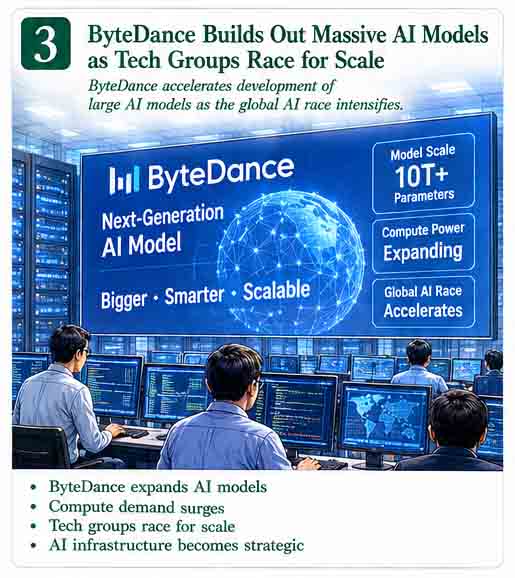
ByteDance AI Models | 규모 경쟁으로 이동하는 글로벌 AI 경쟁
ByteDance AI Models represent a broader shift in the technology industry toward large-scale model development and computing intensity.
The company’s push to build massive AI models comes as technology groups compete to secure a stronger position in the next generation of artificial intelligence.
The competitive landscape is no longer defined only by software features or user experience.
It increasingly depends on computing resources, data, model architecture, engineering talent and the ability to train increasingly complex systems.
This raises the financial stakes of the AI race.
Larger models require substantial infrastructure, energy, chips and capital.
As a result, technology companies must demonstrate that scale can eventually translate into stronger products, greater revenue and sustainable productivity gains.
The AI race is therefore becoming an economic race as much as a technological one.
ByteDance’s expansion illustrates how Chinese technology groups are also seeking greater scale in the global AI competition.
For investors, the next question is whether increasing model size will create proportional increases in commercial value.
• AI model scale continues to expand
• Computing capacity becomes strategically important
• Technology groups compete for scale
• Investors increasingly demand measurable returns
ByteDance AI Models의 확대는 글로벌 기술산업이 대규모 모델과 컴퓨팅 중심의 경쟁으로 이동하고 있음을 보여주는 대표적인 신호다.
기술기업들은 차세대 AI 경쟁에서 우위를 확보하기 위해 모델 규모와 컴퓨팅 역량을 동시에 확대하고 있다.
이제 경쟁력은 단순한 소프트웨어 기능이나 사용자 경험만으로 결정되지 않는다.
컴퓨팅 자원, 데이터, 모델 구조, 엔지니어링 역량, 학습 능력 등이 함께 중요한 요소가 되고 있다.
이는 AI 경쟁의 비용 구조도 크게 변화시키고 있다.
더 큰 모델을 구축하기 위해서는 더 많은 반도체와 데이터센터, 전력, 자본이 필요하다.
따라서 기업들은 단순히 모델의 규모를 키우는 것에서 멈추지 않고 그 규모가 실제 제품과 매출, 생산성 향상으로 연결되는지를 증명해야 한다.
AI 경쟁은 이제 기술 경쟁인 동시에 자본 배분 경쟁이 되고 있다.
ByteDance의 움직임은 중국 기술기업 역시 글로벌 AI 규모 경쟁에서 적극적인 위치를 확보하려 하고 있음을 보여준다.
결국 시장이 주목할 다음 단계는 누가 가장 큰 모델을 만드는지가 아니라 누가 그 규모를 가장 효율적인 경제적 가치로 전환하는가가 될 것이다.
AI Scale Competition | 규모보다 중요한 것은 효율성과 실행이다
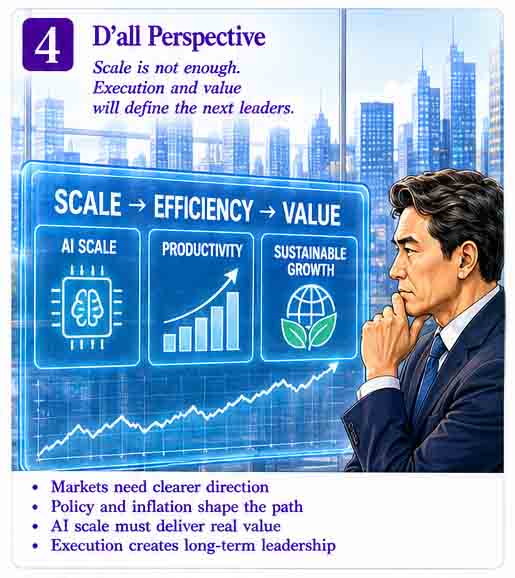
The fourth layer of today’s market is the relationship between scale and execution.
Technology companies can expand AI models rapidly, but investors ultimately evaluate whether those investments generate durable returns.
This distinction is becoming increasingly important as AI infrastructure spending rises across the industry.
A larger model may improve capability, but capability alone does not guarantee profitability.
Companies must optimize training costs, inference efficiency, infrastructure utilization and commercial distribution.
The next competitive advantage may therefore come from efficiency rather than size alone.
This is where execution becomes the decisive variable.
The same amount of capital can create very different outcomes depending on how effectively a company converts infrastructure into products and revenue.
Markets are likely to become more selective as the AI race moves from experimentation toward commercialization.
The winners will be companies that combine scale, efficiency and execution into a sustainable economic system.
AI Scale Competition의 핵심은 결국 규모 자체가 아니라 실행력이다.
기업은 AI 모델의 크기를 빠르게 확대할 수 있지만 투자자들이 최종적으로 평가하는 것은 그 투자가 지속적인 수익으로 연결되는지 여부다.
AI 인프라 투자가 확대될수록 이러한 차이는 더욱 중요해지고 있다.
더 큰 모델은 기능을 향상시킬 수 있지만 모델 규모만으로 수익성이 보장되는 것은 아니다.
기업들은 학습 비용과 추론 비용, 인프라 활용률, 서비스 배포 능력, 상업적 확장성을 동시에 관리해야 한다.
따라서 다음 경쟁우위는 단순한 규모보다 효율성에서 만들어질 가능성이 높다.
같은 규모의 자본을 투입하더라도 이를 제품과 매출로 전환하는 실행 능력에 따라 결과는 크게 달라질 수 있다.
AI 경쟁이 실험 단계에서 상업화 단계로 이동할수록 시장의 선별 과정도 강화될 가능성이 높다.
결국 승자는 가장 큰 모델을 가진 기업이 아니라 규모와 효율성, 실행력을 하나의 지속 가능한 경제 시스템으로 연결하는 기업이 될 것이다.
Mini Insight
AI scale is becoming easier to measure, but AI value is becoming harder to prove.
The next stage of the technology cycle will therefore be defined by efficiency, monetization and execution rather than model size alone.
AI 규모는 측정하기 쉬워지고 있지만 AI가 만들어내는 경제적 가치는 오히려 증명하기 어려워지고 있다.
따라서 다음 기술 사이클의 핵심은 모델의 크기보다 효율성, 수익화, 실행력이 될 가능성이 높다.
D’all Insight
Global Equity Markets are entering a period where macroeconomic data and technology execution must be interpreted together.
Inflation data remains the immediate catalyst because it can reshape expectations for interest rates and liquidity.
But the deeper market question is whether economic growth can remain resilient while policy conditions stay uncertain.
Central banks are facing a more difficult environment because growth signals are no longer moving in a single direction.
Some parts of the economy may remain strong while others show signs of slowing, making a uniform policy response increasingly difficult.
At the same time, the technology sector is creating a second structural variable through massive AI investment.
ByteDance’s model expansion demonstrates how the global AI race is moving toward larger systems and greater computing requirements.
However, capital intensity creates its own constraint because every additional layer of infrastructure must eventually produce measurable economic value.
This is where the distinction between scale and execution becomes critical.
A company can win the model-size race and still lose the economic race if infrastructure costs grow faster than revenue and productivity.
The market will therefore increasingly reward companies that can connect technological capability with efficient capital allocation.
The same principle applies to the broader economy: resilience matters, but resilience without productivity can become expensive.
For central banks, the challenge is to distinguish durable growth from temporary strength while keeping inflation expectations anchored.
For investors, the challenge is to distinguish genuine structural winners from companies benefiting mainly from the enthusiasm surrounding AI.
The next market cycle may therefore be less about predicting a single direction and more about identifying which systems can execute consistently under changing conditions.
D’all sees this as a transition from expectation-driven markets toward execution-driven markets.
In this environment, scale creates opportunity, but efficiency determines durability.
And ultimately, execution determines whether opportunity becomes economic value.
글로벌 증시는 이제 거시경제 데이터와 기술기업의 실행력을 함께 해석해야 하는 단계로 이동하고 있다.
인플레이션 데이터는 금리와 유동성에 대한 기대를 바꿀 수 있기 때문에 당장의 핵심 촉매로 작용한다.
그러나 더 중요한 질문은 정책 환경이 불확실한 상황에서도 경제성장이 얼마나 견고하게 유지될 수 있는가이다.
성장 신호가 하나의 방향으로 움직이지 않으면서 중앙은행이 단일한 정책 대응을 선택하기도 어려워지고 있다.
경제의 일부는 강한 회복력을 보이는 반면 다른 영역에서는 둔화 신호가 나타날 수 있기 때문이다.
동시에 기술산업에서는 대규모 AI 투자가 또 하나의 구조적 변수를 만들어내고 있다.
ByteDance의 대규모 모델 구축은 글로벌 AI 경쟁이 더 큰 시스템과 더 많은 컴퓨팅 자원을 요구하는 방향으로 이동하고 있음을 보여준다.
하지만 자본집약도가 높아질수록 새로운 제약도 발생한다.
추가적인 인프라 투자가 결국 실제 경제적 가치와 생산성으로 연결되어야 하기 때문이다.
바로 이 지점에서 규모와 실행력의 차이가 중요해진다.
모델 규모 경쟁에서 앞선 기업이라도 인프라 비용 증가 속도가 매출과 생산성 증가 속도를 앞서면 경제적 경쟁에서는 뒤처질 수 있다.
따라서 시장은 기술 역량을 효율적인 자본 배분과 연결하는 기업을 더욱 높게 평가할 가능성이 높다.
경제 전체에서도 같은 원리가 적용된다. 회복력은 중요하지만 생산성으로 연결되지 않는 회복력은 높은 비용을 만들어낼 수 있다.
중앙은행은 일시적인 경기 강세와 지속 가능한 성장을 구분하면서 동시에 인플레이션 기대를 안정시켜야 한다.
투자자는 AI 열풍으로 주목받는 기업과 실제 구조적 경쟁력을 가진 기업을 구분해야 한다.
다음 시장 사이클은 하나의 방향을 예측하는 것보다 변화하는 환경 속에서 어떤 시스템이 지속적으로 실행할 수 있는지를 판단하는 과정이 될 가능성이 높다.
D’all은 이를 기대 중심 시장에서 실행 중심 시장으로 이동하는 과정으로 본다.
규모는 기회를 만들지만 효율성은 지속성을 만든다.
그리고 결국 실행력이 기회를 경제적 가치로 바꾼다.
One-line Insight
“Scale creates attention, but execution turns AI investment into sustainable economic value.”
“규모는 관심을 만들지만, 실행력은 AI 투자를 지속 가능한 경제적 가치로 바꾼다.”
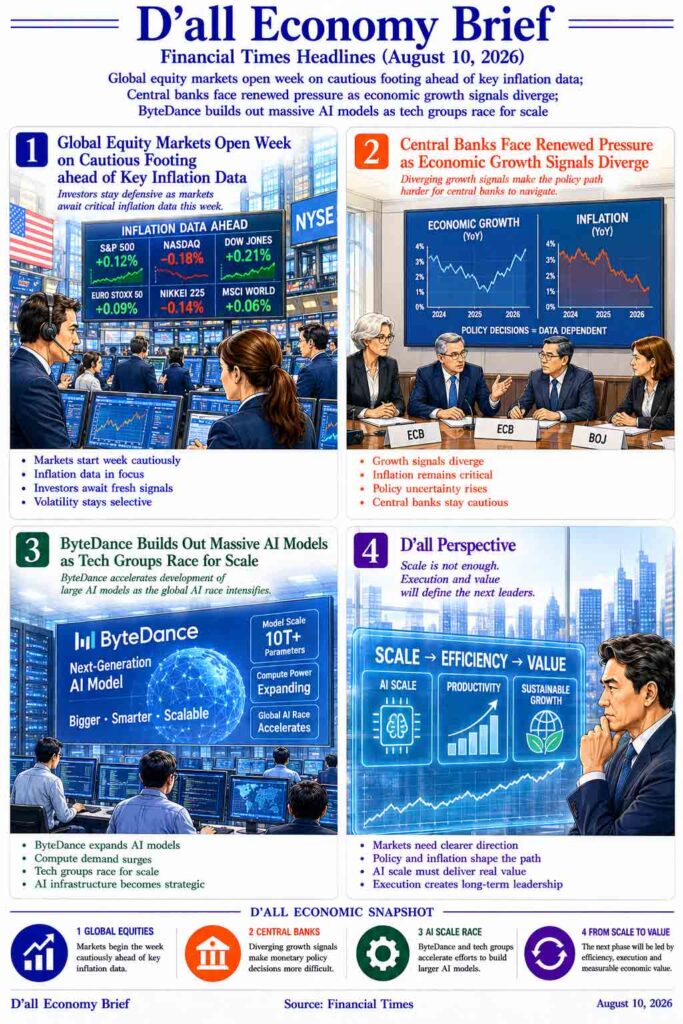
D’ALL ECONOMIC SNAPSHOT
1 GLOBAL EQUITY MARKETS
Global equities open the week cautiously as investors await key inflation data and reassess the path of monetary policy.
글로벌 증시는 핵심 인플레이션 데이터를 기다리며 통화정책 경로를 재평가하는 가운데 신중하게 한 주를 시작한다.
2 CENTRAL BANK POLICY
Diverging growth signals increase pressure on central banks to balance economic resilience with persistent price risks.
엇갈리는 성장 신호는 중앙은행이 경기 회복력과 지속적인 물가 위험 사이에서 균형을 찾도록 압박하고 있다.
3 AI SCALE COMPETITION
ByteDance and other technology groups accelerate massive AI model development as computing scale becomes a strategic advantage.
ByteDance를 비롯한 기술기업들이 대규모 AI 모델 개발을 확대하면서 컴퓨팅 규모가 전략적 경쟁우위로 부상하고 있다.
4 EXECUTION DISCIPLINE
The next phase of AI competition will depend on converting model scale and infrastructure investment into efficiency, revenue and sustainable value.
AI 경쟁의 다음 단계는 모델 규모와 인프라 투자를 효율성, 매출, 지속 가능한 가치로 전환하는 실행력에 달려 있다.
#GlobalEquityMarkets #InflationData #CentralBankPolicy #ByteDanceAI #AIScale #AIEconomy #GlobalMarkets #MonetaryPolicy #MarketOutlook #AIInvestment #TechnologyRace #EconomicGrowth #MarketAnalysis #FinancialTimes #DallEconomyBrief
#글로벌증시 #인플레이션데이터 #중앙은행정책 #바이트댄스AI #AI규모경쟁 #AI경제 #글로벌시장 #통화정책 #시장전망 #AI투자 #기술경쟁 #경제성장 #시장분석 #파이낸셜타임스 #디올이코노미브리프
Source
Financial Times (FT), August 10, 2026
Based on the provided Financial Times headlines covering cautious global equity markets ahead of key inflation data, renewed pressure on central banks amid diverging growth signals, and ByteDance’s expansion of massive AI models as technology groups compete for scale.
Content reconstructed and expanded for analytical insight by D’all Economy Brief.
- D'all Visual Intelligence
- D’all Public Design Intelligence
- D’all Motion Intelligence
- D’all Interaction Intelligence
- D’all Spatial Intelligence
- D’all Advertising Intelligence
- D’all Economy Brief
- D’all Food Intelligence
- D’all Health Insight
- D’all Global Power
- D’all Culture Hybrid
- D’all Knowledge Architecture
- D'all Capital History
- D’all Society Agenda
