

Autonomic Nervous System | 자율신경계는 왜 무너지는가
자율신경계 불균형은 현대인의 가장 흔하지만 가장 잘 인식되지 않는 건강 문제 중 하나다.
많은 사람들은 이유 없이 피곤하고, 충분히 잠을 자도 개운하지 않으며, 작은 스트레스에도 쉽게 예민해진다.
하지만 대부분은 단순 피로, 수면 부족, 혹은 나이 때문이라고 생각한다.
실제로는 몸의 자동 제어 시스템인 자율신경계가 이미 균형을 잃고 있을 가능성이 높다.
자율신경계는 심장 박동, 호흡, 소화, 체온, 회복, 면역 반응까지 의식하지 않아도 작동하는 생명 유지 시스템이다.
문제는 만성 스트레스와 과도한 자극 환경이 지속되면 이 시스템이 끊임없이 긴장 모드에 머물게 된다는 점이다.
몸은 위험이 끝났음에도 계속 위험 상황으로 인식한다.
그 결과 회복은 멈추고 피로는 누적된다.
오늘날 많은 만성 피로와 수면 문제의 시작점에는 자율신경계 불균형이 존재한다.
D’all Health Insight Vol.17은 인간 몸의 보이지 않는 운영체계인 자율신경계를 시스템 관점에서 해석한다.
Why the Autonomic Nervous System Never Truly Rests
The autonomic nervous system operates continuously beneath conscious awareness.
It regulates heartbeat, breathing, digestion, hormonal responses, immune activity, and recovery processes.
Modern lifestyles expose the body to persistent psychological and environmental stress.
When stress becomes chronic, the autonomic nervous system may remain locked in an alert state.
As a result, recovery mechanisms weaken, sleep quality deteriorates, and energy production declines.
Many individuals interpret these symptoms simply as tiredness.
However, the underlying issue may be a dysregulated autonomic control system.
D’all Health Insight reads the Autonomic Nervous System not simply as a stress-response mechanism, but as a regulatory system that continuously coordinates alertness, recovery, energy, and internal balance. The central question is not simply how to reduce stress, but how the body’s regulatory systems shift between activation and recovery over time.
Related Video
Autonomic Nervous System: Crash Course Anatomy & Physiology #13
This video explains how the sympathetic and parasympathetic nervous systems continuously work together to maintain internal balance.
It clearly demonstrates why chronic stress can trap the body in survival mode and interfere with deep recovery.
The lecture also shows how autonomic regulation affects heart rate, digestion, sleep quality, energy production, and emotional resilience.
For understanding the invisible control system behind chronic fatigue and burnout, this video provides an excellent scientific foundation.
이 영상은 교감신경과 부교감신경이 어떻게 균형을 이루며 신체 항상성을 유지하는지 쉽게 설명한다.
또한 만성 스트레스가 몸을 생존 모드에 고정시키고 회복 시스템을 어떻게 방해하는지도 보여준다.
심박수, 소화, 수면, 에너지 생성, 감정 조절에 자율신경계가 어떤 영향을 미치는지 이해할 수 있다.
만성 피로와 번아웃의 근본 구조를 이해하는 데 매우 유용한 자료이다.
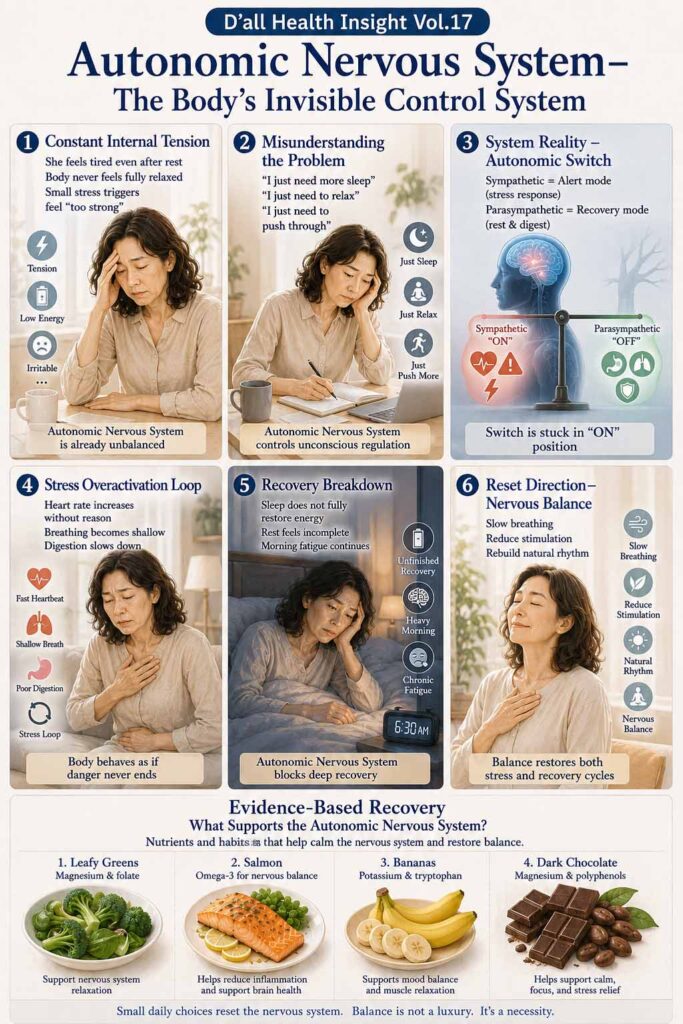
Constant Internal Tension | 지속되는 내부 긴장
Many people experience exhaustion despite adequate sleep.
Small daily stressors often trigger disproportionately strong reactions.
Irritability, persistent fatigue, and emotional instability are frequently early warning signs.
These symptoms suggest that the autonomic nervous system may already be imbalanced.
The body no longer feels truly relaxed, even during rest.
충분히 쉬었는데도 피곤함이 지속된다면 자율신경계 균형 이상을 의심할 수 있다.
작은 자극에도 과민하게 반응하고 쉽게 짜증이 난다면 몸은 이미 긴장 상태에 고정되어 있을 가능성이 높다.
감정 기복이 커지고 사소한 스트레스에도 쉽게 지치는 경우가 많다.
몸은 쉬고 있지만 신경계는 여전히 경계 모드에 머물러 있는 것이다.
Misunderstanding the Problem | 문제를 잘못 이해하다
Many people assume that more sleep, greater willpower, or simply pushing harder will solve persistent fatigue.
However, autonomic dysfunction cannot be corrected by effort alone.
The autonomic nervous system regulates unconscious physiological processes.
Without restoring nervous system balance, symptoms often continue to worsen.
많은 사람들은 더 자거나 더 열심히 버티면 해결될 것이라고 생각한다.
하지만 자율신경계 문제는 의지만으로 해결되지 않는다.
자율신경계는 의식적 통제를 넘어서는 생체 조절 시스템이기 때문이다.
근본적인 균형 회복이 이루어지지 않으면 피로와 스트레스는 반복된다.
Autonomic Nervous System Switch | 자율신경계 스위치 시스템
The autonomic nervous system consists primarily of sympathetic and parasympathetic branches.
The sympathetic system activates alertness and stress responses.
The parasympathetic system promotes rest, digestion, and recovery.
Health depends on the dynamic balance between these two systems.
Chronic stress may leave the body permanently switched into sympathetic dominance.
자율신경계는 교감신경과 부교감신경의 균형으로 유지된다.
교감신경은 경계와 생존 반응을 활성화하고, 부교감신경은 회복과 휴식을 담당한다.
건강은 두 시스템이 유연하게 전환되는 능력에 달려 있다.
만성 스트레스가 지속되면 몸은 교감신경 우세 상태에 고정될 수 있다.
Stress Overactivation Loop | 스트레스 과활성화 루프
When the sympathetic system remains continuously activated, heart rate increases, breathing becomes shallow, and digestion slows.
The body behaves as if danger never disappears.
This creates a self-perpetuating stress loop.
Over time, multiple body systems become affected simultaneously.
교감신경이 지속적으로 활성화되면 심박수 증가, 얕은 호흡, 소화 기능 저하가 나타난다.
몸은 위험 상황이 끝나지 않았다고 판단한다.
결국 스트레스 루프가 형성되며 여러 시스템이 동시에 영향을 받는다.
지속적인 긴장 상태는 만성 피로와 염증 증가로 이어질 수 있다.
Recovery Breakdown | 회복 시스템 붕괴
Sleep alone does not guarantee recovery.
A dysregulated autonomic nervous system may prevent deep restoration.
People often wake up feeling tired despite sufficient sleep duration.
Morning fatigue, brain fog, and chronic exhaustion frequently emerge.
잠을 오래 잔다고 해서 반드시 회복이 이루어지는 것은 아니다.
자율신경계 균형이 무너지면 깊은 회복 자체가 방해받을 수 있다.
충분히 잠을 잤는데도 아침에 피곤함을 느끼는 경우가 많다.
아침 피로, 집중력 저하, 만성 피로가 지속될 수 있다.
Reset Direction for Autonomic Nervous System | 자율신경계 회복 방향
Restoring autonomic balance requires reducing excessive stimulation and rebuilding natural biological rhythms.
Slow diaphragmatic breathing, regular sleep schedules, sunlight exposure, physical activity, and stress reduction strategies support nervous system recovery.
Small daily practices can gradually shift the body back toward balance.
자율신경계 회복의 핵심은 과도한 자극을 줄이고 자연스러운 생체 리듬을 회복하는 것이다.
천천히 호흡하고, 일정한 수면 패턴을 유지하며, 햇빛 노출과 규칙적인 운동을 실천하는 것이 도움이 된다.
명상과 심호흡은 부교감신경 활성화에 긍정적인 영향을 줄 수 있다.
작은 습관 변화가 신경계 회복의 출발점이 된다.
Mini Insight
The autonomic nervous system determines whether the body remains trapped in survival mode or returns to recovery mode.
자율신경계는 몸이 생존 모드에 갇힐지, 회복 모드로 전환될지를 결정하는 핵심 스위치다.
D’all Insight
Modern humans rarely experience true recovery.
Notifications, information overload, emotional pressure, artificial light exposure, irregular sleep schedules, and chronic stress continuously stimulate the nervous system.
Historically, the stress response evolved to manage short-term threats.
However, modern lifestyles expose the body to low-grade stress throughout the entire day.
The autonomic nervous system was never designed for permanent activation.
When sympathetic dominance persists, recovery pathways gradually weaken.
Sleep becomes less restorative.
Inflammation increases.
Energy production declines.
Hormonal regulation becomes unstable.
Ultimately, multiple biological systems begin to fail simultaneously.
Health therefore cannot be understood only through symptoms.
Human health should be interpreted as an interconnected operating system.
현대인은 진정한 회복 상태를 경험하는 시간이 점점 줄어들고 있다.
스마트폰 알림, 정보 과부하, 감정적 압박, 인공조명, 불규칙한 수면, 만성 스트레스는 신경계를 지속적으로 자극한다.
인간의 스트레스 시스템은 원래 단기적 위협에 대응하도록 설계되었다.
그러나 현대 환경에서는 하루 종일 낮은 수준의 스트레스가 지속된다.
자율신경계는 영구적인 긴장 상태를 견디도록 만들어지지 않았다.
교감신경 우세 상태가 지속되면 회복 시스템은 점차 약화된다.
수면의 질은 떨어지고 염증은 증가한다.
에너지 생산 능력도 감소한다.
호르몬 균형 역시 흔들리기 시작한다.
결국 여러 생체 시스템이 동시에 영향을 받는다.
따라서 건강은 단순 증상이 아니라 하나의 연결된 운영체계 관점에서 이해해야 한다.
인간의 몸은 독립된 기관들의 집합이 아니라 상호 연결된 시스템 네트워크다.
One-line Insight
몸은 쉬고 있어도 자율신경계가 쉬지 못하면 회복은 시작되지 않는다. | Recovery cannot begin if the autonomic nervous system never leaves survival mode. | D’all Health Insight Vol.17
#AutonomicNervousSystem #AutonomicNervousSystemBalance #ChronicStress #NervousSystemRecovery #ParasympatheticNervousSystem #StressRecovery #ChronicFatigue #BurnoutRecovery #StressManagement #MindBodyConnection #RecoverySystem #HumanOperatingSystem #WellnessScience #HealthOptimization #DallHealthInsight
#자율신경계 #자율신경계불균형 #만성스트레스 #신경계회복 #부교감신경 #교감신경 #만성피로 #번아웃 #스트레스관리 #회복시스템 #건강최적화 #몸의운영체계 #헬스인사이트 #건강정보 #디올헬스인사이트
Source
Cleveland Clinic. Autonomic Nervous System Overview.
Harvard Health Publishing. Understanding Stress Response.
Crash Course Anatomy & Physiology.
Khan Academy Physiology.
D’all Editorial Analysis and System Interpretation.
- D'all Visual Intelligence
- D’all Public Design Intelligence
- D’all Motion Intelligence
- D’all Interaction Intelligence
- D’all Spatial Intelligence
- D’all Advertising Intelligence
- D’all Economy Brief
- D’all Food Intelligence
- D’all Health Insight
- D’all Global Power
- D’all Culture Hybrid
- D’all Knowledge Architecture
- D'all Capital History
- D’all Society Agenda
