

Metabolic System | 몸은 왜 저장 모드로 바뀌는가
Metabolic System은 단순히 음식을 태우고 칼로리를 소비하는 장치가 아니다.
몸이 들어온 에너지를 사용할지, 저장할지, 보호할지를 결정하는 생존 시스템이다.
우리는 몸이 무겁고 체중이 늘어나면
먹는 양이나 의지 부족부터 의심한다.
그러나 같은 음식을 먹어도
수면, 스트레스, 근육량, 호르몬 신호, 활동 리듬에 따라
몸이 에너지를 처리하는 방식은 달라질 수 있다.
혈당이 반복해서 빠르게 오르고
인슐린 신호가 계속 강해지면
세포는 점차 그 신호에 덜 민감하게 반응할 수 있다.
그 결과 에너지는 충분한데도 활력은 떨어지고,
몸은 사용보다 저장에 더 익숙해질 수 있다.
비만은 언제나 단순한 과식의 결과가 아니다.
때로는 몸 전체의 신호가 저장 방향으로 기울어진 결과다.
회복의 핵심은 몸을 굶기거나 처벌하는 것이 아니다.
불안정한 신호를 낮추고
다시 에너지를 사용할 수 있는 리듬을 만드는 것이다.
Metabolic System — Why the Body Chooses Energy Storage
The Metabolic System is not simply a calorie-burning engine.
It is a survival network that decides when energy should be used, conserved, or stored.
Many people interpret weight gain, fatigue, and hunger as failures of discipline.
But metabolism is influenced by far more than willpower.
Sleep quality, chronic stress, muscle activity, hormonal signals, food composition, and daily rhythm all shape how the body handles energy.
When blood glucose rises repeatedly, insulin is released to help move glucose into cells.
If cells become less responsive to that signal, the pancreas may compensate by releasing more insulin.
The body can then carry plenty of available energy while still producing fatigue, cravings, and unstable concentration.
This is the paradox of metabolic imbalance:
energy exists, but it is not being used efficiently.
The system gradually begins to favor conservation and storage.
Recovery starts by stabilizing the signals that guide energy use—not by punishing the body for adapting.
Related Video | Metabolic System and Insulin Resistance
Insulin resistance does not mean that the body has run out of energy.
It means that cells are becoming less responsive to the signal that helps move glucose from the bloodstream into the body’s tissues.
As this response weakens, the pancreas may release more insulin to maintain blood sugar balance.
Over time, the body can become more likely to store energy while still experiencing fatigue, hunger, and unstable energy levels.
This Cleveland Clinic video explains how insulin resistance affects metabolism, body weight, and long-term metabolic health.
인슐린 저항성은 몸에 에너지가 부족하다는 뜻이 아니다.
혈액 속 포도당을 조직과 세포로 전달하는 신호에 몸이 충분히 반응하지 못하는 상태를 의미한다.
반응이 약해지면 췌장은 혈당 균형을 유지하기 위해 더 많은 인슐린을 분비할 수 있다.
이 과정이 반복되면 몸은 에너지를 충분히 보유하고도 피로와 허기, 불안정한 에너지 변화를 경험하며 저장 쪽으로 기울 수 있다.
이 Cleveland Clinic 영상은 인슐린 저항성이 대사, 체중, 장기적인 대사 건강에 어떤 영향을 줄 수 있는지 설명한다.
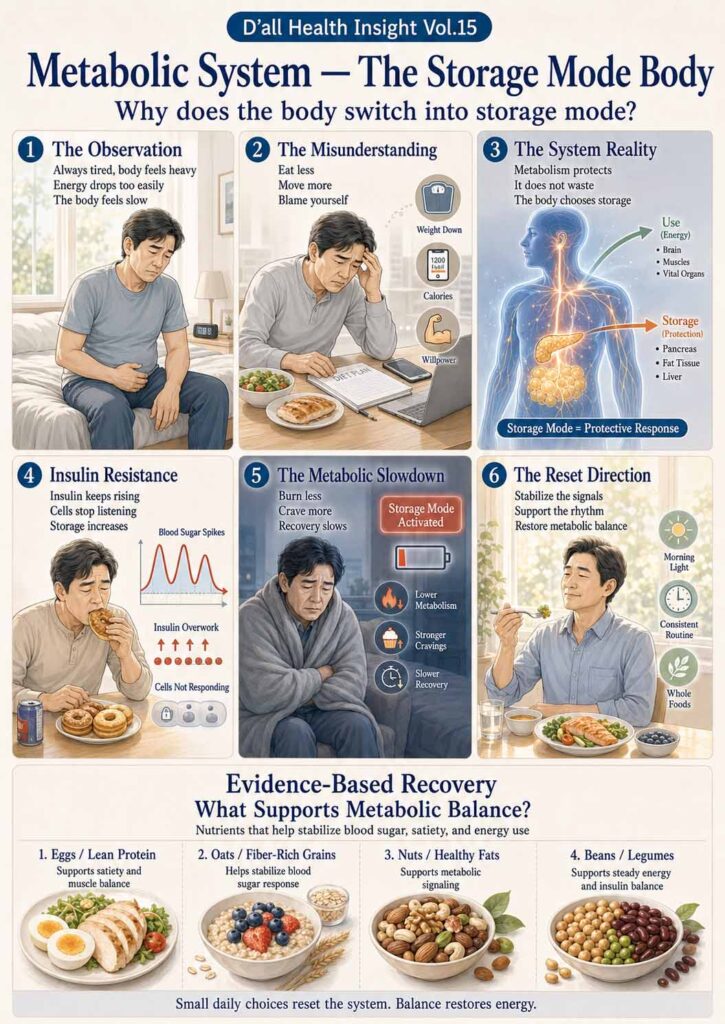
1. Metabolic System Observation — The Heavy Body | 무거워진 몸의 신호
Always tired
Body feels heavy
Energy drops too easily
The body feels slow
Fatigue can appear even when the body has enough stored energy.
The problem may not be a total lack of fuel, but difficulty accessing and using that fuel efficiently.
Low energy, persistent hunger, reduced activity, and slower recovery can appear together when metabolic signals lose stability.
These changes should not be interpreted as proof of laziness.
They may reflect a system struggling to coordinate energy use.
몸에 저장된 에너지가 충분해도 피로는 나타날 수 있다.
연료 자체가 없는 것이 아니라, 그 에너지를 필요한 곳에서 효율적으로 사용하지 못하는 상태일 수 있다.
무거운 몸, 지속되는 허기, 줄어든 활동성, 느린 회복은
대사 신호가 불안정해질 때 함께 나타날 수 있다.
이 변화를 단순히 게으름으로 해석해서는 안 된다.
몸이 에너지 사용을 조절하는 데 어려움을 겪고 있다는 신호일 수 있다.
2. Metabolic System Misunderstanding — Blaming Willpower | 의지를 탓하는 오해
Eat less
Move more
Blame yourself
Weight and metabolic health are often reduced to one equation: eat less and move more.
Energy balance matters, but this explanation alone cannot describe the entire system.
Hunger hormones, sleep loss, stress, muscle mass, insulin sensitivity, and food quality also influence appetite and energy use.
Extreme restriction can become difficult to sustain when the body perceives instability.
The system may respond by increasing hunger, lowering spontaneous movement, and conserving energy.
대사 건강은 흔히 적게 먹고 더 움직이는 문제로만 설명된다.
에너지 균형은 중요하지만
허기 신호, 수면 부족, 스트레스, 근육량, 인슐린 민감도, 음식의 구성도
식욕과 에너지 소비에 영향을 준다.
몸이 불안정성을 감지하는 상태에서 극단적으로 제한하면
허기는 커지고 자연스러운 활동은 줄며
에너지 절약 반응이 강화될 수 있다.
3. Metabolic System Reality — The Storage Logic | 에너지 저장의 생존 논리
Metabolism protects
It does not waste
The body chooses storage
Metabolism evolved to protect survival.
It constantly evaluates whether energy should be spent now or saved for later.
After eating, glucose enters the bloodstream and insulin helps direct that energy toward cells, muscles, the liver, and storage tissues.
When signals remain stable, the body can move flexibly between energy use and storage.
When signals are repeatedly disrupted, that flexibility may decline.
Storage is therefore not automatically a failure.
It is a protective biological function that becomes problematic when the body remains locked in that direction.
대사는 생존을 보호하도록 만들어진 시스템이다.
몸은 에너지를 지금 사용할지, 나중을 위해 남길지를 계속 판단한다.
식사 후 혈액으로 들어온 포도당은
인슐린 신호를 통해 세포, 근육, 간, 저장 조직으로 이동한다.
신호가 안정적이면 몸은 사용과 저장 사이를 유연하게 오갈 수 있다.
하지만 불안정한 신호가 반복되면 그 유연성이 줄어들 수 있다.
저장은 본래 고장이 아니라 보호 기능이다.
문제는 몸이 저장 방향에서 빠져나오지 못할 때 시작된다.
4. Metabolic System Resistance — When Cells Stop Listening | 세포가 신호를 듣지 못할 때
Insulin keeps rising
Cells stop listening
Storage increases
Insulin resistance develops when muscle, fat, and liver cells respond less effectively to insulin.
The pancreas may initially compensate by producing more insulin.
This can help maintain blood glucose for a period of time, even while internal strain is increasing.
Higher insulin levels can make stored energy less accessible and may support continued fat storage.
Meanwhile, the brain can still receive signals of hunger and low energy.
This creates a confusing state:
the body stores more while the person feels less energetic.
인슐린 저항성은 근육, 지방, 간세포가
인슐린 신호에 이전보다 약하게 반응하는 상태다.
초기에는 췌장이 더 많은 인슐린을 분비해 혈당을 유지하려 할 수 있다.
겉으로는 균형이 유지되는 것처럼 보여도 내부 부담은 커질 수 있다.
인슐린이 높은 상태에서는 저장된 에너지를 꺼내 쓰기가 어려워질 수 있고
지방 저장 방향이 지속될 수 있다.
그런데도 뇌는 허기와 에너지 부족 신호를 받을 수 있다.
더 많이 저장하면서도 더 피곤하게 느끼는 역설이 나타나는 이유다.
5. Metabolic System Slowdown — The Storage Mode Loop | 저장 모드의 반복 구조
Burn less
Crave more
Recovery slows
Metabolic slowdown is not one single switch.
It is a pattern created by reduced activity, lower muscle use, poor sleep, repeated blood sugar changes, and chronic stress.
As the body spends less energy, cravings can become harder to regulate.
Unstable meals may then create another cycle of glucose and insulin fluctuation.
Fatigue reduces movement.
Reduced movement lowers energy demand.
Lower demand can reinforce storage.
This creates a loop in which the body becomes increasingly efficient at conserving energy but less flexible at using it.
대사 저하는 하나의 스위치가 갑자기 꺼지는 현상이 아니다.
줄어든 활동, 근육 사용 감소, 수면 부족, 반복되는 혈당 변화, 만성 스트레스가 함께 만드는 패턴이다.
몸이 적은 에너지를 사용하기 시작하면
식욕과 당기는 음식에 대한 조절도 어려워질 수 있다.
피로는 움직임을 줄이고
움직임 감소는 에너지 수요를 낮추며
낮은 수요는 다시 저장을 강화한다.
몸은 에너지를 보존하는 데는 효율적이지만
필요할 때 사용하는 유연성은 점점 잃을 수 있다.
6. Metabolic System Reset — Restoring Energy Flexibility | 에너지 유연성의 회복
Stabilize the signals
Support the rhythm
Restore metabolic balance
Metabolic recovery does not require punishment.
It requires consistent signals that help the body regain flexibility.
Regular meals built around protein, fiber, minimally processed carbohydrates, and healthy fats may support steadier energy.
Walking and resistance exercise help muscles use glucose and support insulin sensitivity.
Sleep and stress regulation also influence appetite, glucose control, and recovery.
The goal is not permanent restriction.
It is helping the body move safely between storing energy and using it.
대사 회복은 몸을 처벌하는 방식으로 이루어지지 않는다.
몸이 다시 유연성을 되찾도록 안정적인 신호를 반복하는 과정이 필요하다.
단백질, 식이섬유, 덜 가공된 탄수화물, 건강한 지방을 포함한 규칙적인 식사는
보다 안정적인 에너지 흐름을 지원할 수 있다.
걷기와 근력 운동은 근육의 포도당 사용과 인슐린 민감도를 돕는다.
수면과 스트레스 조절 역시 식욕, 혈당, 회복 과정에 영향을 준다.
목표는 영구적인 제한이 아니다.
몸이 에너지를 저장하고 사용하는 두 방향을 다시 유연하게 오가도록 만드는 것이다.
Evidence-Based Recovery — What Supports Metabolic System Balance
Eggs / Lean Protein
Supports satiety and muscle maintenance
Oats / Fiber-Rich Grains
May help moderate post-meal blood sugar response
Nuts / Healthy Fats
Supports satiety and metabolic signaling
Beans / Legumes
Supports steady energy, fiber intake, and glucose balance
These foods do not reset metabolism by themselves.
However, when included in a balanced eating pattern, they may support satiety, muscle health, steadier glucose responses, and long-term metabolic balance.
달걀 / 저지방 단백질
포만감과 근육 유지에 도움을 준다.
귀리 / 식이섬유가 풍부한 곡물
식후 혈당 반응을 완만하게 유지하는 데 도움을 줄 수 있다.
견과류 / 건강한 지방
포만감과 대사 신호 유지를 지원한다.
콩 / 콩류
안정적인 에너지, 식이섬유 섭취, 혈당 균형에 도움을 준다.
이 음식들만으로 대사 시스템이 회복되는 것은 아니다.
그러나 균형 잡힌 식사 패턴에 포함하면 포만감, 근육 건강, 안정적인 혈당 반응, 장기적인 대사 균형을 지원할 수 있다.
Mini Insight
The body does not store energy because it is weak.
It stores energy because the system is trying to protect stability.
몸은 약해서 에너지를 저장하는 것이 아니다.
안정성을 지키려는 시스템이 저장을 선택하는 것이다.
D’all Insight
The Metabolic System is often described as a simple contest between calories consumed and calories burned.
But the body is not a passive calculator.
It is an adaptive network that interprets signals from food, muscles, hormones, sleep, stress, and the surrounding environment.
Insulin is one of the central messengers in this network, but it does not act alone.
The brain evaluates energy availability.
The liver stores and releases fuel.
Muscle tissue creates demand.
Fat tissue stores energy and also sends hormonal signals.
When these systems remain synchronized, the body can move between feeding and fasting, activity and rest, storage and use.
Metabolic problems emerge when this flexibility begins to disappear.
Repeated glucose spikes, reduced muscle activity, chronic stress, poor sleep, and highly processed eating patterns can push the body toward persistent storage.
The visible result may be weight gain, but weight is not the entire story.
The deeper issue is that energy becomes increasingly difficult to access, even while more of it is being stored.
This explains why a person may experience fatigue, hunger, brain fog, and low motivation despite carrying abundant energy reserves.
The body is not refusing to cooperate.
It is responding to the signals it repeatedly receives.
That is why sustainable recovery cannot be built around shame.
It must be built around better signals: stable meals, active muscles, restorative sleep, consistent rhythms, and enough time for the system to adapt again.
Metabolic balance is not achieved by forcing the body to burn more at any cost.
It is restored when the body becomes confident that energy can be used without threatening stability.
대사 시스템은 흔히 섭취한 칼로리와 소비한 칼로리의 단순한 경쟁으로 설명된다.
하지만 몸은 수동적인 계산기가 아니다.
음식, 근육, 호르몬, 수면, 스트레스, 주변 환경의 신호를 해석하는 적응형 네트워크다.
인슐린은 이 네트워크의 핵심 전달자 중 하나지만 혼자 작동하지 않는다.
뇌는 에너지 가용성을 판단한다.
간은 에너지를 저장하고 필요할 때 방출한다.
근육은 에너지 수요를 만든다.
지방 조직은 에너지를 저장하면서 동시에 호르몬 신호도 보낸다.
이 시스템이 조화를 이루면
몸은 식사와 공복, 활동과 휴식, 저장과 사용 사이를 유연하게 이동할 수 있다.
대사 문제는 이 유연성이 사라지기 시작할 때 나타난다.
반복되는 혈당 상승, 줄어든 근육 활동, 만성 스트레스, 수면 부족, 고도로 가공된 식사 패턴은
몸을 지속적인 저장 방향으로 밀어갈 수 있다.
겉으로 나타나는 결과는 체중 증가일 수 있지만
체중이 전부는 아니다.
더 깊은 문제는 에너지가 더 많이 저장되면서도
그 에너지를 실제로 사용하기는 점점 어려워진다는 것이다.
그래서 몸에 충분한 에너지가 남아 있는데도
피로, 허기, 브레인포그, 의욕 저하를 경험할 수 있다.
몸이 협조를 거부하는 것이 아니다.
반복적으로 들어오는 신호에 적응하고 있는 것이다.
따라서 지속 가능한 회복은 자기비난 위에 세울 수 없다.
안정적인 식사, 활발하게 사용되는 근육, 회복되는 수면, 일정한 생활 리듬, 그리고 시스템이 다시 적응할 충분한 시간이 필요하다.
대사 균형은 어떤 대가를 치르더라도 더 많이 태우도록 강요해서 만들어지지 않는다.
몸이 안정성을 잃지 않고도 에너지를 사용할 수 있다고 다시 판단할 때 회복된다.
One-line Insight
The body stores energy when it no longer trusts stability.
몸은 안정성을 신뢰하지 못할 때 에너지를 저장한다.
Previous Post :
D’all Health Insight Vol.14
Hormone System — The Loss of Balance
#MetabolicSystem #MetabolicBalance #InsulinResistance #BloodSugarBalance #EnergyStorage #MetabolicHealth #GlucoseControl #HealthyMetabolism #MuscleHealth #FiberRichFoods #WholeFoodNutrition #LifestyleHealth #PreventiveHealth #HealthInsight #DallHealthInsight
#대사시스템 #대사균형 #인슐린저항성 #혈당균형 #에너지저장 #대사건강 #혈당관리 #건강한대사 #근육건강 #식이섬유 #통곡물영양 #생활습관건강 #예방건강 #헬스인사이트 #디올헬스인사이트
Source
Based on metabolic health and insulin resistance research from the National Institute of Diabetes and Digestive and Kidney Diseases, the World Health Organization, Harvard Health Publishing, Cleveland Clinic, and peer-reviewed studies on glucose regulation, muscle metabolism, obesity, and metabolic syndrome.
The dietary section reflects general evidence on protein, dietary fiber, legumes, whole grains, healthy fats, and their roles within balanced eating patterns. Foods are presented as supportive components of metabolic health, not as treatments or substitutes for professional medical care.
Content has been restructured and analyzed for visual insight by D’all.
- D'all Visual Intelligence
- D’all Public Design Intelligence
- D’all Motion Intelligence
- D’all Interaction Intelligence
- D’all Spatial Intelligence
- D’all Advertising Intelligence
- D’all Economy Brief
- D’all Food Intelligence
- D’all Health Insight
- D’all Global Power
- D’all Culture Hybrid
- D’all Knowledge Architecture
- D'all Capital History
- D’all Society Agenda
