

Related Video | 관련 영상
New alliances in East Asia? | DW Documentary
Northeast Asia has become one of the world’s most sensitive geopolitical zones.
As competition between the United States and China intensifies, countries such as South Korea, Japan, and Taiwan are reassessing their security strategies and alliances.
This DW Documentary explores how new partnerships, military modernization, and regional tensions are reshaping the strategic landscape of East Asia.
동북아는 세계에서 가장 민감한 지정학적 공간 중 하나가 되었다.
미국과 중국의 경쟁이 심화되면서 한국, 일본, 대만은 안보 전략과 동맹 구조를 다시 조정하고 있다.
이 DW 다큐멘터리는 새로운 파트너십, 군사 현대화, 그리고 지역 긴장이 어떻게 동아시아의 전략 지형을 재편하고 있는지를 보여준다.
Northeast Asia Collision Zone | 동북아 충돌 지대
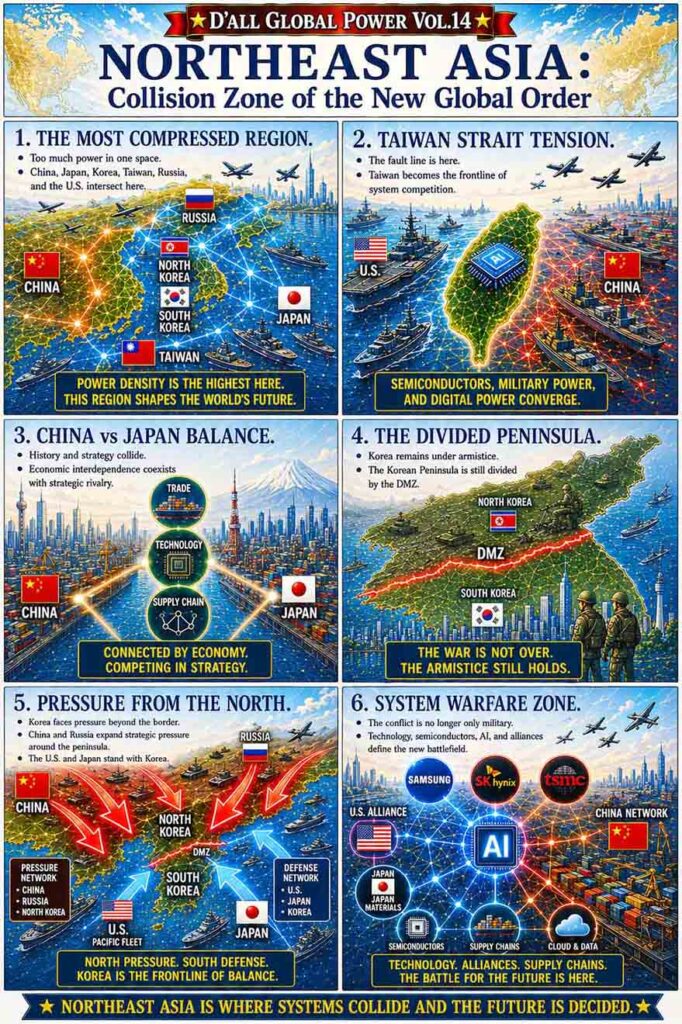
Northeast Asia Collision Zone은 지금 세계에서 가장 압축된 긴장 지역이다.
중국, 미국, 일본, 한국, 러시아, 대만이 하나의 공간 안에서 충돌하고 있다.
이 지역은 단순한 지역 갈등이 아니다.
군사, 반도체, AI, 공급망, 동맹 구조가 동시에 겹쳐지는 글로벌 전장이다.
특히 대만 해협과 한반도는 시스템 충돌의 최전선이 되었다.
한국은 휴전 상태 속에서 압박과 방어 사이에 놓여 있다.
중국과 러시아는 북쪽 압력을 강화하고 있으며
미국과 일본은 동맹 네트워크를 확장하고 있다.
동북아는 경제적으로 연결되어 있지만
전략적으로는 가장 위험한 지역 중 하나다.
이곳에서 벌어지는 긴장은 미래 글로벌 질서의 방향을 결정할 가능성이 높다.
Northeast Asia Collision Zone Shapes the Future Battlefield
Northeast Asia Collision Zone has become the most compressed strategic region in the world.
China, the United States, Japan, Korea, Russia, and Taiwan are concentrated in one geopolitical space.
This is not just a regional dispute.
Military systems, semiconductors, AI, supply chains, and alliance structures converge here simultaneously.
The Taiwan Strait and the Korean Peninsula now function as the frontline of systemic competition.
South Korea remains under armistice while facing pressure from the north.
China and Russia continue expanding strategic pressure around the peninsula.
Meanwhile, the U.S. and Japan strengthen their defense coordination networks.
Northeast Asia is economically interconnected but strategically unstable.
The region now represents one of the most critical collision zones of the emerging world order.
1. Northeast Asia Collision Zone Density | 압축된 권력 밀도
Too much power is concentrated in Northeast Asia.
China, Japan, Korea, Taiwan, Russia, and the U.S. intersect within one strategic space.
Military pressure, economic interdependence, and alliance competition coexist simultaneously.
This region now shapes the future balance of global power.
동북아에는 과도할 정도의 권력이 집중되어 있다.
중국, 일본, 한국, 대만, 러시아, 미국이 하나의 공간에서 충돌한다.
군사 압박과 경제 연결, 동맹 경쟁이 동시에 존재한다.
이 지역은 미래 세계 권력 균형을 결정하는 핵심 공간이 되었다.
2. Taiwan Strait Tension | 대만 해협 긴장
The Taiwan Strait is becoming the frontline of system competition.
Semiconductors, military power, and digital infrastructure converge around Taiwan.
China increases military pressure while the U.S. expands strategic support.
Taiwan is no longer just an island.
It is a critical node of global technology and geopolitical tension.
대만 해협은 시스템 경쟁의 최전선이 되고 있다.
반도체, 군사력, 디지털 인프라가 대만 주변에 집중된다.
중국은 군사 압박을 강화하고 미국은 전략 지원을 확대한다.
대만은 더 이상 단순한 섬이 아니다.
세계 기술과 지정학 긴장이 교차하는 핵심 노드다.
3. China Japan Balance Structure | 중국과 일본의 균형 구조
China and Japan remain economically connected while strategically competing.
Trade and supply chains tie both countries together.
However, military expansion and regional influence create long-term tension.
Economic cooperation and geopolitical rivalry now operate simultaneously.
중국과 일본은 경제적으로 연결되어 있지만 전략적으로 경쟁한다.
무역과 공급망은 서로를 강하게 묶고 있다.
하지만 군사 확장과 지역 영향력 경쟁은 긴장을 만든다.
경제 협력과 지정학적 경쟁이 동시에 작동하는 구조다.
4. Korean Peninsula Armistice Structure | 한반도 휴전 구조
The Korean Peninsula remains divided under an armistice system.
The DMZ is not just a border.
It is one of the most militarized lines in the world.
The war has technically never ended.
This unresolved structure continues shaping regional security tension.
한반도는 여전히 휴전 체제 아래 분단되어 있다.
DMZ는 단순한 국경선이 아니다.
세계에서 가장 군사화된 경계 중 하나다.
전쟁은 기술적으로 끝나지 않았다.
이 미해결 구조는 동북아 긴장을 지속적으로 만든다.
5. Northern Pressure and Defense Network | 북방 압박과 방어 네트워크
Strategic pressure expands from China and Russia toward the Korean Peninsula.
North Korea acts as an unstable pressure point inside the system.
Meanwhile, the U.S. and Japan reinforce defense cooperation with Korea.
Northeast Asia is becoming a layered defense and confrontation zone.
중국과 러시아의 전략 압박은 한반도로 확장되고 있다.
북한은 시스템 내부의 불안정 압력 지점처럼 작동한다.
반면 미국과 일본은 한국과의 방어 협력을 강화한다.
동북아는 다층적 방어와 대치 구조로 변하고 있다.
6. Northeast Asia System Warfare | 시스템 전쟁의 전장
The conflict in Northeast Asia is no longer limited to military competition.
Semiconductors, AI, cloud infrastructure, and supply chains define the new battlefield.
Samsung, SK hynix, Korea, and TSMC are now part of strategic competition itself.
Technology alliances increasingly shape geopolitical influence.
The future war is becoming systemic rather than territorial.
동북아 갈등은 더 이상 군사 경쟁만이 아니다.
반도체, AI, 클라우드 인프라, 공급망이 새로운 전장을 만든다.
삼성, SK hynix, 한국, TSMC는 전략 경쟁의 일부가 되었다.
기술 동맹은 점점 더 지정학적 영향력을 결정한다.
미래 전쟁은 영토보다 시스템 중심으로 변화하고 있다.
Mini Insight
The future battlefield is not one border.
It is the intersection of systems, technology, and alliances.
미래 전장은 하나의 국경선이 아니다.
시스템과 기술, 동맹이 교차하는 공간이다.
D’all Insight
Northeast Asia Collision Zone represents the highest concentration of systemic tension in the modern world.
Military confrontation, semiconductor competition, alliance structures, and digital infrastructure overlap within a single region.
Unlike previous geopolitical conflicts, the competition here is multidimensional.
Economic interdependence does not reduce strategic rivalry.
Instead, it increases systemic vulnerability.
Korea and Taiwan hold critical leverage in the global semiconductor structure.
Korea remains trapped inside an unfinished war structure.
Japan expands defense normalization while balancing economic exposure.
China seeks regional influence expansion while confronting U.S. containment strategies.
Russia adds northern military pressure and strategic uncertainty.
This creates a compressed geopolitical environment where every movement affects global systems.
The conflict is no longer about territory alone.
It is about control over technology, networks, supply chains, and future standards.
Northeast Asia therefore becomes the laboratory of the next global order.
동북아 충돌 지대는 현대 세계에서 가장 높은 수준의 시스템 긴장이 집중된 공간이다.
군사 대치, 반도체 경쟁, 동맹 구조, 디지털 인프라가 하나의 지역 안에 겹쳐진다.
과거 지정학 갈등과 달리 이 경쟁은 다차원적이다.
경제적 연결은 전략 경쟁을 줄이지 않는다.
오히려 시스템 취약성을 확대한다.
한국과 대만은 글로벌 반도체 구조에서 핵심 영향력을 가진다.
한국은 끝나지 않은 전쟁 구조 안에 놓여 있다.
일본은 방어 정상화를 확대하면서 경제 의존을 동시에 관리한다.
중국은 미국 견제 속에서 지역 영향력 확대를 시도한다.
러시아는 북방 군사 압박과 불확실성을 더한다.
이 구조는 모든 움직임이 글로벌 시스템에 영향을 주는 압축 환경을 만든다.
갈등은 더 이상 영토만의 문제가 아니다.
기술, 네트워크, 공급망, 미래 표준의 통제 경쟁이다.
동북아는 결국 새로운 세계 질서의 실험장이 되고 있다.
One-line Insight
👉 Northeast Asia is where military power, technology, and systems collide.
👉 동북아는 군사력과 기술, 시스템이 충돌하는 공간이다.
Further Insight | 추가 시청
Northeast Asia: the Balkans of the 21st Century
The Korean Peninsula, the Taiwan Strait, and maritime disputes are creating overlapping security risks across Northeast Asia.
The region is increasingly viewed as one of the most dangerous geopolitical flashpoints of the 21st century.
Understanding Northeast Asia means understanding the future balance of global power.
한반도, 대만해협, 해양 영유권 분쟁은 동북아 전역에 중첩된 안보 위험을 만들어내고 있다.
이 지역은 21세기 가장 위험한 지정학적 충돌 지대 가운데 하나로 평가받는다.
동북아를 이해하는 것은 미래 세계 권력 균형을 이해하는 것과 같다.
Previous Post
Southeast Asia ASEAN Strategic Hub | D’all Global Power Vol.13
#NortheastAsia
#TaiwanStrait
#KoreanPeninsula
#Geopolitics
#SemiconductorWar
#AICompetition
#USChinaConflict
#GlobalSupplyChain
#TechWar
#MilitaryTension
#SystemCompetition
#EastAsiaSecurity
#DigitalGeopolitics
#GlobalPowerShift
#DallGlobalPower
#동북아
#대만해협
#한반도
#지정학
#반도체전쟁
#AI경쟁
#미중갈등
#공급망
#기술패권
#군사긴장
#시스템경쟁
#동아시아안보
#디지털지정학
#세계질서
#디올글로벌파워
Source
Based on geopolitical analysis of Northeast Asia security structures, Taiwan Strait tensions, semiconductor competition, alliance systems, and global technology supply chains.
Content restructured for D’all Global Power visual storytelling.
Focus Keywords
Northeast Asia Collision Zone
Taiwan Strait Tension
Korean Peninsula Security
Semiconductor War
System Warfare Asia
- D'all Visual Intelligence
- D’all Public Design Intelligence
- D’all Motion Intelligence
- D’all Interaction Intelligence
- D’all Spatial Intelligence
- D’all Advertising Intelligence
- D’all Economy Brief
- D’all Food Intelligence
- D’all Health Insight
- D’all Global Power
- D’all Culture Hybrid
- D’all Knowledge Architecture
- D'all Capital History
- D’all Society Agenda
