

Cognitive Slot | 질문은 왜 지능을 만드는가
Cognitive Slot(인지적 빈 공간)은 수동적인 정보 흡수를 능동적인 지식의 구조화로 바꾸는 가장 강력한 트리거입니다. 우리는 흔히 책상에 오래 앉아 텍스트를 눈에 바르고 강의를 많이 들으면, 자연스럽게 지능이 높아지고 머릿속에 지식이 쌓일 것이라고 착각합니다. 하지만 목적과 호기심이 빠진 맹목적인 읽기는 틈이 없는 유리 바닥에 물을 붓는 것과 같습니다. 수많은 정보가 뇌를 스쳐 지나가지만, 정작 팀 프로젝트나 시험 등 중요한 순간에는 아무것도 기억나지 않고 튕겨 나가는 억울한 경험을 해보셨을 것입니다. 밤을 새워 공부 했는데 왜 이런 일이 발생할까요? 그것은 우리의 뇌가 정보를 단단하게 꽂아둘 ‘그릇’이나 ‘홈’을 미리 준비하지 않았기 때문입니다. 정보가 단순히 휘발 되는 데이터로 남지 않고 의미 있는 지식으로 전환되기 위해서는, 반드시 그것을 걸어둘 갈고리가 필요합니다. 그 핵심적인 갈고리의 역할을 하는 것이 바로 ‘질문’입니다. “이게 왜 이렇지?” 혹은 “어떻게 적용할 수 있을까?”라는 질문을 던지는 순간, 우리의 뇌는 그 답을 채우기 위해 인지적인 빈 공간을 창조해 냅니다. 이 빈 공간이 마련된 후에야 비로소 데이터는 의미를 잃지 않고 제자리를 찾아 결합됩니다. D’all Knowledge Architecture는 Cognitive Slot을 단순한 학습 기법이 아니라, 질문을 통해 정보를 지식으로 전환하고 사고를 구조화하는 하나의 인지 시스템으로 해석한다. 핵심 질문은 얼마나 많은 정보를 기억하는가가 아니라, 질문이 어떻게 지식의 구조를 만들고 스스로 생각하는 능력을 형성하는가에 있다.
Why Questions Create Intelligence through a Cognitive Slot
A Cognitive Slot is the most powerful trigger that transforms passive information absorption into active structural understanding. We often mistakenly believe that staring at textbooks for hours or listening to endless lectures will naturally increase our intelligence and build a solid foundation of knowledge. However, reading blindly without clear purpose or curiosity is exactly like pouring water onto a completely flat, frictionless glass surface. You have likely experienced that deeply frustrating moment when countless pieces of information flow through your brain during an all-night study session, yet absolutely nothing remains when you actually need it for a project or an exam. Why does this fundamental learning failure continuously occur? It happens because our brains have not prepared a ‘receptacle’ or ‘groove’ to securely hold that specific information. For raw data to successfully transition into meaningful knowledge rather than instantly evaporating, it absolutely requires a sturdy hook to hang upon. The crucial mechanism that acts as this very hook is a ‘question’. The exact moment you playfully ask, “Why does this happen?” or “How can we apply this?”, your brain actively creates a cognitive empty space eager to be filled with the answer. Only after this space is firmly established can incoming data find its rightful place and integrate without losing its structural integrity. D’all Knowledge Architecture reads the Cognitive Slot not simply as a learning technique, but as a cognitive system that transforms information into knowledge through questioning and structural thinking. The central question is not how much information we remember, but how questions create the structure through which knowledge becomes meaningful and independent thinking develops.
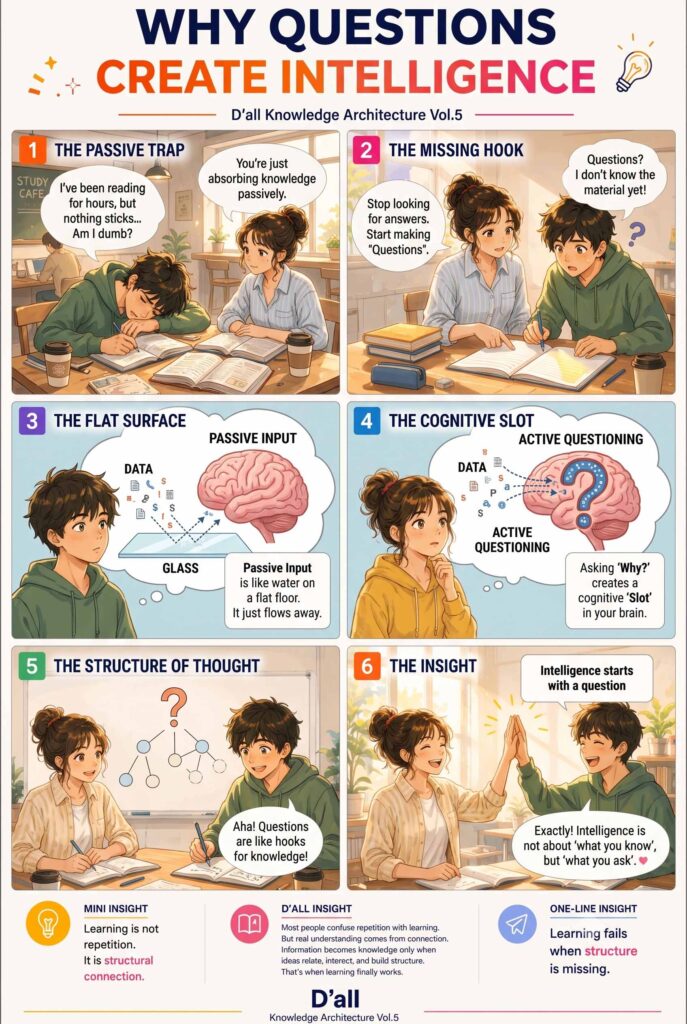
1. The Passive Trap | 수동적 흡수의 함정
I’ve been reading this material for three hours, but absolutely nothing sticks in my head. Am I just not smart enough for this? No, you are simply absorbing the knowledge passively without a filter.
세 시간째 전공 서적에 형광펜을 칠하며 읽고 있지만, 머릿속에 남는 게 하나도 없어 좌절스럽습니다. 내가 바보인 걸까요? 아닙니다. 그저 텍스트라는 정보를 아무런 필터 없이 수동적으로 흡수하고 있기 때문입니다.
2. The Missing Hook | 연결 고리의 부재
Stop looking for the right answers immediately. Start making your own questions through Active Questioning. How can I ask questions when I don’t even know what the material is about yet?
당장 정답을 달달 외우고 찾으려는 노력을 멈춰야 합니다. 대신 능동적인 질문을 통해 물음표를 먼저 만들어보세요. 내용을 하나도 모르는데 어떻게 질문을 던질 수 있냐고요? 그것이 바로 함정입니다.
3. The Flat Surface | 튕겨 나가는 정보
Passive input without curiosity is exactly like pouring water onto a completely flat glass floor. All the data and facts simply flow away without leaving a single trace in your memory.
질문과 호기심이 완전히 배제된 수동적인 정보 입력은, 평평하고 매끄러운 유리 바닥에 물을 붓는 것과 정확히 같습니다. 무수히 많은 데이터와 팩트들은 어떤 흔적도 남기지 못한 채 미끄러져 흘러가 버립니다.
4. The Cognitive Slot | 인지적 빈 공간의 탄생
However, the exact moment you ask ‘Why?’, it instantly creates a profound Cognitive Slot in your brain. This specific emptiness magnetically pulls relevant data into its perfect place.
하지만 ‘왜?’라는 질문을 던지는 바로 그 순간, 우리의 뇌 속에는 깊고 선명한 인지적 빈 공간이 즉각적으로 파이게 됩니다. 이 특정한 빈 공간이 관련된 텍스트 조각들을 자석처럼 찰칵하고 제자리로 끌어당깁니다.
5. The Structure of Thought | 사고의 구조화
Aha! Now I realize that questions are not just doubts; they act as the absolute structural hooks for knowledge. A solid Learning Structure requires these active hooks to build upon.
아하! 이제야 깨달았습니다. 질문은 내가 모른다는 단순한 증명이 아니라, 지식을 단단하게 걸어두는 ‘옷걸이’ 같은 절대적인 구조적 갈고리 역할을 하는 것이군요. 견고한 학습 구조는 반드시 이 갈고리에서 시작됩니다.
6. The Insight | 지능의 발현
Exactly! We finally figured it out together. True Intelligence is not defined by ‘what you know’, but profoundly determined by ‘what you ask’. It all starts with a single bright question.
맞아, 우리가 드디어 알아냈어! 진정한 지능은 ‘머릿속에 얼마나 많은 지식이 있느냐’로 정의되는 것이 아니라, ‘어떤 질문을 던지느냐’에 의해 결정되는 거야. 똑똑함은 언제나 작은 질문 하나에서 싹트지!
Mini Insight
Learning is not reading. It is creating a structural hook.
학습은 단순히 읽는 행위가 아니다. 구조적인 갈고리를 만드는 일이다.
D’all Insight
People constantly confuse passive reading with active understanding. They believe that exposing their eyes to text or their ears to lectures will automatically transfer knowledge into their brains. However, the human brain does not retain data that lacks relevance or context. Without a predefined Knowledge Architecture, information simply washes over you like a brief rainstorm on concrete. To capture this intellectual rain, you must dig a well first. That well is created by asking questions. A question forms a deficit, a mental vacuum that desperately seeks to be filled. When you read with a specific question in mind, every sentence becomes a potential answer, actively engaging your cognitive functions to evaluate, sort, and connect the incoming data. Therefore, the depth of your intellect is directly proportional to the quality of the questions you formulate before you even begin to seek the answers. Intelligence is, fundamentally, the art of asking.
사람들은 끊임없이 수동적인 읽기와 능동적인 이해를 혼동하며 살아갑니다. 밤새워 텍스트에 눈을 노출 시키거나 팀플 회의에서 귀를 열어두는 것만으로 지식이 뇌로 자동 전송될 것이라 굳게 믿습니다. 하지만 인간의 뇌는 스스로 연관성이나 맥락을 찾지 못한 데이터를 결코 보존하지 않습니다. 미리 정의된 지식 구조가 없다면, 그토록 열심히 외운 정보는 그저 꽉 막힌 콘크리트 바닥에 내리는 짧은 소나기처럼 당신을 적시고 흘러가 버릴 뿐입니다. 이 귀중한 지적인 비를 온전히 내 것으로 담아 내려면 먼저 내 머릿속에 우물을 파야 합니다. 그리고 그 깊은 우물은 바로 ‘질문’을 통해 만들어집니다. 질문은 뇌에 결핍을 만들고, 무언가 채워지기를 간절히 원하는 정신적 진공 상태, 즉 인지적 빈 공간을 형성합니다. 명확한 질문을 품고 책을 보거나 대화를 나눌 때, 스쳐 가는 모든 문장은 잠재적인 해답이 되며, 유입되는 데이터를 평가하고 분류하며 연결하기 위해 우리의 인지 기능이 비로소 능동적으로 깨어납니다. 따라서 당신이 가진 지성의 깊이는 해답을 찾기 전, 당신이 어떤 질문을 설계 했는지 그 질문의 질에 비례합니다. 지능은 본질적으로 답을 외우는 기술이 아니라, 질문을 던지는 예술입니다.
One-line Insight
Intelligence grows not by absorbing facts, but by creating a Cognitive Slot to house them.
지능은 사실을 흡수 함으로써 커지는 것이 아니라, 그것을 담을 인지적 빈 공간을 창조함으로써 성장한다.
#CognitiveSlot #Intelligence #KnowledgeArchitecture #ActiveQuestioning #LearningStructure #InformationDesign #DataVisualization #InsightDesign #MediaStrategy #DesignThinking #CriticalThinking #VisualStorytelling #MeaningMaking #DataToInsight #FutureMedia #DallKnowledgeArchitecture
#인지적빈공간 #지능 #지식구조 #능동적질문 #학습구조 #정보디자인 #데이터시각화 #인사이트디자인 #미디어전략 #디자인사고 #비판적사고 #비주얼스토리텔링 #의미설계 #데이터인사이트 #디올날리지아키텍처
Source:
D’all Knowledge Architecture Original Framework, inspired by cognitive psychology principles of active learning and constructivism (Jean Piaget, Jerome Bruner, and John Dewey).
- D'all Visual Intelligence
- D’all Public Design Intelligence
- D’all Motion Intelligence
- D’all Interaction Intelligence
- D’all Spatial Intelligence
- D’all Advertising Intelligence
- D’all Economy Brief
- D’all Food Intelligence
- D’all Health Insight
- D’all Global Power
- D’all Culture Hybrid
- D’all Knowledge Architecture
- D'all Capital History
- D’all Society Agenda
