

Interaction Design은 왜 인간 행동을 바꾸는가?
우리는 보통 행동이 “설명”으로 바뀐다고 생각한다. 하지만 인간은 논리보다 먼저 반응한다.
The Piano Stairs 프로젝트는 단순한 공공디자인 사례가 아니다. 이 사례는 curiosity, participation, emotional response, behavioral transformation이 어떻게 연결되는지를 보여주는 현대 Interaction Design의 대표 사례다.
Humans do not simply follow instructions. They respond to emotion first. 그리고 감정은 행동을 바꾼다.
Why Interaction Design Changes Human Behavior
Humans often believe behavior changes through explanation. But humans react before they understand.
The Piano Stairs project is not simply a public design campaign. It is one of the most iconic examples of modern Interaction Design showing how curiosity, participation, emotional response, and behavioral transformation become connected through experience.
Humans do not simply follow instructions. They respond to emotion first. And emotion changes behavior.
🎬 Embedded Experience
The Piano Stairs | 행동은 어떻게 놀이가 되는가
👉 Recommended Viewing:
The Piano Stairs | 행동은 왜 놀이가 되는 순간 바뀌는가
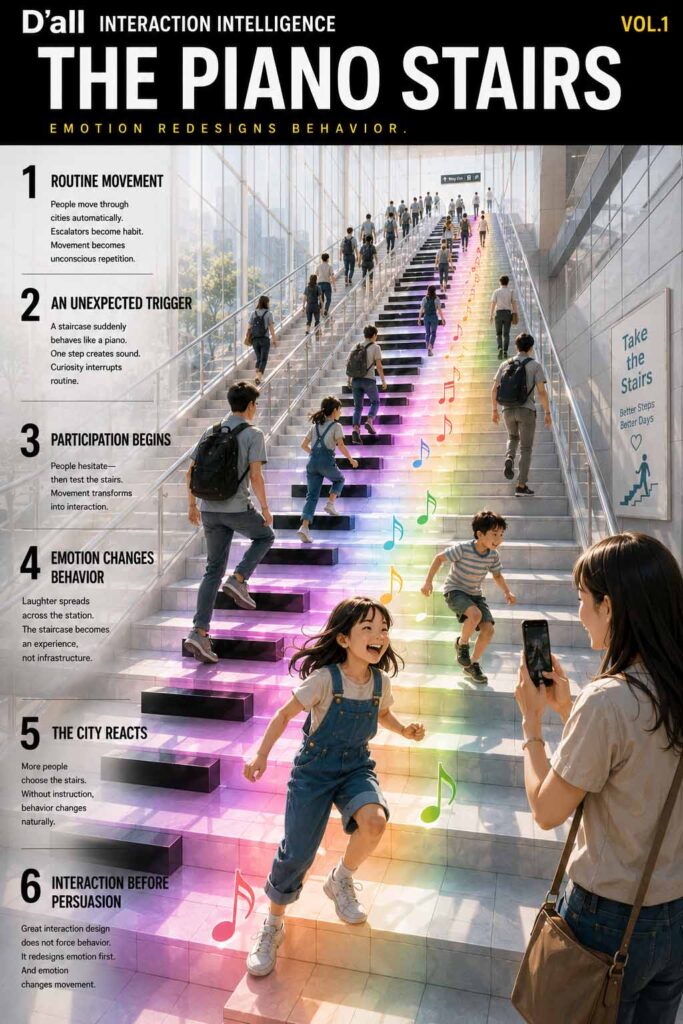
ROUTINE MOVEMENT | 반복되는 도시의 움직임
People move through cities automatically. Escalators become habit, and movement becomes unconscious repetition.
Modern urban systems are optimized for efficiency, but efficiency often removes emotional engagement. Humans stop noticing movement itself.
도시 속 인간은 무의식적으로 움직인다. 에스컬레이터는 습관이 되고, 이동은 반복 시스템이 된다.
현대 도시 시스템은 효율 중심으로 설계되어 있다. 하지만 효율은 종종 감정적 참여를 제거한다. 인간은 움직임 자체를 느끼지 않게 된다.
AN UNEXPECTED TRIGGER | 예상하지 못한 반응 유도
A staircase suddenly behaves like a piano. One step creates sound, and curiosity interrupts routine.
This is the moment where interaction design begins. Not through instruction, but through emotional interruption.
계단이 갑자기 피아노처럼 반응한다. 한 걸음이 소리를 만들고, 호기심이 반복 행동을 멈춘다.
이 순간부터 Interaction Design이 시작된다. 설명이 아니라 감정적 interruption을 통해서다.
PARTICIPATION BEGINS | 참여는 놀이에서 시작된다
People hesitate, then test the stairs. Movement transforms into interaction.
The body becomes curious, and the environment becomes responsive. Participation is no longer forced. It becomes voluntary emotional engagement.
사람들은 잠시 멈춘다. 그리고 계단을 시험하기 시작한다. 이동은 Interaction으로 변하기 시작한다.
몸은 호기심을 느끼고, 환경은 반응하기 시작한다. 참여는 더 이상 강요되지 않는다. 감정 기반의 자발적 행동이 된다.
EMOTION CHANGES BEHAVIOR | 감정은 행동을 바꾼다
Laughter spreads across the station. The staircase becomes an experience, not infrastructure.
Children run upward. Adults begin filming. People smile at strangers. The environment changes social energy.
웃음이 지하철역 전체로 퍼진다. 계단은 더 이상 시설이 아니라 하나의 경험이 된다.
아이들은 뛰어오르고, 어른들은 영상을 찍기 시작한다. 낯선 사람들 사이에도 감정 반응이 발생한다. 환경은 도시의 social energy를 바꾸기 시작한다.
THE CITY REACTS | 도시 전체가 반응하기 시작한다
More people choose the stairs. Without instruction, behavior changes naturally.
The Piano Stairs experiment reportedly increased stair usage by over 60%. This is the power of interaction design. Not persuasion. Not enforcement. But emotional participation.
더 많은 사람들이 계단을 선택한다. 설명 없이도 행동은 자연스럽게 변화한다.
The Piano Stairs 프로젝트는 계단 사용률을 60% 이상 증가시켰다고 알려져 있다. 이것이 바로 Interaction Design의 힘이다. 강요가 아니라 감정 기반 참여다.
INTERACTION BEFORE PERSUASION | 인간은 설득보다 먼저 반응한다
Great interaction design does not force behavior. It redesigns emotion first, and emotion changes movement.
Modern cities are filled with information. But information alone rarely changes humans. Interaction changes behavior because it creates emotional synchronization between people and systems.
위대한 Interaction Design은 행동을 강요하지 않는다. 먼저 감정을 재설계하고, 감정이 움직임을 바꾼다.
현대 도시는 수많은 정보로 가득 차 있다. 하지만 정보만으로 인간은 잘 바뀌지 않는다. Interaction은 인간과 시스템 사이의 감정 동기화를 만들기 때문에 행동을 변화시킨다.
D’all Insight | 인간은 왜 반응하는 환경에 몰입하는가
Humans are naturally drawn to responsive environments. When movement creates reaction, the brain perceives participation instead of obligation.
That is why interaction design feels powerful. It transforms passive movement into emotional experience. Modern interaction systems no longer simply guide behavior. They redesign human emotion through participation.
인간은 반응하는 환경에 본능적으로 끌린다. 움직임이 반응을 만들 때, 인간의 뇌는 그것을 의무가 아니라 참여로 인식한다.
그래서 Interaction Design은 강력하다. 수동적 움직임을 감정 경험으로 바꾸기 때문이다. 현대 Interaction System은 더 이상 행동만 유도하지 않는다. 참여를 통해 인간 감정을 다시 설계한다.
🎬 Motion Expansion Example
Interactive Public Experience | 인간은 왜 반응하는 공간에 몰입하는가
Modern interaction systems are no longer limited to usability. The most powerful public experiences transform passive movement into emotional participation.
Humans do not simply observe responsive environments. They synchronize with them.
현대 Interaction System은 더 이상 usability에만 머물지 않는다. 가장 강력한 공공 경험은 수동적 움직임을 감정 기반 참여로 전환한다.
인간은 반응하는 환경을 단순히 관찰하지 않는다. 그 환경과 감정적으로 동기화된다.
👉 Recommended Viewing:
One-Line Insight
Interaction redesigns behavior through emotion.
Interaction은 감정을 통해 행동을 다시 설계한다.
#InteractionDesign #PianoStairs #BehavioralDesign #PublicInteraction #EmotionalInteraction #UrbanDesign #ExperienceDesign #HumanBehavior #InteractiveDesign #DesignThinking #PublicSpace #MotionDesign #VisualCommunication #CityExperience #DallInteractionIntelligence
#인터렉션디자인 #피아노계단 #행동디자인 #공공디자인 #감정디자인 #도시디자인 #경험디자인 #행동변화 #공간디자인 #디자인분석 #인터렉티브디자인 #비주얼인텔리전스 #모션디자인 #도시경험 #디올인터렉션인텔리전스
- D'all Visual Intelligence
- D’all Public Design Intelligence
- D’all Motion Intelligence
- D’all Interaction Intelligence
- D’all Spatial Intelligence
- D’all Advertising Intelligence
- D’all Economy Brief
- D’all Food Intelligence
- D’all Health Insight
- D’all Global Power
- D’all Culture Hybrid
- D’all Knowledge Architecture
- D'all Capital History
- D’all Society Agenda
