

Singapore Food Culture | 세계를 연결하는 푸드 시스템
Singapore Food Culture는 단순히 다양한 음식을 모아놓은 미식 도시를 의미하지 않는다.
싱가포르는 세계 항로와 무역의 중심에서 수백 년 동안 문화와 사람이 교차하며 하나의 음식 시스템을 발전시켜 왔다.
중국, 말레이, 인도, 페라나칸 등 다양한 문화의 음식 전통은 서로 분리된 채 존재하지 않고 도시의 일상 속에서 함께 변화했다.
이곳의 음식은 국적보다 공존을 먼저 이야기한다.
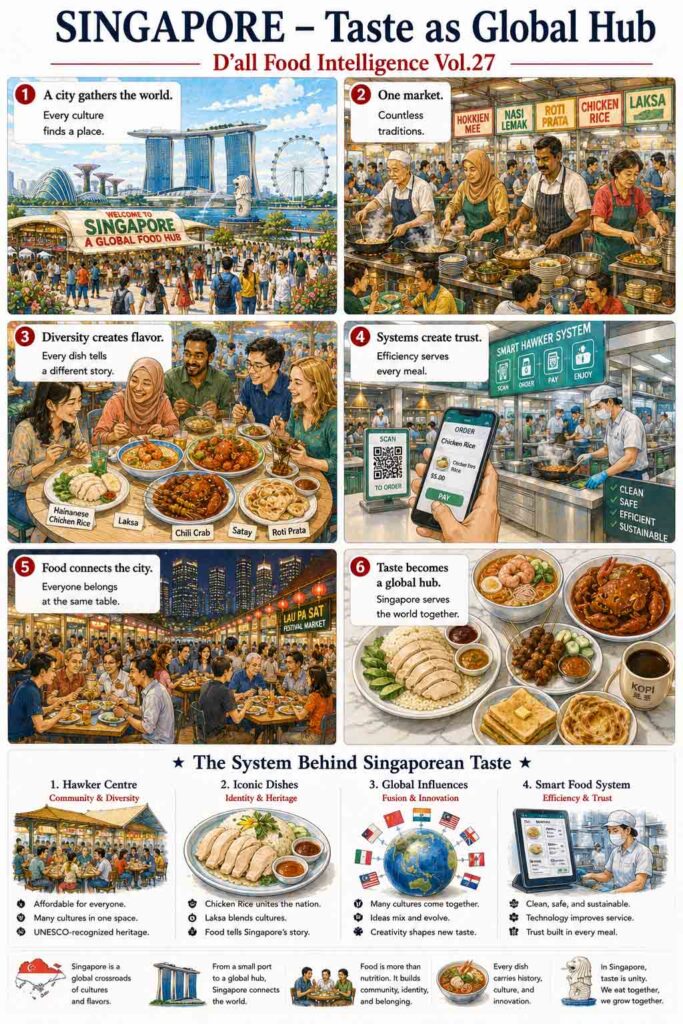
호커센터는 단순히 음식을 판매하는 장소가 아니라 서로 다른 사람들이 일상을 공유하는 생활 공간으로 기능한다.
같은 공간에서 다양한 배경의 사람들이 식사를 하며 도시의 다양성을 경험한다.
음식의 전통은 세대를 거치며 이어지고, 새로운 조리법과 재료를 통해 다시 해석된다.
기술과 도시 운영 방식 역시 음식 시스템의 일부가 되어 효율성과 접근성을 높인다.
싱가포르는 음식이 어떻게 문화유산과 공동체, 도시 생활을 동시에 연결할 수 있는지를 보여준다.
결국 이 나라에서 음식은 맛을 넘어 세계를 연결하는 도시의 운영 방식을 설명하는 언어가 된다.
D’all Food Intelligence는 싱가포르의 음식을 유명한 메뉴의 목록이 아니라 도시가 다양성을 조직하는 방식으로 바라본다.
음식이 사람과 문화, 공간과 시스템을 어떻게 연결하는지를 통해 싱가포르의 Food Culture를 해석한다.
이 관점에서 호커센터는 음식점이 아니라 도시의 관계를 작동시키는 하나의 생활 인프라다.
Singapore Food Culture is more than a collection of famous dishes.
It represents a food ecosystem shaped by trade, migration, multicultural coexistence, and urban development.
Chinese, Malay, Indian, Peranakan, and other culinary traditions have interacted over generations rather than simply existing side by side.
Hawker centres became important everyday spaces where food, affordability, and community meet.
People from different backgrounds gather in the same places for breakfast, lunch, dinner, and casual conversation.
Recipes and culinary knowledge are transmitted across generations while also adapting to changing tastes.
Modern systems surrounding food have further influenced convenience, hygiene, accessibility, and the organization of urban dining.
UNESCO inscribed Singapore’s hawker culture on the Representative List of the Intangible Cultural Heritage of Humanity in 2020, recognizing its role in community dining and Singapore’s multicultural social fabric.
From this perspective, food becomes more than consumption.
It becomes an everyday infrastructure through which Singapore expresses identity, diversity, and connection.
D’all Food Intelligence reads Singapore not as a list of famous dishes, but as a system in which food connects people, cultures, spaces, and everyday urban life.
The focus is therefore not simply on what Singapore eats, but on how its food culture creates connection through shared spaces and repeated social interaction.
Related Video | 싱가포르 호커 문화의 역사와 현재
This documentary-style conversation traces the development of Singapore’s hawker culture from informal street vending to its recognition as intangible cultural heritage.
It also examines the people, economic realities, and cultural practices behind the food itself.
The video provides useful context for understanding why hawker culture is a social system rather than simply a dining format.
이 영상은 싱가포르 호커 문화가 비공식적인 거리 음식에서 오늘날의 문화유산으로 발전해 온 과정을 살펴본다.
음식 자체뿐 아니라 호커와 노동, 경제적 현실, 문화적 전승이라는 측면도 함께 다룬다.
따라서 호커센터가 단순한 식사 공간을 넘어 하나의 사회적 시스템으로 작동하는 이유를 이해하는 데 도움이 된다.
Related Story | 음식이 도시의 공동체가 되는 방식
Singapore’s hawker culture represents a distinctive combination of food heritage and everyday community life.
UNESCO describes hawker centres as community dining spaces where people from diverse backgrounds gather, dine, and mingle.
Singapore’s official tourism resources likewise present hawker food as a major part of the country’s multicultural food heritage.
싱가포르의 호커 문화는 음식유산과 일상의 공동체 문화가 결합된 독특한 사례다.
유네스코는 호커센터를 다양한 배경의 사람들이 함께 식사하고 교류하는 공동체 식사 공간으로 설명한다.
싱가포르 공식 관광 자료 역시 호커 음식을 다문화적인 국가 음식유산의 중요한 일부로 소개한다.
UNESCO — Hawker Culture in Singapore
Visit Singapore — Experience Local Hawker Food
A City Welcomes Every Flavor | 도시가 모든 맛을 품다
Every global city has restaurants, but Singapore developed an entire food environment around cultural coexistence.
Its position as a major trading and migration hub allowed different culinary traditions to enter the city and interact over time.
Chinese, Malay, Indian, Peranakan, and other influences did not remain completely separate.
They became part of an evolving local food culture.
This process demonstrates that culinary identity does not always emerge by choosing one tradition over another.
It can also emerge by creating conditions in which multiple traditions remain visible while becoming part of a shared everyday experience.
세계의 많은 도시에는 다양한 음식점이 있지만, 싱가포르는 문화적 공존을 중심으로 하나의 음식 환경을 발전시켰다.
무역과 이주의 중심지라는 위치는 서로 다른 음식 전통이 도시로 들어오고 교류할 수 있는 조건을 만들었다.
중국계, 말레이계, 인도계, 페라나칸 등 다양한 영향은 완전히 분리된 상태로 남지 않았다.
서로 영향을 주고받으며 하나의 지역 음식 문화로 발전했다.
이는 음식의 정체성이 하나의 전통을 선택하는 방식으로만 만들어지는 것은 아니라는 점을 보여준다.
서로 다른 전통이 함께 존재하면서도 일상의 공유 경험으로 연결될 때 새로운 정체성이 만들어질 수 있다.
Hawker Culture Builds Community | 호커 문화가 공동체를 만든다
Hawker centres are more than food courts.
They function as everyday gathering places where people from different generations, occupations, and cultural backgrounds eat and interact.
UNESCO specifically describes them as community dining rooms and notes their role in strengthening social interaction and Singapore’s social fabric.
Affordability also matters because accessibility allows food culture to remain part of ordinary daily life rather than becoming an experience reserved for special occasions.
The result is a food environment in which eating and social interaction naturally occur together.
호커센터는 단순한 푸드코트가 아니다.
서로 다른 세대와 직업, 문화적 배경을 가진 사람들이 식사하고 교류하는 일상의 공간으로 기능한다.
유네스코 역시 호커센터를 공동체 식사 공간으로 설명하며 사회적 교류와 사회적 결속을 강화하는 역할을 강조한다.
또한 접근 가능한 가격은 음식 문화를 특별한 경험이 아니라 일상생활의 일부로 유지하는 중요한 조건이다.
결국 식사와 사회적 교류가 자연스럽게 동시에 일어나는 음식 환경이 만들어진다.
Diversity Becomes Identity | 다양성이 정체성이 되다
Chicken Rice, Laksa, Chili Crab, Satay, and Roti Prata reflect different culinary histories and cultural influences.
Their significance is not only that they represent different traditions, but that they have become part of the shared Singaporean food landscape.
The diversity remains visible while the dishes participate in a common national food identity.
This creates an interesting structure: cultural difference is preserved through everyday food rather than hidden by national standardization.
Singapore therefore demonstrates how diversity itself can become a source of identity.
Chicken Rice, Laksa, Chili Crab, Satay, Roti Prata와 같은 음식은 서로 다른 문화적 배경과 음식의 역사를 보여준다.
중요한 것은 이 음식들이 각각 다른 전통을 대표한다는 사실에 그치지 않는다.
오늘날에는 모두 싱가포르의 공동 음식 문화 안에서 경험된다.
다양성은 그대로 남아 있으면서도 하나의 국가적 음식 정체성에 참여한다.
즉 문화적 차이를 없애는 것이 아니라 일상적인 음식 속에서 차이를 유지하는 방식이다.
싱가포르는 다양성 자체가 정체성의 자원이 될 수 있음을 보여준다.
Smart Systems Protect Quality | 스마트 시스템이 품질을 지키다
Food culture does not operate independently from urban systems.
Singapore’s hawker environment has developed alongside public health regulation, infrastructure, management, and digital transformation.
The country’s heritage framework also recognizes that sustaining hawker culture requires ongoing support, documentation, training, and transmission of knowledge.
Technology can improve convenience and operational efficiency, but the deeper issue is how systems allow traditional food practices to remain viable in a modern city.
Innovation becomes meaningful when it supports continuity rather than simply replacing older practices.
음식 문화는 도시 시스템과 분리되어 작동하지 않는다.
싱가포르의 호커 환경은 공공위생 규제와 인프라, 운영 체계, 디지털 전환과 함께 발전해 왔다.
문화유산을 지속하기 위해서는 기록과 교육, 전승, 지원 체계가 필요하다는 점도 공식 자료에서 확인된다.
기술은 편의성과 운영 효율성을 높일 수 있지만 더 중요한 문제는 현대 도시 안에서 전통 음식 문화가 지속될 수 있는 조건을 만드는 것이다.
따라서 혁신은 과거의 방식을 단순히 대체할 때보다 문화의 연속성을 지원할 때 더 큰 의미를 갖는다.
Meals Connect the City | 식사가 도시를 연결한다
Food creates repeated encounters.
A breakfast at a neighbourhood hawker centre, lunch near an office district, or an evening meal with family can place different groups in the same physical environment.
These repeated interactions are important because community is not created only through large cultural events.
It is also built through ordinary routines.
Hawker centres provide a setting where eating, conversation, work breaks, family time, and informal social interaction overlap.
The everyday nature of these encounters is one reason food becomes such a powerful part of urban identity.
음식은 반복적인 만남을 만든다.
동네 호커센터에서의 아침 식사, 직장가에서의 점심, 가족과 함께하는 저녁 식사는 서로 다른 사람들이 같은 공간을 공유하게 만든다.
공동체는 거대한 문화행사만으로 만들어지는 것이 아니다.
반복되는 평범한 일상 속에서도 형성된다.
호커센터에서는 식사와 대화, 휴식, 가족의 시간, 비공식적인 사회적 교류가 하나의 공간에서 겹친다.
이러한 일상성이 음식이 도시 정체성의 중요한 부분이 되는 이유 중 하나다.
Singapore Food Culture Defines Global Hub | 세계 허브를 완성하는 싱가포르의 맛
Singapore demonstrates that globalization does not necessarily erase local identity.
Its food culture shows another possibility: different traditions can remain recognizable while becoming part of a shared urban system.
Trade creates movement, migration creates diversity, public spaces create interaction, and cultural transmission creates continuity.
Hawker centres bring these layers together in an ordinary setting.
That is what makes Singapore’s food system distinctive.
The city does not simply display global flavors.
It organizes them into everyday life.
Food becomes a practical language through which diversity, belonging, heritage, and urban identity can coexist.
싱가포르는 세계화가 반드시 지역의 정체성을 약화시키는 것은 아니라는 점을 보여준다.
서로 다른 전통이 각자의 특징을 유지하면서도 하나의 공유된 도시 시스템에 참여할 수 있기 때문이다.
무역은 이동을 만들고, 이주는 다양성을 만들며, 공공 공간은 교류를 만들고, 문화적 전승은 연속성을 만든다.
호커센터는 이 여러 층위를 일상의 공간에서 하나로 연결한다.
이것이 싱가포르 음식 시스템의 중요한 특징이다.
싱가포르는 단순히 세계의 맛을 보여주는 도시가 아니다.
그 맛들을 일상 속에서 작동하도록 조직한다.
음식은 다양성과 소속감, 문화유산과 도시 정체성이 함께 존재할 수 있도록 만드는 실질적인 언어가 된다.
Mini Insight
Singapore Food Culture demonstrates how food can operate simultaneously as heritage, social infrastructure, and national identity.
Its strength comes from the interaction between diverse culinary traditions and shared public spaces.
Hawker centres make cultural diversity visible through ordinary meals rather than occasional festivals.
They also provide a setting in which culinary knowledge can move between generations.
The system is therefore not static.
It changes while maintaining recognizable cultural references.
This balance between continuity and adaptation is central to Singapore’s food identity.
싱가포르 음식 문화는 음식이 문화유산이면서 동시에 사회적 인프라이자 국가 정체성이 될 수 있음을 보여준다.
강점은 서로 다른 음식 전통과 공유된 공공 공간이 결합하는 데서 나온다.
호커센터는 특별한 축제가 아니라 평범한 식사를 통해 문화적 다양성을 일상에서 보여준다.
또한 음식 지식과 기술이 세대 사이에서 이동할 수 있는 환경을 제공한다.
따라서 이 시스템은 고정되어 있지 않다.
문화적 기억을 유지하면서도 계속 변화한다.
연속성과 적응 사이의 균형이 싱가포르 음식 정체성의 중요한 기반이다.
D’all Insight
Singapore Food Culture reveals a broader principle about how cities can organize diversity.
A multicultural city does not automatically become a multicultural food system.
It requires spaces where different traditions can actually meet.
Hawker centres provide one such everyday interface.
They allow food traditions to remain distinct while placing them within a shared social environment.
This creates a form of cultural coexistence that is experienced rather than merely represented.
The system also depends on continuity.
Recipes, skills, and knowledge need to move from one generation to another.
At the same time, food must remain adaptable enough to respond to changing urban life.
This makes Singapore particularly interesting from a systems perspective.
Its food culture is neither completely traditional nor completely modern.
It is continuously negotiated between heritage and innovation.
The public environment matters because culture becomes stronger when people repeatedly encounter it in ordinary life.
Food therefore works as an interface between individual choice and collective identity.
Singapore’s lesson is not that every city should copy the hawker centre model.
Rather, it suggests that cities become culturally resilient when diversity is given a shared place to operate.
When food, space, people, and heritage reinforce one another, culinary culture becomes part of the city’s social infrastructure.
싱가포르 음식 문화는 도시가 다양성을 조직하는 더 큰 원리를 보여준다.
다문화 도시라고 해서 자동으로 다문화 음식 시스템이 만들어지는 것은 아니다.
서로 다른 전통이 실제로 만날 수 있는 공간이 필요하다.
호커센터는 그러한 일상의 인터페이스 역할을 한다.
각 음식 전통의 차이를 유지하면서도 하나의 사회적 환경 안에서 함께 경험하도록 만든다.
이러한 구조는 단순히 다양성을 보여주는 것이 아니라 실제 생활 속에서 경험하게 만든다는 점에서 중요하다.
동시에 지속성도 필요하다.
레시피와 기술, 지식이 세대에서 세대로 이동해야 한다.
그러면서도 음식은 변화하는 도시의 생활 방식에 대응할 수 있을 만큼 유연해야 한다.
이 점에서 싱가포르의 음식 문화는 시스템 관점에서 특히 흥미롭다.
완전히 전통적이지도 않고 완전히 현대적이지도 않다.
문화유산과 혁신 사이에서 계속 조정되는 구조다.
공공 환경이 중요한 이유도 여기에 있다.
문화는 사람들이 일상에서 반복적으로 경험할 때 더욱 강한 힘을 갖는다.
음식은 개인의 선택과 집단의 정체성을 연결하는 인터페이스가 된다.
싱가포르가 보여주는 핵심은 모든 도시가 호커센터를 그대로 복제해야 한다는 것이 아니다.
다양성이 함께 작동할 수 있는 공유 공간을 제공할 때 도시의 문화적 회복력이 높아질 수 있다는 점이다.
음식과 공간, 사람과 문화유산이 서로 강화될 때 음식 문화는 도시의 사회적 인프라로 발전한다.
One-line Insight
Food is strongest when every culture has a place at the same table.
모든 문화가 같은 식탁에 앉을 때 음식은 가장 강한 연결이 된다.
Previous Post
Vol.26 explored how food can create community through shared meals, hospitality, and everyday cultural rituals.
Vol.27 extends that idea into an urban context, examining how a city can organize multicultural food traditions into a shared public system.
Vol.26에서는 함께 먹는 식사와 환대, 일상의 문화적 의례가 어떻게 공동체를 만드는지 살펴봤다.
Vol.27에서는 그 구조를 도시 차원으로 확장해 다문화 음식 전통이 하나의 공공 시스템 안에서 어떻게 공존하는지를 살펴본다.
#SingaporeFoodCulture #SingaporeCuisine #GlobalFoodHub #HawkerCulture #MulticulturalCuisine #AsianFood #FoodSystem #FoodHeritage #UNESCOHeritage #HawkerCentre #SingaporeFood #CulinaryCulture #FoodIdentity #UrbanFoodCulture #DallFoodIntelligence
#싱가포르음식문화 #싱가포르미식 #호커센터 #호커문화 #세계음식허브 #푸드시스템 #다문화음식 #아시아미식 #유네스코문화유산 #싱가포르음식 #음식문화 #음식정체성 #도시음식문화 #푸드인텔리전스 #디올푸드인텔리전스
Source
This article is an original editorial interpretation by D’all Food Intelligence based on publicly available cultural heritage, tourism, and institutional materials. It does not reproduce any single source or present third-party material as original reporting. Instead, D’all uses these references to examine Singapore’s food culture through the relationship between multicultural coexistence, shared dining spaces, culinary heritage, and urban systems.
The primary reference is UNESCO’s official record for “Hawker culture in Singapore, community dining and culinary practices in a multicultural urban context.” UNESCO states that the element was inscribed on the Representative List of the Intangible Cultural Heritage of Humanity in 2020 and describes hawker centres as community dining spaces where people from diverse backgrounds gather, dine, and mingle.
Additional reference material comes from Singapore’s official tourism and heritage resources, which document hawker food as part of Singapore’s multicultural culinary heritage and explain the continuing role of hawker centres in neighbourhood, recreational, and business districts.
D’all’s contribution is the interpretive layer: rather than treating hawker culture only as a food destination or tourism attraction, this article examines it as a system connecting food, public space, cultural diversity, intergenerational transmission, and urban identity.
이 글은 공개적으로 이용 가능한 문화유산 자료, 관광 자료, 공공기관 자료를 바탕으로 D’all Food Intelligence가 독자적으로 구성한 편집적 해석이다. 특정 자료의 내용을 그대로 재현하거나 제3자의 자료를 자체 취재처럼 제시하지 않는다. D’all은 여러 공개 자료를 교차 참고하여 싱가포르 음식 문화가 다문화 공존, 공동 식사 공간, 음식유산, 도시 시스템과 어떤 관계를 갖는지를 분석했다.
주요 참고 자료는 유네스코 공식 기록인 “Hawker culture in Singapore, community dining and culinary practices in a multicultural urban context”이다. 유네스코는 이 문화요소가 2020년 인류무형문화유산 대표목록에 등재되었다고 기록하고 있으며, 호커센터를 다양한 배경의 사람들이 함께 식사하고 교류하는 공동체 식사 공간으로 설명한다.
추가적으로 싱가포르 공식 관광 및 문화유산 자료를 참고했다. 이 자료들은 호커 음식을 싱가포르의 다문화 음식유산으로 소개하고 있으며, 호커센터가 주거지역과 여가공간, 업무지역에서 다양한 공동체의 일상적인 음식 공간으로 기능하고 있음을 보여준다.
D’all의 독자적인 기여는 이러한 공개 자료를 하나의 구조로 연결해 해석하는 데 있다. 호커 문화를 단순한 음식 관광이나 미식 명소로 바라보는 대신 음식과 공공 공간, 문화적 다양성, 세대 간 전승, 도시 정체성이 서로 연결되는 시스템으로 분석했다.
- D'all Visual Intelligence
- D’all Public Design Intelligence
- D’all Motion Intelligence
- D’all Interaction Intelligence
- D’all Spatial Intelligence
- D’all Advertising Intelligence
- D’all Economy Brief
- D’all Food Intelligence
- D’all Health Insight
- D’all Global Power
- D’all Culture Hybrid
- D’all Knowledge Architecture
- D'all Capital History
- D’all Society Agenda
